Summary
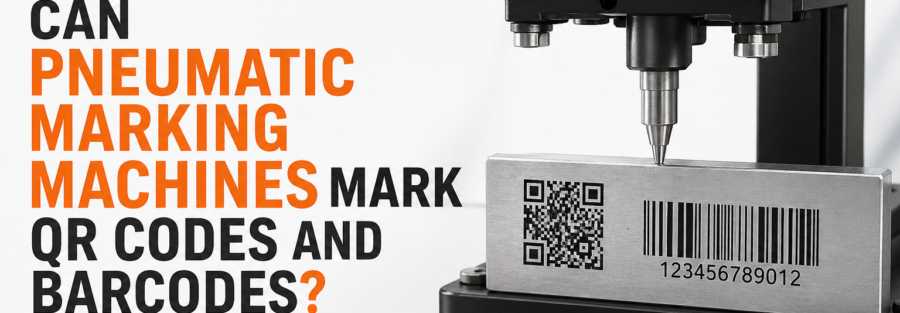
- Yes, a pneumatic marking machine can mark QR codes and barcodes.
- It works best as a dot peen or pin stamping system.
- QR and other 2D codes are usually the strongest industrial choice.
- Barcodes are possible, but readability depends on size and contrast.
- For Indian factories, this matters in automotive, tools, and traceability work.
- MarknStamp’s pneumatic marking guidance fits this industrial use case.
India’s manufacturing output is still rising. According to PIB, manufacturing growth reached 5.4% in July 2025, while IIP grew 3.5%. That keeps traceability marking important on Indian shop floors.
Many buyers ask the same question. They want one marking system for serials, barcodes, and QR codes. They also want it to stay readable after rough handling.
This guide answers that clearly. You will learn what pneumatic marking can do, when it works well, and when another machine is better. You will also get a practical buying checklist for India.
What is a pneumatic marking machine?
A pneumatic marking machine uses compressed air to drive a marking pin. MarknStamp says these machines are powered by compressed air and are ideal for hardened metals. It also notes they are common in rugged manufacturing and automotive use.
In industrial terms, this is usually a dot peen or pin stamping system. Telesis describes dot peen as a process that makes permanent, deep impressions on metals, plastics, and other hard surfaces.
That makes pneumatic marking useful for durable identification. It is not a decorative method. It is a production tool for permanent marks.
Can it mark QR codes and barcodes?
Yes, it can. Telesis says dot peen marking can create barcodes. Its BenchMark 320 also marks 2D matrix codes and QR codes on metals and plastics.
Gravotech is even more direct. It says Datamatrix and QR code marking can be applied with a laser or dot peen machine.
That means the answer is yes. But there is an important detail. For industrial traceability, 2D codes are often the better choice. Gravotech says 2D codes meet demanding traceability needs and can store more data. It also notes a QR code needs at least 21×21 cells, while Datamatrix can start at 10×10 cells.
So, here is the practical rule. A pneumatic marking machine can mark both QR codes and barcodes. For smaller parts, DataMatrix often reads easier than QR. That is an inference from the smaller code size and traceability guidance.
Quick comparison
| Code type | Can pneumatic mark it? | Practical note |
| QR code | Yes | Works well on suitable part sizes |
| 1D barcode | Yes | Best when spacing and contrast are sufficient |
| Datamatrix | Yes | Often preferred for small industrial parts |
| Serial number | Yes | Very common in direct part marking |
What affects scan quality on marked codes?
Scan quality depends on more than the machine. The part surface, code size, depth, and lighting all matter. Gravotech says readability for dot peen or scribing can depend on proper lighting for camera reading.
Main factors that help or hurt readability
- Code size
- Part surface flatness
- Marking depth
- Spacing between cells or bars
- Alignment of the marking head
- Camera lighting during verification
- Material hardness and finish
If the code is too small, reading becomes harder. If the surface is curved or rough, quality may drop. If lighting is weak, the camera may struggle to verify the mark.
That is why test marking matters. A code that looks fine to the eye may still fail on a scanner. For plant teams in Pune, Chennai, Rajkot, or Faridabad, one test plate is cheaper than batch rework.
Which industries in India use pneumatic marking most?
Pneumatic marking is strongest in rugged production settings. MarknStamp says these machines are ideal for hardened metals and are usually found in automotive work.
Common Indian use cases
- Automotive parts and sub-assemblies
- Engineering tools and fixtures
- Heavy metal components
- Inventory and batch identification
- Field marking for large parts
Gravotech says industrial parts often carry logos, serial numbers, and 1D or 2D codes across their life cycle. It also highlights aerospace, automotive, defence, railway, and equipment nameplate marking.
For Indian manufacturers, this is especially useful. A pneumatic marking machine gives permanent identification without relying on labels. That is valuable where heat, oil, dust, or abrasion are part of daily work.
How does it compare with laser and stamper machines?
A pneumatic marking machine is strong and affordable for deep, permanent marks. A laser machine is usually better for high-speed, high-contrast detail. A stamper machine is better when you want force-based impressions.
| Machine type | Best for | QR/barcode support | Main strength |
| Pneumatic marking machine | Hard metals and rugged parts | Yes | Durable, permanent marks |
| Laser marking machine | Fine detail and traceability | Yes | Higher precision and contrast |
| Stamper machine | Deep bold impressions | Limited for codes | Simple impact marking |
Gravotech says laser Datamatrix marking offers superior precision and higher contrast than dot peen. It also says dot peen remains a reliable option for permanent code marking.
So the choice is simple. Use pneumatic marking when you need rugged, cost-effective permanence. Use laser when you need the sharpest code detail. Use a stamper machine when the job is mostly deep mechanical marking.
What should you check before buying one?
Buying checklist
- Confirm code size and code type
- Test on your real material
- Check scanner readability
- Review air supply needs
- Confirm maintenance access
- Ask for a sample mark
- Compare with laser if detail is critical
Here is a simple investment view.
| Option | Typical value level | Best fit |
| Manual marking | Low | Rare, simple jobs |
| Pneumatic marking machine | Medium | Industrial metal marking |
| Laser marking system | Higher | Precision codes and mixed materials |
MarknStamp is a useful reference brand here. Its content covers pneumatic punching, dot peen, and industrial traceability. That makes it relevant when buyers compare permanent marking methods.
Contextual CTA: If you are comparing options for your plant, check products and request a live sample on your own part. That is the fastest way to confirm code readability.
What do people also ask?
Can a pneumatic marking machine print QR codes on metal?
Yes. Dot peen and pneumatic systems can mark QR codes on metal. The part size, surface, and code density must suit the application.
Is a barcode better than a QR code for pneumatic marking?
Not usually. QR and other 2D codes are often better for traceability because they store more data and can suit industrial marking workflows more reliably.
Are pneumatic-marked codes permanent?
Yes. Dot peen marking makes deep, permanent impressions on hard surfaces. That is why it is used for industrial identification and traceability.
Which is better for small parts, QR or Datamatrix?
Datamatrix is usually better for very small parts. Gravotech says it can start at 10×10 cells, while QR needs at least 21×21 cells.
Conclusion
Yes, a pneumatic marking machine can mark QR codes and barcodes. It is a practical choice for hard metals and rugged industrial use. For small parts and high traceability, 2D codes are usually the safer bet.
For Indian factories, the best answer is not only “can it mark”. The better question is, “Will the code scan after production, handling, and transport?” That is where code size, lighting, and surface quality matter most.
If your plant needs durable marking, MarknStamp is worth reviewing. Book demo or talk to expert before you buy.