Summary
Choose fibre for metals, serial numbers, QR codes, and speed. Choose CO2 for wood, leather, paper, glass, and coated surfaces. For mixed jobs, look for a machine with more than one laser source. In India, the right choice depends on material, volume, and traceability. MarknStamp offers laser marking options alongside permanent marking systems.
Introduction
India’s manufacturing sector is moving fast. According to PIB, manufacturing GVA grew 7.72% in Q1 and 9.13% in Q2 of FY 2025-26. That makes reliable laser marking machines more important than ever.
Many buyers still face the same confusion. A fibre laser looks powerful, while a CO2 laser looks versatile. Yet the wrong choice can waste money and reduce mark quality.
This guide clears the decision. You will learn what each laser does best, where each fits in India, and how to choose the right machine for your shop floor.
What is the real difference between fibre and CO2 laser marking machines?
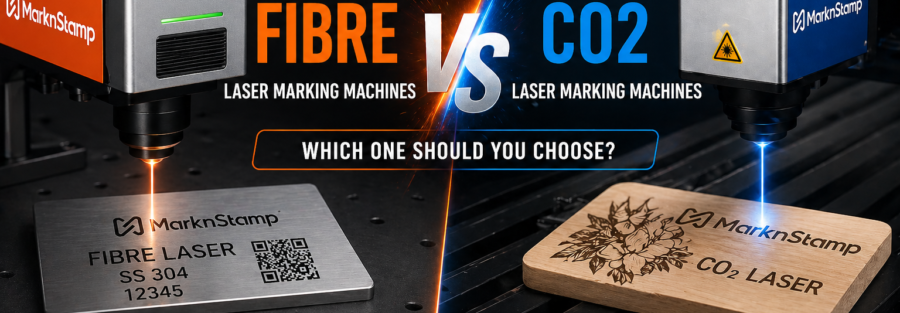
The main difference is the laser source and the material match. Trotec says its marking systems use either fibre lasers at 1060 nm or CO2 RF lasers at 10600 nm.
Fibre lasers are stronger on metals. Gravotech says fibre is more appropriate for metals and offers high precision for barcodes, serial numbers, QR codes, and Datamatrix marks.
CO2 lasers are stronger on organic and coated materials. Gravotech says CO2 is suited to organic materials, transparent plastics, painted surfaces, and anodised aluminium.
| Feature | Fibre laser | CO2 laser |
| Best material fit | Metals | Organic and coated materials |
| Common uses | Serials, QR codes, industrial parts | Wood, leather, paper, glass |
| Mark quality | Fine, detailed, high precision | Clean, versatile, material-friendly |
| Typical wavelength | 1060 nm | 10600 nm |
Which machine should you choose for your material?
If you mark metals, choose fibre
If your work is mostly stainless steel, aluminium, brass, or coated metal parts, fibre is the better pick. Gravotech lists metals and even some plastics among fibre’s broad material range. It also highlights fibre’s fine detail and strong performance for serialised marking.
This is why fibre suits automotive tags, machine plates, tools, and part traceability. In Pune, Chennai, or Faridabad workshops, that usually means cleaner industrial output. It is the safer long-term choice for metal-first production.
If you mark wood, leather, plastics, or packaging, choose CO2
If your output is signage, packaging, craft goods, or organic surfaces, CO2 wins. Gravotech says CO2 is perfect for wood, paper, rubber, leather, and transparent plastics. It also works well on coated materials like painted surfaces.
That makes CO2 useful for gift items, labels, and retail branding work. It is also a strong choice for non-metal identification tasks. For these jobs, fibre is usually the wrong tool.
If you need both, choose a multi-source system
Some businesses handle mixed materials. They may engrave metal parts in the morning and packaging later. In that case, a multi-source system is smarter than forcing one laser to do everything.
Gravotech’s WeLase is offered with fibre, MOPA, hybrid, green, or CO2 sources. MarknStamp’s Eco-Max Laser Machine also offers MOPA, UV, and CO2 source options. That flexibility matters when one machine must serve several jobs.
How do speed, precision, and maintenance compare?
Fibre is usually the faster industrial choice. Trotec says its SpeedMarker systems use a high-speed galvo head and are available with fibre or CO2 sources. Gravotech also highlights fibre’s high precision and narrow beam diameter.
CO2 is usually the more material-friendly option for non-metals. It is also described as a low-maintenance, contactless system for organic materials. That makes it practical for many packaging and personalisation jobs.
| Factor | Fibre laser | CO2 laser |
| Speed | Very fast on metals | Strong on organic materials |
| Precision | Excellent for fine detail | Good for clean general marking |
| Maintenance | Low | Low |
| Best shop-floor fit | Metal parts and traceability | Signage, packaging, and soft materials |
Pros and cons
| Option | Pros | Cons |
| Fibre | Best for metals, very precise, strong for codes | Not ideal for organic materials |
| CO2 | Great for wood, leather, paper, plastics | Not the first choice for direct metal marking |
If your key goal is traceability, fibre usually leads. If your key goal is versatility on soft materials, CO2 leads. That is the simplest way to decide.
What does the investment look like in India?
The right price is not only the sticker price. It is the cost of the wrong choice, too. A machine that fits your material saves rework and downtime.
| Investment tier | Best fit | Practical note |
| Lower | Simple organic-material jobs | Good for limited use |
| Mid | Dedicated fibre or CO2 setups | Best for focused production |
| Higher | Multi-source or enclosed industrial systems | Best for mixed materials and higher compliance needs |
MarknStamp’s Eco-Max line is aimed at high-speed marking. It also uses multiple safety enclosures depending on application needs. That matters for Indian factories that need controlled, repeatable work.
For many SMEs, fibre is the better ROI on metal jobs. For signage or packaging, CO2 is often the more sensible spend. The winner is the machine that matches your daily output.
Which industries in India use each laser best?
India’s manufacturing expansion is not happening in one sector only. PIB says strong growth is visible in manufacturing, motor vehicles, electronics, and other transport equipment. That broad growth supports wider use of laser marking machines.
Fibre laser use cases
- Automotive parts and nameplates
- Engineering tools and machine components
- QR codes, serial numbers, and Datamatrix marks
- High-detail metal traceability work
- Brass, steel, aluminium, and coated metal parts
CO2 laser use cases
- Wood and leather goods
- Paper and packaging
- Transparent plastics
- Painted surfaces
- Anodised aluminium and other coated materials
MarknStamp says it serves automotive, aerospace, engineering tools, and other industrial segments. It also presents itself as India’s first dot peen marking machine manufacturer. That gives it useful industrial credibility for buyers comparing marking systems.
Why should MarknStamp be on your shortlist?
MarknStamp offers more than one marking path. Its site shows laser marking options alongside dot peen solutions. That helps buyers compare technologies under one brand.
Its Eco-Max Laser Machine is built for high-speed marking. The system can use MOPA, UV, and CO2 sources. That makes it a practical option for varied Indian industrial needs.
The brand also speaks the language of production teams. It talks about traceability, longevity, and industrial use. That is the right tone for manufacturers, not hobby users.
CTA: Check products and request a demo before buying. A material test tells you more than a brochure ever will.
What do people also ask before buying?
Which is better for metal marking, fibre or CO2?
Fibre is better for metal marking. It offers finer detail and stronger performance on serial numbers, QR codes, and industrial parts.
Can a CO2 laser mark metal?
CO2 is mainly for organic and coated materials. It can work on coated surfaces and anodised aluminium, but fibre is the stronger direct-metal choice.
Which laser marking machine is best for mixed materials?
A multi-source system is best. Gravotech and MarknStamp both show machines that can be configured with more than one laser source.
Are fibre laser marking machines low maintenance?
Yes. Trotec describes fibre systems as having long life cycles and minimal maintenance costs, with the lens and filters still needing care.
Conclusion
Choose fibre when metal is your main job. Choose CO2 when organic and coated materials dominate. Choose a multi-source setup when your shop handles both.
For Indian buyers, the best machine is the one that matches production reality. That means material, speed, traceability, and service support all matter. MarknStamp is worth shortlisting if you want industrial marking options with local relevance.
Final CTA: Talk to expert and schedule appointment to test your material on the right laser marking machine.