Summary
Yes, a dot peen machine can mark curved surfaces. It is not limited to flat parts. Small cylinders and round parts often need a rotary axis. That helps keep the mark even. Many systems can handle moderate surface height differences without extra tooling. Some machines manage 5 to 8 mm. Dot peen is a strong choice for permanent metal identification. It suits serial numbers, batch codes, and traceability marks. For curved metal parts, the right fixture matters as much as the machine.
Introduction
Many manufacturers need marks on pipes, shafts, valves, and housings. Flat parts are easy. Curved ones are not. That is why traceability tools keep growing in demand. A 2024 report valued the dot peen marking machines market at USD 514.8 million. It also links growth to automated, traceable production.
Curved parts create real frustration on the shop floor. A bad setup can distort characters. It can also slow production. In India and across Asia-Pacific, traceability pressure is rising in manufacturing. That makes surface flexibility a practical need, not a nice extra.
This guide explains what dot peen can handle, when it needs a rotary axis, and how it compares with a laser marking machine. You will also see where MarknStamp fits into the decision.
Can a dot peen machine mark curved surfaces?
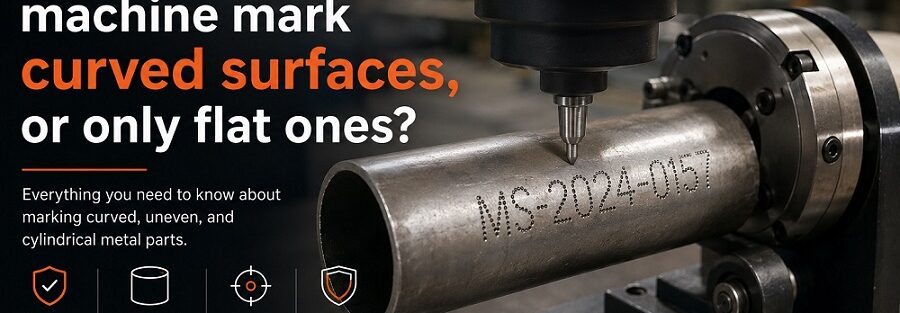
Yes. Modern dot peen systems can mark flat, curved, and uneven surfaces. Dot peen is ideal for flat, curved, and uneven materials. Moreover, dot peen use on flat or curved metal parts.
That matters for real industrial parts. Think of metal tubes, castings, valves, and round housings. These are common in automotive, aerospace, oil and gas, and general fabrication.
| Surface type | Can dot peen mark it? | Best setup |
| Flat plate | Yes | Standard marking head |
| Slight curve | Yes | Standard head or light fixturing |
| Tube or cylinder | Yes | Rotary axis for best results |
| Small-diameter round part | Yes | Rotary axis is usually needed |
On many curved parts, the key is not the machine alone. It is the support, angle, and travel path. That is what keeps the mark readable and consistent.
When does a rotary axis become necessary?
A rotary axis becomes important when the mark must follow the full circumference of a part. It helps mark cylinders, tubes, and round parts. For small diameters, it becomes necessary to rotate the part during marking.
That is the simple rule. If the part is only slightly curved, many systems cope well. Laser and dot peen machines can handle differences in level of 5 to 8 mm. If the part is round and narrow, a rotary axis gives better consistency.
Parts that usually need rotary support
- Shafts
- Pipes
- Tubes
- Bottles in industrial lines
- Small round bushes
- Cylindrical fittings
These shapes create a changing surface under the stylus. Without rotation, the mark may stretch or vary in depth. With rotation, the tool follows the surface more cleanly.
For shops that handle mixed parts, this is useful. You can mark some jobs directly. You can set others on a rotary fixture. That flexibility makes one metal marking machine useful across many jobs.
What affects mark quality on curved metal?
Several things control the final result. Surface radius matters. Material hardness matters. So does the depth setting and the marking pressure. MarknStamp explains that dot peen uses controlled stylus movement, while pressure changes with the material being marked.
Here are the main factors to watch:
- Part shape: sharper curves need tighter control.
- Fixturing: the part must sit still.
- Stylus pressure: too much can damage the mark.
- Material: steel, aluminium, brass, and cast iron react differently.
- Mark depth: deeper marks last longer, but need stable contact.
The biggest mistake is assuming one setting fits all. Curved parts often need a test mark first. That is especially true for batch numbers, QR codes, and serial marks. Good setup protects both legibility and throughput.
Common mistakes to avoid
- Clamping the part loosely
- Ignoring radius changes
- Using the same depth on every material
- Skipping trial marks
- Trying to force small cylinders without rotation
These mistakes usually cause shallow dots, uneven spacing, or unreadable characters.
Dot peen vs laser marking on curved parts: which is better?
Both technologies can work on curved shapes. Both laser and dot peen machines can overcome level differences and keep consistent marks. The choice depends on the part, the mark depth, and the production setup.
| Factor | Dot peen | Laser marking |
| Contact with part | Yes | No |
| Mark depth | Deep and durable | Usually shallower |
| Curved surface use | Strong with fixturing | Strong with correct focus and setup |
| Small cylinder support | Often needs rotary axis | Often needs rotary axis |
| Best use | Permanent metal IDs | Fine, high-detail marks |
Dot peen is often preferred for rugged metal parts. It is durable, permanent, and suitable for traceability. Laser marking is also effective, especially where fine detail or non-contact marking matters.
For heavy industrial jobs, dot peen often has an edge. It physically indents the metal. That makes the mark harder to lose through wear. For delicate or highly detailed work, an engraving machine laser may be a better fit. The right choice depends on the part, not the buzzword.
How should you set up dot peen for curved parts?
The setup should match the geometry first. Then match the material. Then set the mark depth. That order matters more than speed. Support accessories, including rotary axes, help keep quality steady on cylindrical parts.
A good setup usually follows these steps:
- Measure the curve radius.
- Decide whether rotation is needed.
- Lock the part firmly in place.
- Run a small sample mark.
- Check legibility, depth, and alignment.
- Adjust pressure or speed if needed.
This is especially useful in Indian fabrication shops. Many plants handle varied parts in one day. A flexible marking system reduces changeover stress. It also helps maintain traceability across batches. That is why portable and adaptable systems stay popular in industrial marking.
Best use cases for curved-surface dot peen
- Pipes and tubes
- Engine and machine parts
- Castings
- Tool bodies
- Heavy fabricated components
- Stainless steel and aluminium parts
If your workload includes many round or irregular parts, choose a machine with the right accessories. That is where MarknStamp’s industrial marking range becomes valuable for day-to-day production.
Is dot peen the right choice for your workshop?
Dot peen is a smart choice when you need permanent, readable, metal marks. It works well on curved surfaces too. The real question is whether your parts need direct contact, deep indentation, or rotary support. If the answer is yes, dot peen is a strong fit.
It is also a practical option for traceability-heavy sectors. Automotive, aerospace, energy, and general metal fabrication all rely on part codes and serial numbers. Those markings must survive heat, wear, handling, and cleaning. Dot peen is built for that kind of job.
FAQ
Can a dot peen machine mark pipes and tubes?
Yes. A dot peen machine can mark pipes and tubes. Small diameters usually need a rotary axis for even marking around the full circumference.
Can dot peen mark irregular or uneven surfaces?
Yes. Dot peen works on uneven surfaces. It is widely used where the part shape is not perfectly flat.
Do curved parts always need a rotary axis?
No. Slight curves may not need one. Some systems handle 5 to 8 mm level differences without a rotary axis.
Which is better for curved metal, laser or dot peen?
Both can work. Dot peen is often better for deep, permanent marks. Laser is useful when non-contact or fine-detail marking matters.
Conclusion
Curved parts do not rule out dot peen. They just demand the right setup. With proper fixturing, or a rotary axis when needed, dot peen can mark round and uneven metal cleanly. For permanent industrial traceability, that makes it one of the most practical options available.
Talk to a MarknStamp expert and check the right machine for your parts.