Summary
For most steel serial numbers, a dot peen stamper machine is the safest all-round choice. For simple, deep impressions on flat parts, a stamp punching machine can work well. For QR codes, logos, and high-contrast detail, fibre laser is often the better fit. For heavy, uneven, or hard-to-reach parts, a portable dot peen setup is very useful. The right choice depends on depth, speed, part shape, and traceability needs.
Introduction
According to GS1’s 2024/25 Year in Review, 51 countries, representing 90% of global GDP, are piloting or implementing 2D barcodes. That is a strong sign that traceability is becoming a core manufacturing requirement, not a nice extra.
If your steel parts must carry serial numbers for life, the wrong marking method becomes expensive fast. Marks can fade, slow down dispatch, or fail audit checks. That is why buyers often compare a stamper machine with a stamp punching machine before they buy.
This guide shows which machine fits which job. You will learn what to choose, what to avoid, and how MarknStamp’s range fits steel-part marking in Indian factories.
What machine is best for permanent serial numbers on steel parts?
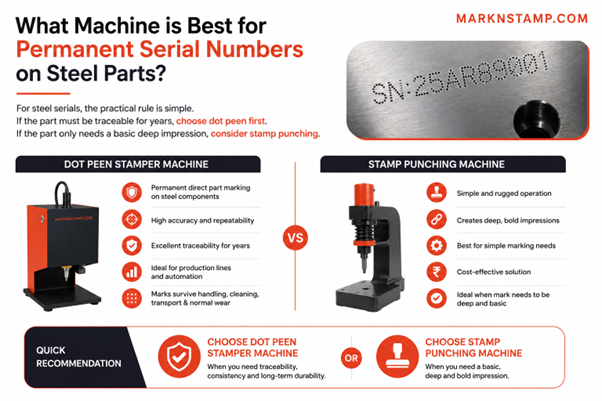
For most factories, the best answer is a dot peen stamper machine. MarknStamp says dot peen is the best all-round choice for most metal-marking jobs in India. The company also positions its systems for permanent direct part marking on metal components and tags.
That matters because serial numbers need more than visibility. They need durability, repeatability, and traceability. A proper steel mark should survive handling, cleaning, transport, and normal wear.
A stamper machine is usually the better fit when you need regular serial numbers, consistent depth, and production-line repeatability. A stamp punching machine is better when the job is simple and the mark must be deep, bold, and basic. MarknStamp’s own guidance says simple deep impressions suit a pneumatic stamp punching machine, while higher traceability points toward dot peen.
For steel serials, the practical rule is simple. If the part must be traceable for years, choose dot peen first. If the part only needs a basic deep impression, consider stamp punching.
How is a stamper machine different from a stamp punching machine?
A stamper machine is built for controlled, repeatable part marking. MarknStamp describes it as a mechanical or pneumatic marking device that indelibly stamps text, serial numbers, logos, or part codes using a die. That makes it useful when your mark must stay legible across many parts.
A stamp punching machine is more direct. It presses a character or die into the metal to create a deep impression. That works well for flat steel parts, batch codes, and simple serials. It is less flexible when you need frequent format changes or more complex traceability data.
Here is a quick comparison.
| Option | Best for | Strengths | Limits |
| Stamper machine | Serial numbers, part codes, logos | Durable, repeatable, traceable | Less ideal for complex variable data |
| Stamp punching machine | Simple deep serials on flat steel | Strong visible impression, straightforward use | Limited flexibility |
| Dot peen machine | Most steel serial-number jobs | Permanent, traceable, adaptable | Needs correct setup and stylus choice |
| Fibre laser | QR codes, fine detail, high-contrast marks | Clean, precise, fast | Needs the right power and safety setup |
When should you choose dot peen instead?
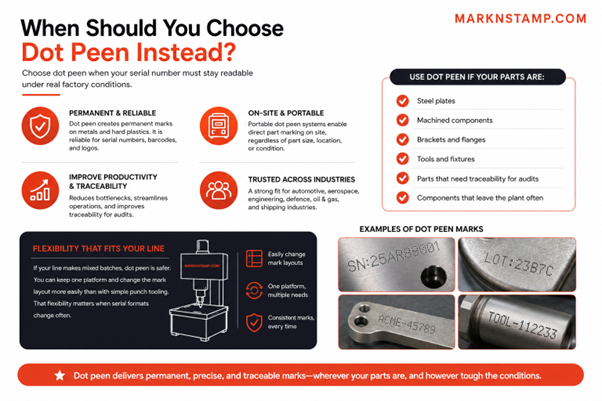
Choose dot peen when your serial number must stay readable under real factory conditions. MarknStamp says dot peen creates permanent marks on metals and hard plastics. It also says the technique is reliable for serial numbers, barcodes, and logos.
Dot peen is especially useful when parts are not easy to move. MarknStamp notes that portable dot peen systems help with direct part marking on site, regardless of part size, location, or condition. It also says these systems reduce bottlenecks and improve traceability.
That makes dot peen a strong fit for Indian plants in automotive, aerospace, engineering, defence, oil and gas, and shipping. Those are the sectors MarknStamp already serves.
Use dot peen if your parts are:
- steel plates
- machined components
- brackets and flanges
- tools and fixtures
- parts that need traceability for audits
- components that leave the plant often
If your line makes mixed batches, dot peen is also safer. You can keep one platform and change the mark layout more easily than with simple punch tooling. That flexibility matters when serial formats change often.
How do part shape, volume, and budget change the answer?
The right machine depends on the part, not just the budget. A flat steel tag needs a different solution from a heavy, curved, or awkward component. MarknStamp’s products reflect that reality through portable, pneumatic, battery-operated, deep-marking, and table-top options.
A good buying rule is to match the machine to the marking environment.
| Your need | Best fit | Why |
| Low-cost, simple serials | Stamp punching machine | Deep, basic marking |
| Repeated steel serials | Stamper or dot peen | Better consistency |
| Heavy or fixed parts | Portable dot peen | Mark in place |
| Fine codes and logos | Fibre laser | High precision |
| Uneven or harder surfaces | Deep marking or portable dot peen | Better reach and depth |
MarknStamp’s deep-marking machine is designed for tougher marking jobs. It uses pneumatic dot peen technology and is described as suitable for surface irregularities up to 12mm, with depth up to 1mm on soft steel parts. Its portable pneumatic machine also supports steel marking with the LP-10 stylus.
That means a plant in Thane, Pune, or Bhiwandi can pick one platform for multiple steel jobs. MarknStamp lists a manufacturing plant in Bhiwandi, a head office in Thane, and a branch office in Pune.
What should you check before buying the machine?
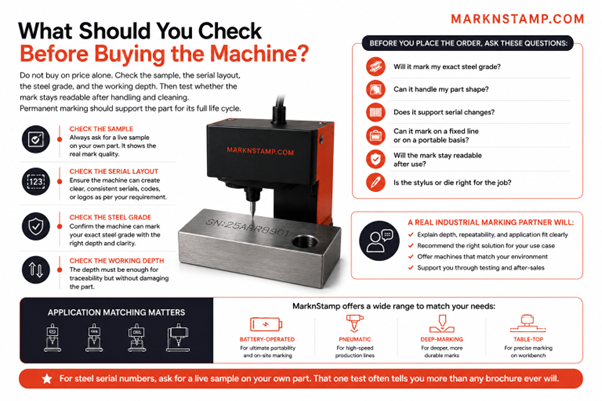
Do not buy on price alone. Check the sample, the serial layout, the steel grade, and the working depth. Then test whether the mark stays readable after handling and cleaning. Permanent marking should support the part for its full life cycle.
Before you place the order, ask these questions:
- Will it mark my exact steel grade?
- Can it handle my part shape?
- Does it support serial changes?
- Can it mark on a fixed line or on a portable basis?
- Will the mark stay readable after use?
- Is the stylus or die right for the job?
If the supplier cannot answer clearly, pause. A real industrial marking partner should explain depth, repeatability, and application fit without confusion. MarknStamp’s product range, including battery-operated, pneumatic, deep-marking, and table-top machines, shows why application matching matters.
For steel serial numbers, ask for a live sample on your own part. That one test often tells you more than any brochure ever will.
Which MarknStamp machine should you shortlist for steel serial marking?
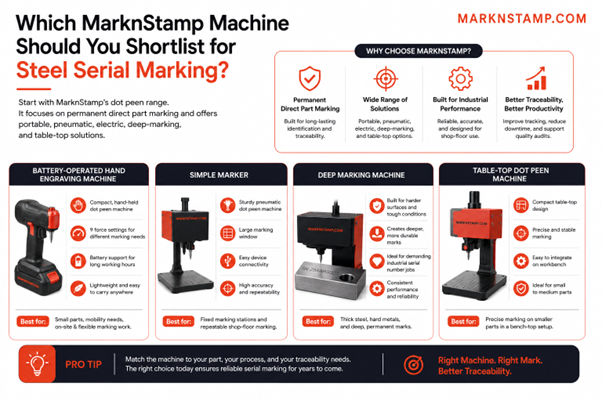
If you need the most balanced answer, start with MarknStamp’s dot peen range. The company says it focuses on permanent direct part marking and offers portable, pneumatic, electric, deep-marking, and table-top solutions. That range gives you room to match the machine to the job.
If your parts are small or your line needs mobility, the battery-operated hand engraving machine is worth a look. MarknStamp describes it as a compact hand-held dot peen machine with nine force settings and battery support for long working hours. That makes it useful for flexible marking work.
If your job is a fixed marking station, the Simple Marker is another practical option. MarknStamp calls it a sturdy pneumatic machine with a large marking window and easy device connectivity. That is useful for repeatable shop-floor marking.
For deeper steel work, the Deep Marking Machine is the better fit. It is built for harder surfaces and deeper marks, which suits demanding industrial serial-number jobs.
Frequently asked questions
Is a stamper machine good for steel serial numbers?
Yes, when you need a permanent, repeatable mark. It works best for straightforward serials and part codes. For broader traceability and more flexible marking, dot peen is usually stronger.
Is a stamp punching machine enough for permanent marking?
It can be, if the mark is simple and the part is flat. MarknStamp says simple deep impressions suit a pneumatic stamp punching machine. For more traceability, dot peen is the safer option.
Which machine is best for QR codes on steel?
A fibre laser is often the best fit. MarknStamp says fibre suits metals, serial numbers, QR codes, and speed. It is a strong choice when you need high precision and clean contrast.
Can portable marking work on large steel parts?
Yes. MarknStamp says portable dot peen systems are useful for large, difficult-to-move parts. They help reduce handling and support on-site marking without moving the component.
What is the biggest mistake factories make?
They choose the cheapest machine first. Then they discover the mark is too shallow, too slow, or not traceable enough. The better approach is to match the machine to the part and the required depth.
Conclusion
If your steel parts need permanent serial numbers, start with a dot peen stamper machine. It gives the best balance of permanence, traceability, and day-to-day use. Use a stamp punching machine only when the job is simple and the mark does not need much flexibility.
For tougher steel, uneven surfaces, or shop-floor mobility, MarknStamp’s portable, pneumatic, and deep-marking options make the decision easier. That range gives factories a practical way to mark parts without compromising readability or traceability.
Book Demo with MarknStamp.