By Mark N Stamp | 10 min read
For bare aluminium, both work. A hand held marking machine using dot peen gives you a deep, permanent mark you can feel, and it still reads after painting or blasting. A fiber laser gives a faster, finer and cleaner mark. Anodised parts are where they differ. A laser removes the dyed layer and leaves a bright, crisp mark. Dot peen punches straight through the coating, so the mark is readable, but the finish is broken.
Key insights
- Aluminium is soft, so force matters more than speed: too much stylus force on a thin wall dents the part as well as the mark.
- Anodising is a coating grown from the metal: a laser clears it in a light pass, while dot peen breaks it at every dot.
- Bare aluminium gives a laser less natural contrast: the mark often comes out pale grey unless the settings are tuned for it.
- Dot peen wins after the marking stage: if the part gets blasted, painted or anodised after marking, a recessed dot mark survives that better.
Before you go
Bring two samples to any trial, one bare and one anodised, plus the thinnest section you’ll ever need to mark. Aluminium jobs usually go wrong on the thin part or the coated one, not the easy solid block.
So you’ve got aluminium parts to mark and two options on the table. You can go with dot peen, which most shops already know, or a fiber laser, which everyone tells you is “the modern way”. You’ll find people who swear by each, and they’re usually both right about their own parts.
Here’s the thing. Aluminium behaves differently from steel under both methods. It’s softer, it reflects more light, and a lot of the time it arrives with an anodised finish on it, which changes the job completely.
Let’s go through what actually happens when each method hits aluminium, how anodising shifts the answer, and how to pick without guessing.
Why is aluminium a different job from steel?
Most marking advice is written with steel in mind. Aluminium changes three things, and each one affects your choice of method.
It’s much softer
Aluminium alloys are far softer than hardened or even mild steel. That’s good news for dot peen, because the stylus doesn’t need much force to make a clear dot. The flip side is that the same force that’s just right on steel can sink too deep and push the surface around on aluminium.
It reflects a lot of light
Polished or bright aluminium reflects a big share of the light that hits it. A fiber laser still marks it, but bare aluminium tends to give a lighter, lower-contrast mark than steel unless the settings are dialled in.
It often arrives coated
Plenty of aluminium parts come anodised, in clear, black, blue or another colour. Once there’s a coating on top, you’re no longer just marking metal. You’re deciding what happens to the coating too.
| Property | What it means for dot peen | What it means for fiber laser |
| Softness | Clear dots at low force, but risk of denting thin walls | No contact, so no denting |
| Reflectivity | Doesn’t matter, it’s mechanical | Bare metal can give a pale, low-contrast mark |
| Melting point around 660°C | Not relevant | Heat builds quickly on small or thin parts |
| Anodised finish | Breaks through the coating at every dot | Clears the dye layer for a bright mark |
That melting point comes from aluminium’s own material data, and it’s well below steel’s. That’s why heat control matters more on thin aluminium than on a steel block.
How does dot peen mark aluminium?
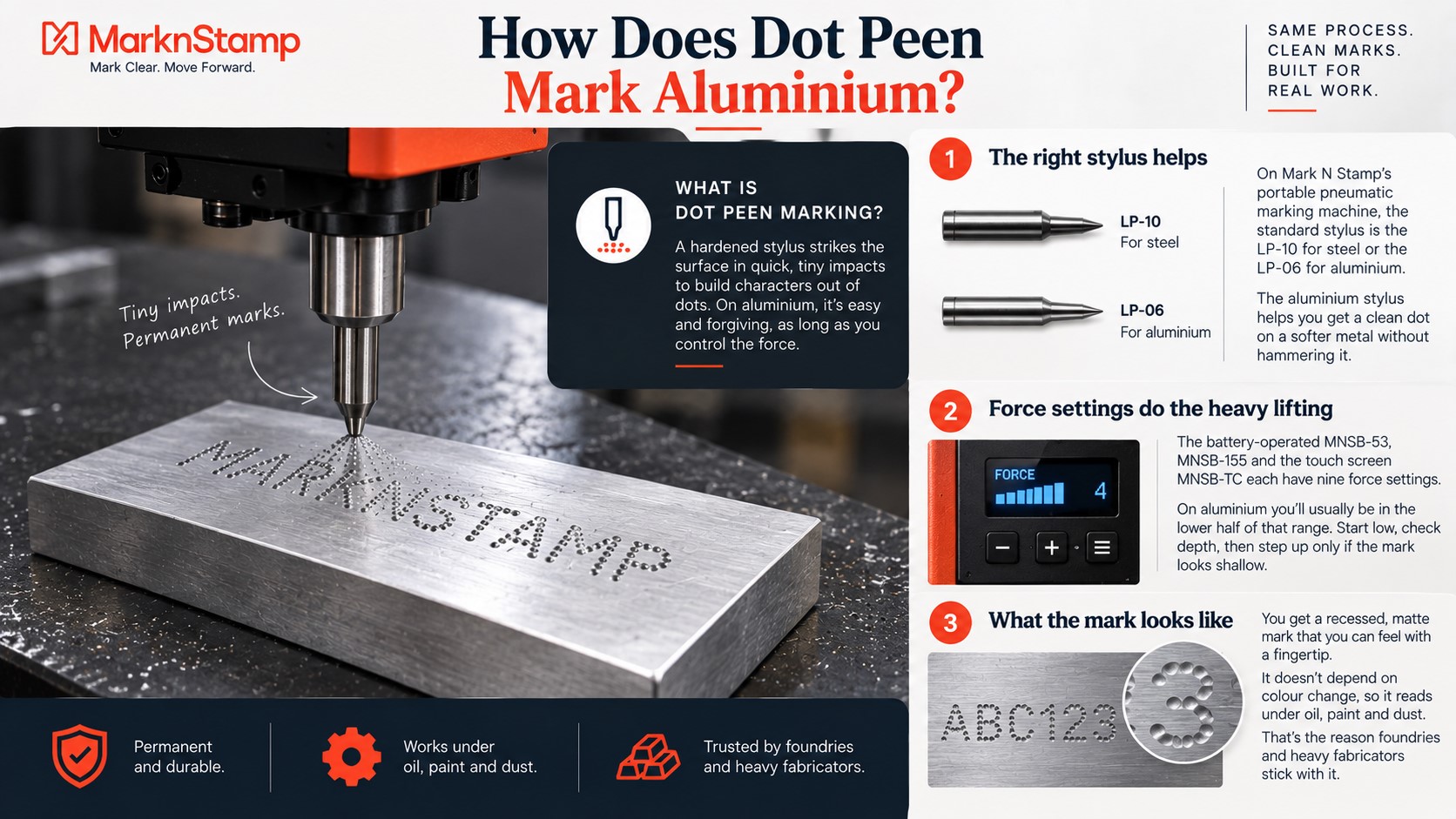
Dot peen, also called micropercussion, uses a hardened stylus that strikes the surface in quick, tiny impacts to build characters out of dots. On aluminium, it’s easy and forgiving, as long as you control the force.
The right stylus helps
On Mark N Stamp’s portable pneumatic marking machine, the standard stylus is the LP-10 for steel or the LP-06 for aluminium. The point of having a separate aluminium stylus is to get a clean dot on a softer metal without hammering it.
Force settings do the heavy lifting
The battery-operated MNSB-53 and MNSB-155 and the touch screen MNSB-TC each have nine force settings. On aluminium you’ll usually be in the lower half of that range. Start low, check depth, then step up only if the mark looks shallow.
What the mark looks like
You get a recessed, matte mark that you can feel with a fingertip. It doesn’t depend on colour change, so it reads under oil, paint and dust. That’s the reason foundries and heavy fabricators stick with it.
How does a fiber laser mark aluminium?
A fiber laser focuses an infrared beam onto the surface and moves it with mirrors. Nothing touches the part. On aluminium, it can do three different things depending on the settings.
Surface marking
A light pass changes the surface texture and gives a light grey or frosted mark. It’s quick, but on bright bare aluminium the contrast can be soft.
Engraving
With more energy, the laser removes material and leaves a shallow recess. It takes longer per part, but it holds up better to handling and cleaning.
Darker marks with MOPA sources
MOPA fiber lasers let you adjust the pulse width. That extra control helps you pull darker, higher-contrast marks out of bare aluminium than a fixed-pulse source usually gives. Mark N Stamp’s laser range is built on MOPA sources at 30W, 60W and 120W, and the compact ECO laser runs a 30W MOPA source.
What actually changes when the part is anodised?
This is the part most buyers skip, and it’s the part that decides the answer for a lot of aluminium work.
The coating is grown, not painted
Anodising builds an oxide layer out of the aluminium itself through an electrochemical process, and that layer can then be dyed. It’s hard, thin and bonded to the metal, which is why it protects the part so well.
Laser: clears the dye, keeps it tidy
A fiber laser removes or bleaches the dyed oxide in the shape of the mark. On black or dark blue anodising, you get a sharp white or silver mark with excellent contrast, usually in a light, fast pass. The coating around the mark stays intact.
Dot peen: breaks the coating at every dot
Every impact cracks through the oxide layer and exposes the aluminium underneath. The mark still reads fine, and it’s deep and permanent. But the finish is broken across the marked area, and on a visible cosmetic face that may not be acceptable.
Why that matters
Aluminium does grow a thin natural oxide again on exposed spots, so it won’t rust the way steel does. But that natural film isn’t the same as the anodised layer, which is much harder. Aluminium oxide is extremely hard, and that hardness is a big part of why anodised parts wear well. Break it and the marked area is softer than the rest of the surface.
| Finish | Dot peen result | Fiber laser result | Usually better |
| Bare, machined | Deep, matte, durable | Light grey, softer contrast | Depends on the next process |
| Black or dark anodised | Readable, coating broken | Bright white, coating intact | Laser |
| Clear anodised | Readable, coating broken | Subtle, needs tuned settings | Test both |
| Hard anodised | Needs more force | Needs more energy | Test both |
| Anodised after marking | Dots survive the process | Mark can fade under the coating | Dot peen |
Should you mark before or after anodising?
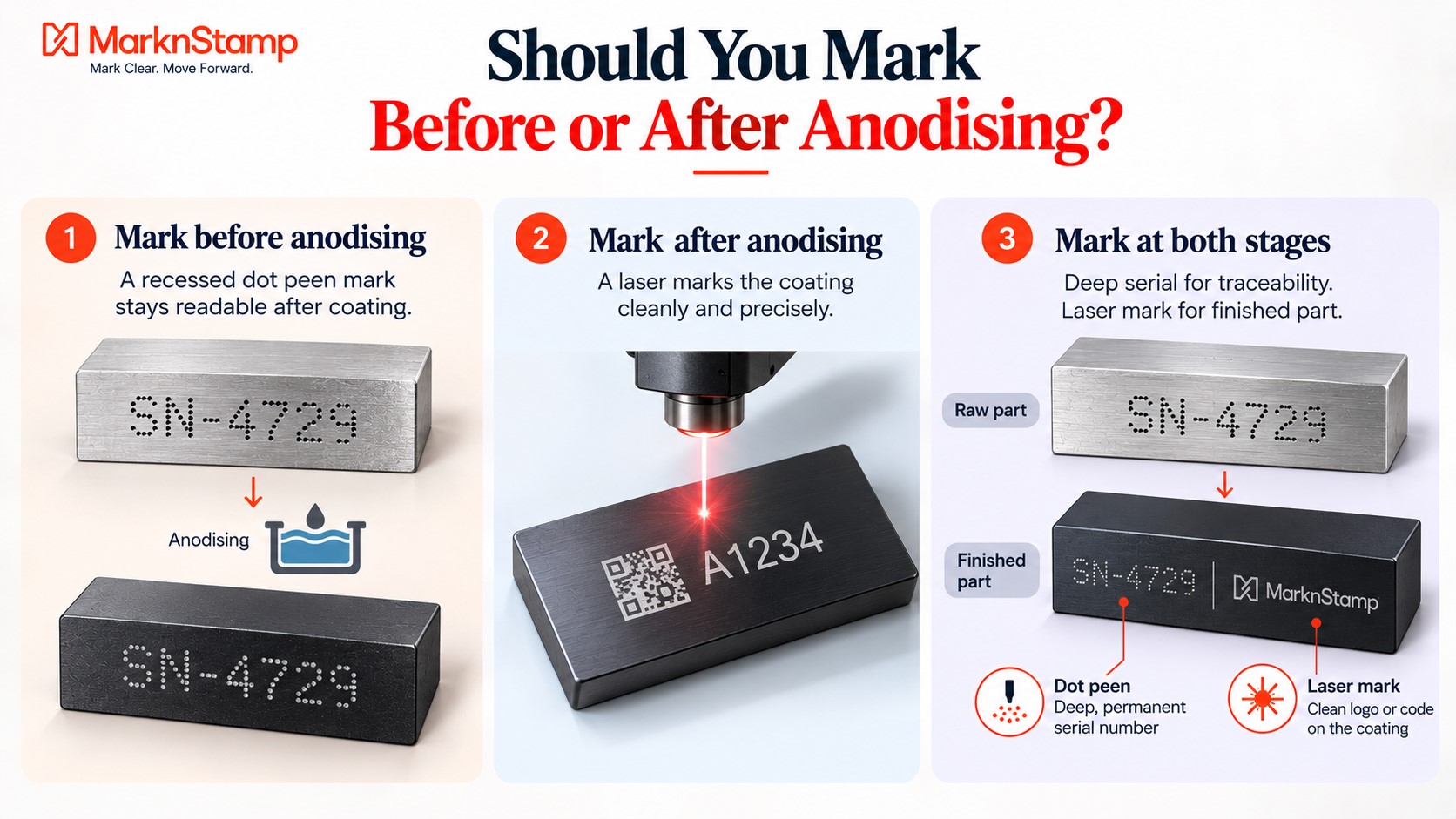
Here’s a question that sorts out a lot of confusion. Your answer changes which machine makes sense.
Marking before anodising
If parts get marked first and anodised later, a laser surface mark can get washed out or covered by the coating. A recessed dot peen mark keeps its shape through the process, so it stays readable.
Marking after anodising
If parts arrive already finished, a laser is usually the cleaner choice. It marks the coating without breaking the surface around it.
Marking at both stages
Some plants put a deep dot peen serial on the raw part for traceability through machining, then a laser-marked logo or code on the finished part. It sounds like overkill, but on high-value parts it’s pretty common.
When does a hand held marking machine make more sense?
A hand held marking machine isn’t only about method. It’s about getting the machine to the part.
Big or awkward aluminium parts
Extrusions, frames, enclosures and assembled units don’t fit under a laser enclosure. A portable dot peen head goes to them.
Parts marked on site or at assembly
If you’re marking aluminium after it’s bolted together, or in a yard or at a customer site, battery dot peen is the practical route. The MNSB-53 runs up to 8 hours of normal working on its battery, and the MNSB-155 has a bigger 150mm x 50mm window for long strings.
Mixed shop with no laser enclosure
If you mark aluminium only a few times a week, a handheld dot peen machine you already own will often do the job well enough, especially on bare parts.
What goes wrong on aluminium, and how do you fix it?
Most aluminium marking problems come from settings borrowed from steel jobs.
Dents and distortion on thin sections
The stylus force is too high for the wall thickness. Drop the force setting, switch to the aluminium stylus, and support the back of the part if you can.
Pale laser marks on bare aluminium
The settings are tuned for steel. On a MOPA source, try adjusting pulse width and frequency before you crank up power.
Scorched or blotchy anodised marks
Too much energy on a dark coating. Speed up and reduce power, because anodising usually needs a lighter touch than people expect.
| Symptom | Method | Likely cause | First fix |
| Part dented around the mark | Dot peen | Force too high | Lower force, use LP-06 stylus |
| Uneven depth along the string | Dot peen | Head not seated flat | Use a front fixture |
| Mark too pale | Laser | Steel settings on aluminium | Tune pulse width and frequency |
| Brown or burnt edge on anodising | Laser | Too much energy | Faster speed, lower power |
| Mark gone after anodising | Laser | Marked before coating | Mark after, or switch to dot peen |
Which one should you pick?
Run through these questions in order and the answer usually falls out.
Is the part anodised when you mark it?
If yes and the face is visible, lean towards laser. If it gets anodised afterwards, lean towards dot peen.
Can the part go to the machine?
If it’s large, installed or assembled, a handheld dot peen machine is the realistic option.
How many parts per shift?
High volumes of small, finished parts suit a laser station. Lower volumes or varied parts suit a portable dot peen machine.
Does the mark need to survive blasting or painting?
If yes, dot peen. A recessed mark holds up where a surface mark doesn’t. If you’re still torn, Mark N Stamp’s piece on whether dot peen and micropercussion are really different clears up the naming, which helps when you’re comparing quotes.
Wrapping up
Aluminium isn’t hard to mark, but it’s easy to mark badly. It’s soft, so dot peen needs a lighter hand. It’s reflective, so a laser needs tuned settings. When it’s anodised, you have to decide whether breaking that coating is fine or not.
As a rough rule, a laser suits finished anodised parts where looks matter, and dot peen suits raw, large or later-coated parts where the mark has to survive whatever comes next. Lots of plants end up using both.
Mark N Stamp makes both dot peen and laser marking machines, so a trial can put the same aluminium part under each method side by side. Bring your thinnest and your most coated samples, and you’ll see the answer on the part instead of in a brochure.
FAQs
Can a dot peen machine mark anodised aluminium?
Yes. The stylus breaks through the anodised layer and makes a clear, permanent mark. The coating gets broken across the marked area, so check whether that’s acceptable on visible or cosmetic faces before you commit to it.
Is fiber laser marking good for aluminium?
Yes, especially on anodised parts, where it gives a bright, sharp mark without touching the surface. Bare aluminium can give a paler mark, so settings matter, and MOPA sources help with contrast.
What stylus should I use to mark aluminium?
On Mark N Stamp’s portable pneumatic machine, the LP-06 stylus is offered for aluminium marking and the LP-10 for steel. Using the aluminium stylus with lower force gives clean dots without denting softer parts.
Should I mark aluminium before or after anodising?
If you mark before, use dot peen, since a recessed mark survives the coating process. If you mark after, a fiber laser usually gives the cleanest result without breaking the finish around the mark.
Will a dot peen mark make aluminium corrode?
Aluminium won’t rust like steel. Exposed spots grow a thin natural oxide again. That film is much weaker than the anodised layer, though, so the marked area has less protection than the surrounding finish.
Can one hand held marking machine handle both steel and aluminium?
Yes. A handheld dot peen machine with adjustable force can mark both. Lower the force for aluminium, raise it for steel, and swap to the right stylus where your machine offers one.