By Mark N Stamp | 10 min read
If your parts are small enough to lift and you mark them in batches, a mobile station is the better choice. That’s a table top micropercussion marking machine on a wheeled trolley you can move between cells. If your parts are big, heavy, fixed in place or spread across the site, go handheld, because the machine has to go to the part. Plenty of shops end up running one of each.
Key insights
- Ask who moves, the part or the machine: that one question settles most of the decision.
- Stations win on repeatability: a fixed head and a fixture give the same position and depth on every part.
- Handhelds win on reach: they mark parts that can’t be lifted, turned or brought to a bench.
- Some machines do both: several portable heads can be mounted on a stand when you need a station.
Before you go
Walk your floor with a notepad for a day and write down every part that needs a mark, where it is when it needs it, and roughly what it weighs. The pattern on that sheet will tell you more than any brochure.
You need marking in more than one place on the shop floor. Maybe it’s machining, assembly and dispatch. Maybe it’s three bays that don’t share a bench. Either way, a single fixed marking machine in a corner isn’t working, because parts keep queuing up beside it.
So you’re weighing up two ways to make marking mobile. One is a station on wheels that you push from cell to cell. The other is a handheld machine an operator carries straight to the part.
Both are micropercussion marking, the same dot-by-dot process, just packaged differently. The right choice depends less on the machine and more on your parts and how they move through the shop. Let’s walk through it.
What do we mean by each option?
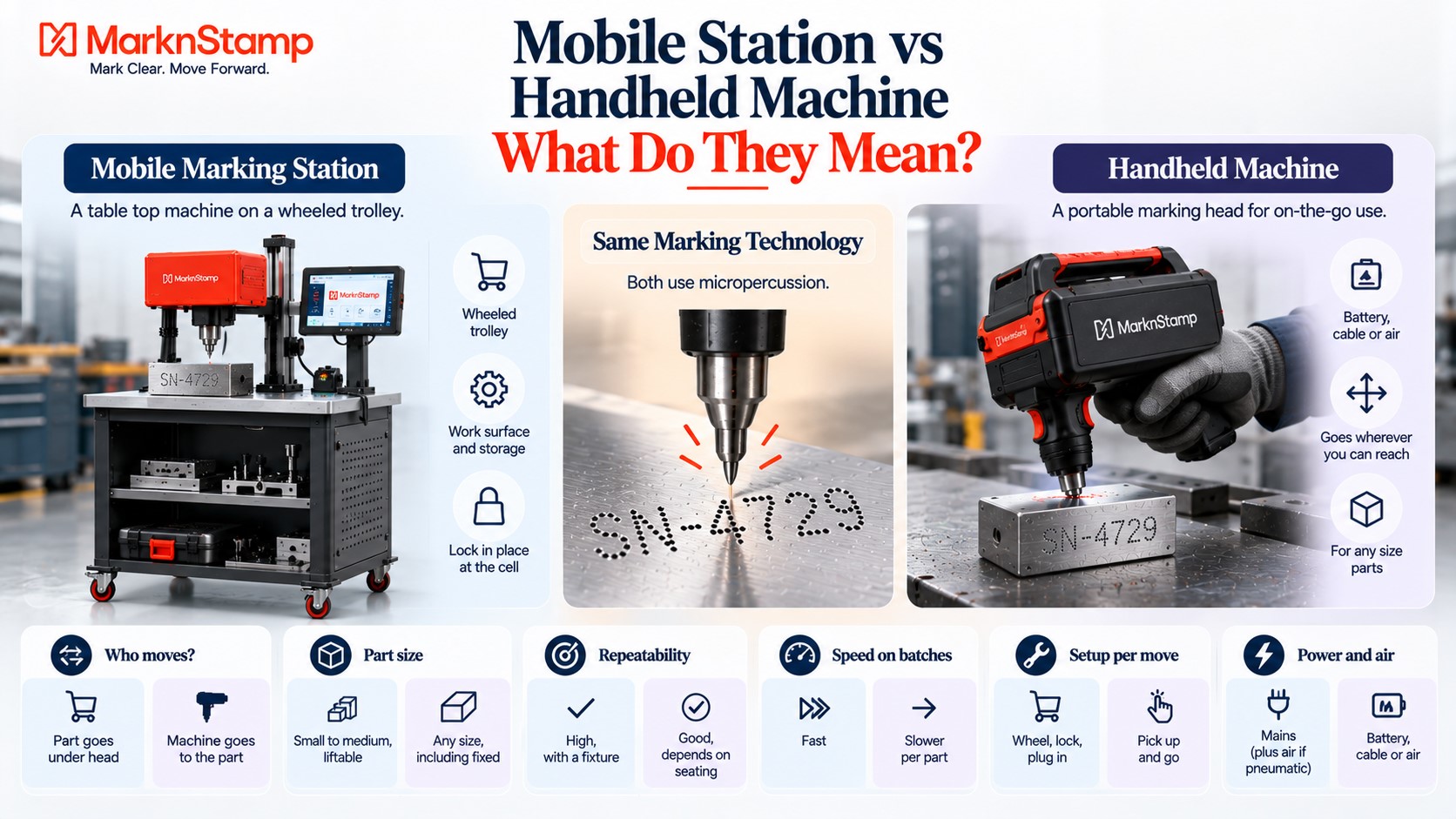
Let’s get the terms straight first, because people use them loosely.
A mobile marking station
A table top dot peen machine mounted on a sturdy wheeled trolley, usually with its controller, a work surface and somewhere to keep fixtures. You wheel it to a cell, lock the castors, load parts under the head and mark.
A handheld machine
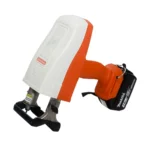
A portable marking head that an operator places on the part by hand. It runs from a battery, a cable or an airline, and it goes wherever the operator can reach.
What they share
Both use micropercussion, a hardened stylus striking the surface in fast dots. Mark N Stamp’s piece on what a portable metal marking machine is explains the handheld side in more detail.
| Mobile station | Handheld machine | |
| Who moves | The part goes under the head | The machine goes to the part |
| Part size | Small to medium, liftable | Any size, including fixed |
| Repeatability | High, with a fixture | Good, depends on seating |
| Speed on batches | Fast | Slower per part |
| Setup per move | Wheel, lock, plug in | Pick up and go |
| Power and air | Mains, plus air if pneumatic | Battery, cable or air |
When does a mobile station make more sense?
A station shines when parts can come to it, even if the station itself moves around.
Batches of small and medium parts
Brackets, housings, valve bodies, tools. If one person can lift the part and put it in a fixture, a station marks it faster and more consistently than a handheld.
Parts that need the same position every time
A fixture on a station puts the mark in the same spot on every part. That matters when a drawing specifies position or a scanner has to find a code.
Marking in several cells on a schedule
If machining needs marking on Monday and assembly on Thursday, a station on wheels can follow the work without needing a second machine.
Which machine suits a station
A touch screen table top machine like the MNS-TC has a 120mm x 100mm marking area, nine force codes and a choice of seven stylus attachments. It can also connect to a PC over Ethernet, which makes it a good fit for a station that moves between cells.
When does a handheld machine make more sense?
When the part can’t move, or shouldn’t, the handheld wins every time.
Big and heavy parts
Castings, forgings, frames and pipe spools don’t go under a table top head. Lifting them to a station ties up a crane and a person.
Installed or assembled equipment
Pumps, valves and vessels that are already bolted down can only be marked where they sit.
Marking spread across a site
Yards, stores and customer sites are all handheld territory, especially with a battery or wireless machine.
Parts with awkward faces
Curved, angled or recessed surfaces are often easier to reach by hand. Mark N Stamp has a piece on whether a dot peen machine can mark curved surfaces or only flat ones, which is handy if your parts aren’t flat.
How do air and power affect the decision?
This is a practical point that catches a lot of shops out.
Pneumatic stations need air at every stop
A pneumatic station needs a compressed air supply wherever it’s parked. If some of your cells don’t have an airline drop, an electric machine on the station is simpler.
Electric stations need a socket
Most table top machines run from a separate 24V DC power adapter. Make sure each stop has a socket that won’t get kicked out.
Handhelds can skip both
Battery machines like the MNSB-53, MNSB-155 and MNSB-TC need no cable or air during marking. The MNSBP-145 gives pneumatic force on a battery, with a 140mm x 50mm window and 4 to 6 hours of working time.
| Situation | Station: electric | Station: pneumatic | Handheld: battery |
| No airline in some cells | ✓ | ✗ | ✓ |
| Deep marks on rough parts | Limited | ✓ | ✓ with MNSBP-145 |
| No socket nearby | ✗ | ✗ | ✓ |
| High batch volume | ✓ | ✓ | Slower |
What about the people who’ll use it?
The operator side matters as much as the machine.
Fatigue over a shift
Handhelds weigh a few kilos. The MNSB-TC is 4.7kg and the standard pneumatic portable is 3.2kg with its front fixture. That’s fine for occasional marking, but holding one up hundreds of times a shift is tiring. The HSE’s guidance on manual handling at work is a good reminder to think about repeated lifting and holding, not just heavy loads.
Moving a station safely
A trolley with a machine and controller on it isn’t light either. Good castors with brakes, a sensible handle height and clear floor routes make a big difference.
Training
Stations are usually quicker to train on, because the fixture does the positioning. Handhelds need a bit more skill in seating the head flat.
Can one machine do both jobs?
Sometimes, yes. And that’s worth knowing before you buy two.
Portable heads that mount on a stand
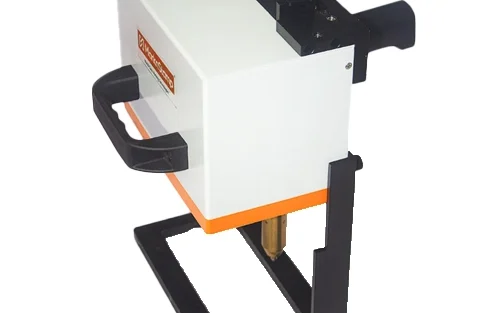
The MNSB-53 can be table mounted, and Mark N Stamp’s portable pneumatic machine can be adapted to a table top version with front-fitted trays. So a portable head can act like a station when you need it to.
Where the hybrid falls short
A portable head on a stand doesn’t give you the bigger window, extra axes or automation inputs of a dedicated table top machine. For high-volume batches, a proper station is still faster.
Hands-free on heavy parts
The deep marking machine uses special front holding attachments and permanent magnets for grip, which allows hands-free marking on steel parts. It sits somewhere between handheld and fixed.
How do you decide for your shop floor?
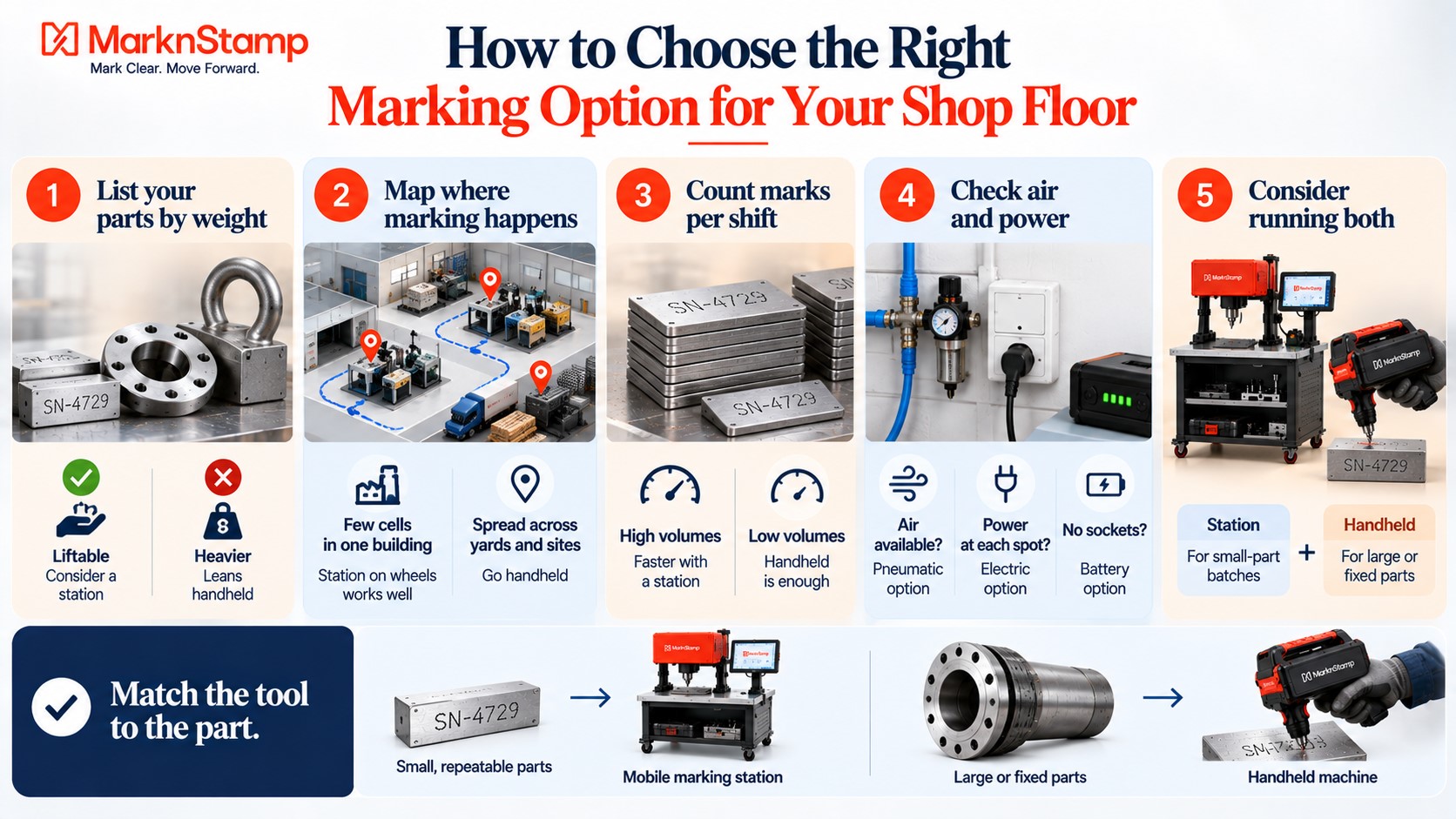
Go through these steps and you’ll usually land on an answer.
Step 1: List your parts by weight
Anything one person can lift comfortably is a station candidate. Anything heavier leans handheld.
Step 2: Map where marking happens
If it’s three or four cells in one building, a station on wheels can cover them. If it’s spread across yards, stores and sites, go handheld.
Step 3: Count marks per shift
High batch volumes favour a station. Low volumes spread over many locations favour a handheld.
Step 4: Check air and power at each spot
No air at some stops means electric or battery. No sockets means battery.
Step 5: Consider running both
Many shops use a station for small-part batches and a handheld for the big stuff. That isn’t overkill, it’s just matching the tool to the part.
| If your shop mostly has… | Choose |
| Small parts, batches, several cells | Mobile station |
| Large or installed parts | Handheld |
| A mix of both | One of each, or a portable head that can be stand-mounted |
| Marking outdoors or on customer sites | Battery handheld |
Wrapping up
A mobile marking station and a handheld machine both bring micropercussion marking closer to the work, but they do it from opposite directions. A station brings the part to the head and gives you speed and repeatability. A handheld brings the head to the part and gives you reach.
The deciding question is simple: who moves, the part or the machine? Answer that for your heaviest, most awkward part and your highest-volume part, and you’ll know whether you need one approach or both.
If you’re still unsure, send Mark N Stamp a quick list of your parts with sizes and where they get marked. The team can tell you which setup fits, and whether a portable head on a stand could do both jobs.
FAQs
What is a mobile marking station?
It’s a table top marking machine mounted on a wheeled trolley, usually with its controller and fixtures. You move it between work cells, lock it in place, and mark parts by loading them under the head.
Is micropercussion marking the same as dot peen?
Yes. Micropercussion, dot peen and dot pin all describe a stylus striking the surface in fast dots to form characters. The names are used interchangeably, so you’ll see all three in quotes and catalogues.
When should I choose a handheld marking machine over a station?
When parts are too heavy to lift, already installed, or spread across different locations. A handheld machine goes to the part, which saves crane time and lets you mark parts exactly where they sit.
Can a handheld marking machine be used on a stand?
Some can. The MNSB-53 can be table mounted, and Mark N Stamp’s portable pneumatic machine can be adapted into a table top version. That lets one machine handle both batches and big parts.
Do mobile marking stations need compressed air?
Only if the machine on them is pneumatic. Electric table top machines run from a power adapter, so they’re simpler to move between cells that don’t all have an airline drop nearby.
Which is faster for batch marking, a station or a handheld?
A station, usually. With a fixture holding each part in the same place, loading and marking is quick and repeatable. Handhelds are slower per part but reach parts a station can’t.