By Mark N Stamp | 10 min read
To survive sandblasting and hot-dip galvanizing, a mark has to be a physical indentation deep enough that the blast profile and the zinc layer together can’t fill or flatten it. That means a press-type stamper machine or a long-stroke pneumatic dot peen, marked deep, on a clean flat face. Shallow laser or light dot peen marks are usually lost.
Key insights
- Think in microns, not looks: blasting roughens the surface by tens of microns and galvanizing can add hundreds, so the mark needs real depth to stay visible.
- Contrast marks don’t survive: laser annealing and light etching sit on the surface, which is exactly what a blast strips away.
- Deep dot peen is the modern stamper: long-stroke pneumatic machines reach up to about 1mm on soft steel, programmably and without hard punches.
- Character size matters as much as depth: zinc rounds off fine detail, so go bigger and simpler.
Before you go
Don’t trust a test plate marked in the office. Mark three offcuts of your real steel, send them through your actual blaster and your actual galvanizer, and read them when they come back. Any setting that survives that trip is the one to standardise.
Fabricators run into this problem all the time. A beam, bracket or pole gets a neat ID mark at the cutting station. Then it’s blasted, dipped in molten zinc and stacked in the yard. By the time it reaches site, the number has vanished under a grey, lumpy coat, and someone’s comparing it to a drawing and guessing.
The fix isn’t a better pen or a paint marker. It’s a mark with enough depth to outlast the processes that come after it. This guide covers how deep that needs to be, which machines get there, and how to prove it before a whole batch goes through.
Why do marks disappear in blasting and galvanizing?
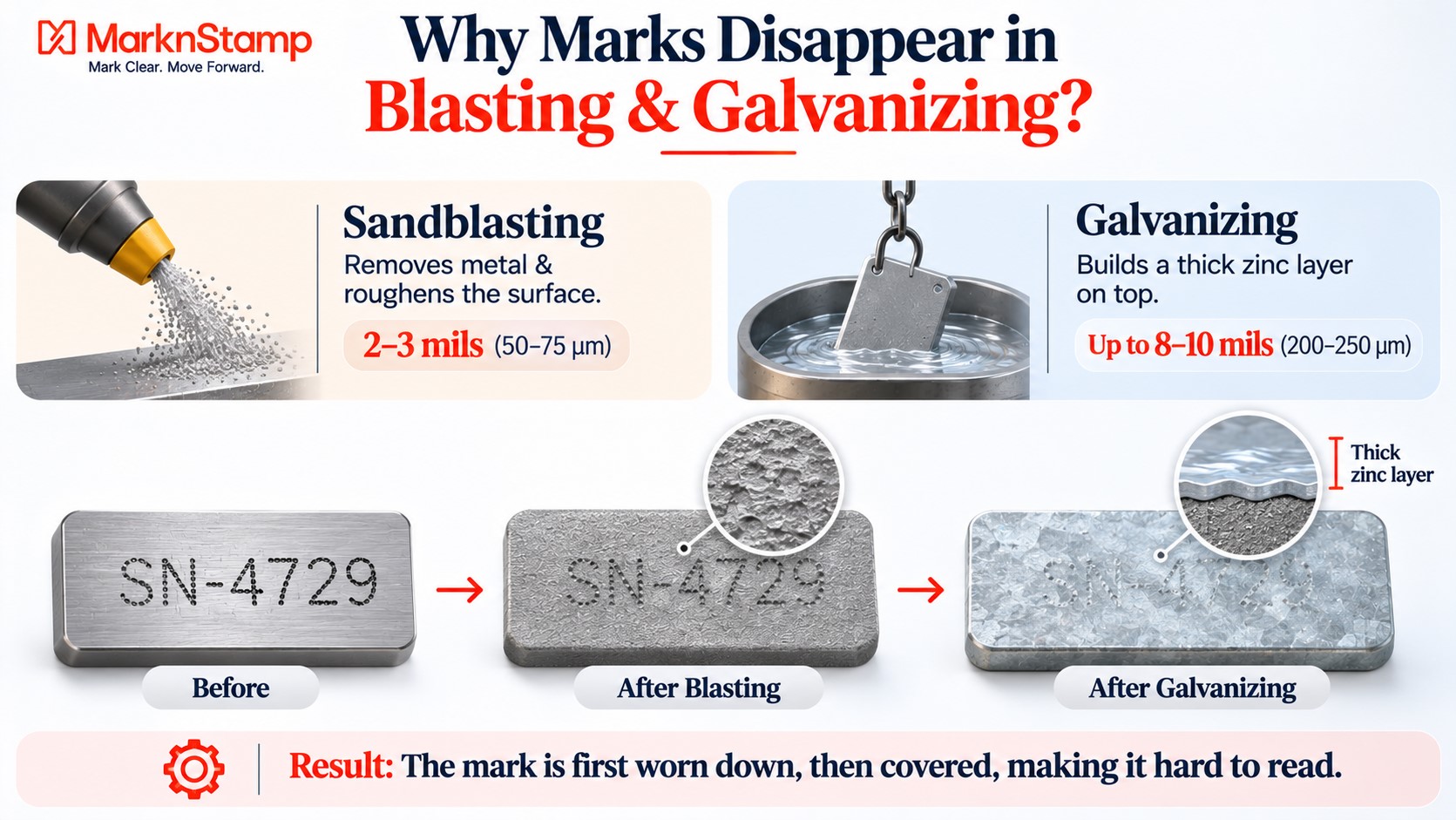
Marks disappear because both processes change the surface the mark lives in. Blasting removes and roughens metal at the surface. Galvanizing then builds a thick zinc layer on top. A shallow mark is erased by the first and buried by the second.
What sandblasting does
Abrasive blasting cleans the steel and cuts a rough anchor profile for coatings to grip. Coating specialists DeFelsko cite research concluding that a 2 to 3 mil (50 to 75 micron) profile suits a wide range of industrial coatings. That’s the surface being deliberately pitted to a depth of a few hundredths of a millimetre, all over, including across your mark.
What hot-dip galvanizing does
Galvanizing dips the steel in molten zinc, which bonds and builds up as a coating. Its thickness depends on the steel’s chemistry and section, and it can get heavy. The American Galvanizers Association notes that coatings thicker than about 8 to 10 mils (roughly 200 to 250 µm) start to raise brittleness concerns, which tells you how thick real coatings can run on reactive steels.
Why the two together are hard
Each process alone might spare a modest mark. Together, they first soften its edges and then fill it in. A mark that starts at a tenth of a millimetre can end up as a faint blur, which won’t scan and is hard to read even by eye.
How deep does the mark need to be?
There’s no single number, because it depends on your blast spec and your steel. Work it out as a depth budget: what’s lost to blasting, plus what’s added by zinc, plus a margin so the characters still read.
| Layer | What it does to the mark | Rough scale |
| Blast profile | Roughens edges and floor of the mark | Around 50 to 75 µm for typical coating prep |
| Zinc coating | Fills the mark from the bottom up | Can run to 200 µm or more on reactive steels |
| Readability margin | Keeps characters distinct after both | Depends on character size and font |
A practical starting point
For blasted and galvanized steel, plan for marks measured in tenths of a millimetre, not hundredths. Deep pneumatic dot peen marks can reach around 1mm on soft steel. Start deep, test, then back off only if the results allow it.
Character size and spacing
Depth alone won’t save you if the characters are tiny. Zinc rounds every edge, so fine fonts and tight spacing merge into a smudge. Use larger characters, a simple font, and more space between them than you would on a bare part.
Codes versus text
Dense 2D codes rarely survive galvanizing because their cells are too small to stay distinct under zinc. For galvanized parts, human-readable serials, or a large code with generous cells, are far more reliable.
Stamper machine, deep dot peen or laser: which one works?
For marks that must survive both blasting and galvanizing, a physical indentation wins. Here’s how the three main methods compare.
| Press stamper machine | Deep pneumatic dot peen | Laser | |
| How it marks | Hard punches pressed or struck in | Stylus strikes in fast, deep dots | Beam changes or removes surface |
| Depth potential | Very deep | Up to about 1mm on soft steel | Mostly shallow |
| Changing the text | Swap punches or wheels by hand | Type it on the controller | Type it on the controller |
| Serial numbers and dates | Slow, error-prone changes | Automatic, programmable | Automatic, programmable |
| Effect on thin parts | Can distort them | Lower stress, force adjustable | No impact |
| Survives blast and zinc | Yes, if deep | Yes, if deep | Usually not |
Where a traditional stamper machine still fits
A press stamper with fixed punches is hard to beat for one mark repeated on thousands of identical heavy parts. The trouble starts when every part needs a different serial. Changing punches for every number is slow, and mistakes are easy to make.
Why deep dot peen has taken over
A long-stroke pneumatic dot peen does the stamper’s job without hard type. You type the text, the controller works out the dots, and every serial is different with no tooling change. That’s why most fabricators now treat deep dot peen as their stamper machine. Our guide on what a stamper machine is covers how the two technologies relate.
Where laser falls short here
Laser is excellent on finished parts, but most laser marks on steel are contrast, not depth. Blasting strips them. Deep laser engraving is possible, but it’s slow, and it still has to beat the zinc.
How do you set up a deep mark that lasts?
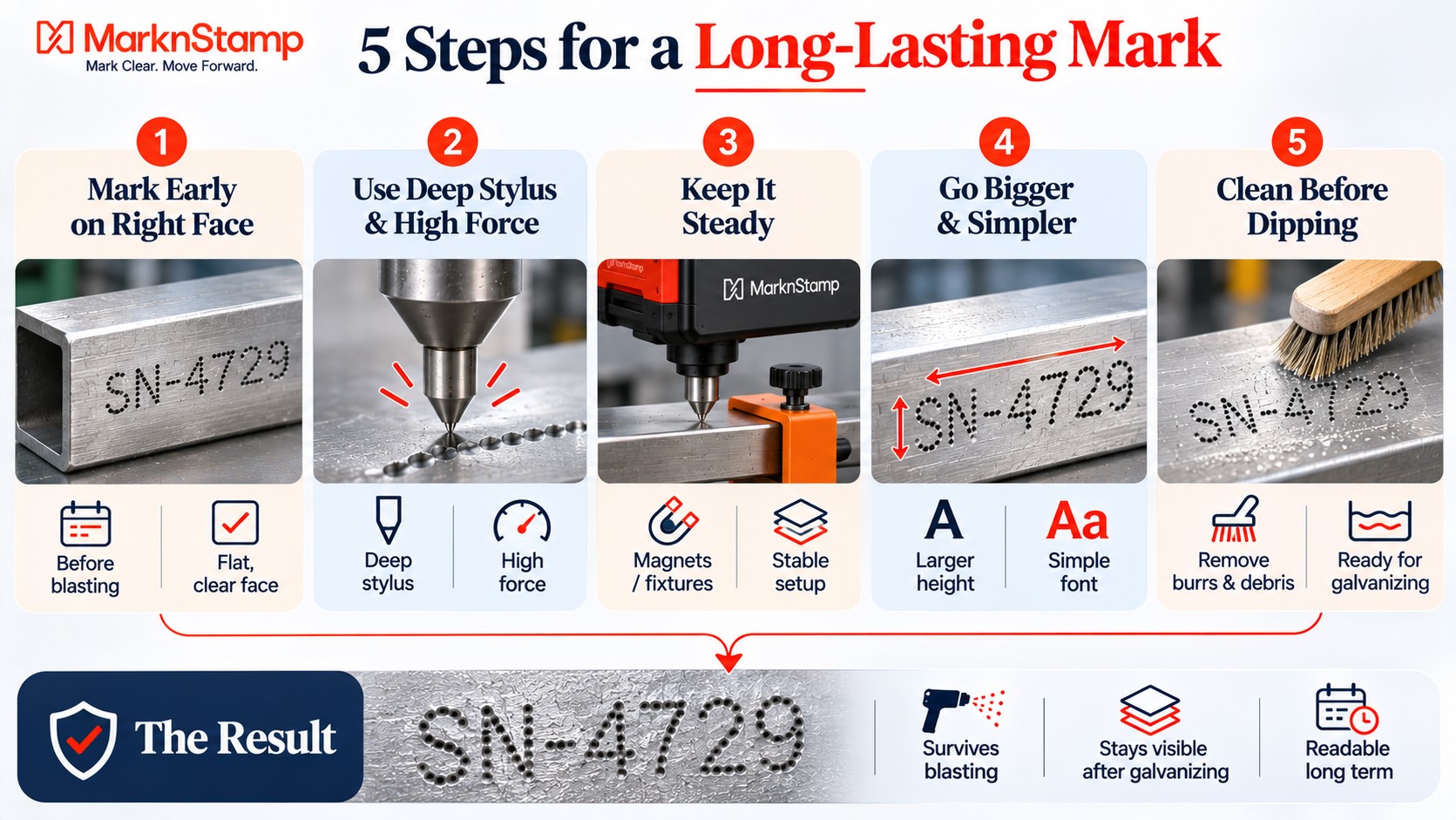
Five decisions make the difference between a mark that survives and one that doesn’t.
1. Mark before blasting, on the right face
Mark early, at cutting or fabrication, so the ID travels with the part from the start. Choose a flat face that won’t be welded over, ground or hidden by a connection.
2. Use a deep-marking stylus and high force
Deep marks come from long strokes and the right stylus. Our deep marking machine uses long stylus strokes with an LP-25 stylus and high-depth valves, reaching up to 1mm on soft steel and coping with surface irregularities up to 12mm.
3. Keep it steady
A deep mark needs the head held still while it strikes. Front holding attachments and permanent magnets help on steel sections, freeing the operator’s hands and keeping depth even across the whole mark.
4. Go bigger and simpler
Raise character height, use a simple font and widen the spacing. A slightly larger mark that reads after galvanizing beats a neat one that doesn’t.
5. Clean the mark before dipping
Burrs, spatter and blast debris in the mark can trap flux or zinc unevenly. A quick brush-out before the part goes to the galvanizer helps the characters stay crisp.
How do you prove the mark will survive?
Test with your real process before you mark a full batch.
Run a trip test
Mark several offcuts of the same steel grade and thickness at a few depth settings. Send them through your normal blast and your galvanizer, then read them by eye and with any scanner you use.
Record the winning settings
Write down the force, stylus, character height and font that survived. Store them as a saved job on the controller so every operator marks the same way.
Retest when things change
A new steel supplier, a new galvanizer or a change in blast media can shift the results. Retest whenever one of those changes. It takes an afternoon and saves a whole consignment.
Want a second opinion on your settings? Send us a few offcuts and tell us what happens to them after marking. We’ll mark them deep and send them back for your trip test.
How can Mark N Stamp help with deep marking?
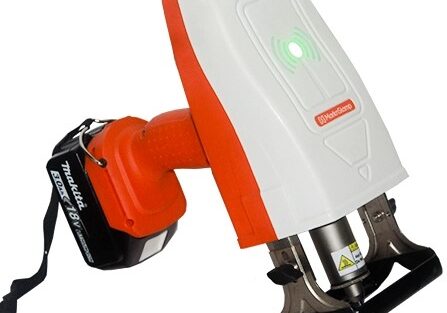
We’ve built pneumatic deep marking machines for fabricators, structural steel shops and heavy engineering plants that blast and galvanize as routine. Alongside the deep marking machine, the MNSBP-145 is a wireless pneumatic dot peen marker that reaches up to 1mm depending on material, so you can take deep marks to parts too big to move.
If your parts are also hard to mark because of the material itself, our post on deep marking hardened metals covers that side of the problem.
Wrapping up
Blasting and galvanizing are designed to change the surface, and a mark that only lives on the surface will go with it. Mark deep, mark big, mark early, and prove it with a trip test on your own steel.
If you’re losing IDs between fabrication and site, talk to our team about a deep marking setup that will hold.
FAQs
Will a dot peen mark survive hot-dip galvanizing?
Yes, if it’s deep enough and the characters are large enough. Zinc fills shallow marks, so use a long-stroke pneumatic dot peen, mark in tenths of a millimetre, and test on your own steel first.
Can laser marks survive sandblasting?
Most can’t. Laser marks on steel are mainly surface contrast, and blasting strips the surface. Deep laser engraving can survive, but it’s slow, so deep dot peen is usually the practical choice.
What is a stamper machine used for?
A stamper machine presses or strikes characters into metal to make a permanent indented mark. Traditional stampers use fixed punches, while modern pneumatic dot peen machines do the same job with programmable text and serials.
How deep can a pneumatic dot peen marking machine mark?
Long-stroke pneumatic machines can reach up to about 1mm on soft steel. Actual depth depends on the material, stylus, force setting and how firmly the part and machine are held.
Should I mark parts before or after galvanizing?
Mark before blasting and galvanizing if the part needs to be tracked through fabrication. Make the mark deep and large, and clean it out before dipping so zinc fills it as little as possible.
Can I mark a 2D code on galvanized steel?
It’s risky. Small Data Matrix cells tend to merge under zinc. Human-readable serials, or a large code with generous cells, are much more reliable on parts that will be galvanized.