By Mark N Stamp | 10 min read
For traceability, pick the method whose mark is still readable at the last station that scans it. Laser marking machines give you the sharpest, fastest Data Matrix codes and suit parts that leave the cell in their final finish. Dot peen gives you a physical dent that survives paint, blasting, heat and rough handling. If your part gets coated or machined after marking, dot peen usually wins. If it doesn’t, laser usually does.
Key insights
- Traceability fails at the reader, not the marker: a mark that looks perfect at the machine can still fail a scan three processes later.
- Laser is the precision pick: small, high-contrast codes, fast cycle times and no consumables, on parts in their final finish.
- Dot peen is the survival pick: the mark is a physical indentation, so a coating covers it rather than erasing it.
- Map the part route first: the processes after marking decide the method, not the material alone.
Before you choose
Take one finished part from the end of your line and try to scan whatever ID it carries today. If it reads first time, your current method is fine. If someone has to wipe it, tilt it or type the number in by hand, you’ve found the real problem the new machine has to solve.
Most comparisons of dot peen and laser stop at speed, cost and depth. Those matter, but they’re not what traceability is about.
Traceability is about one thing: can someone, somewhere down the line, read the mark and pull up the part’s history? That someone might be your own final inspection, your customer’s goods-in team, or a service engineer five years later. The mark has to survive everything that happens to the part between your marking station and their scanner.
So this guide looks at dot peen and laser through that lens. Where does each mark hold up, where does it fade, and how do you pick?
What does traceability actually need from a mark?
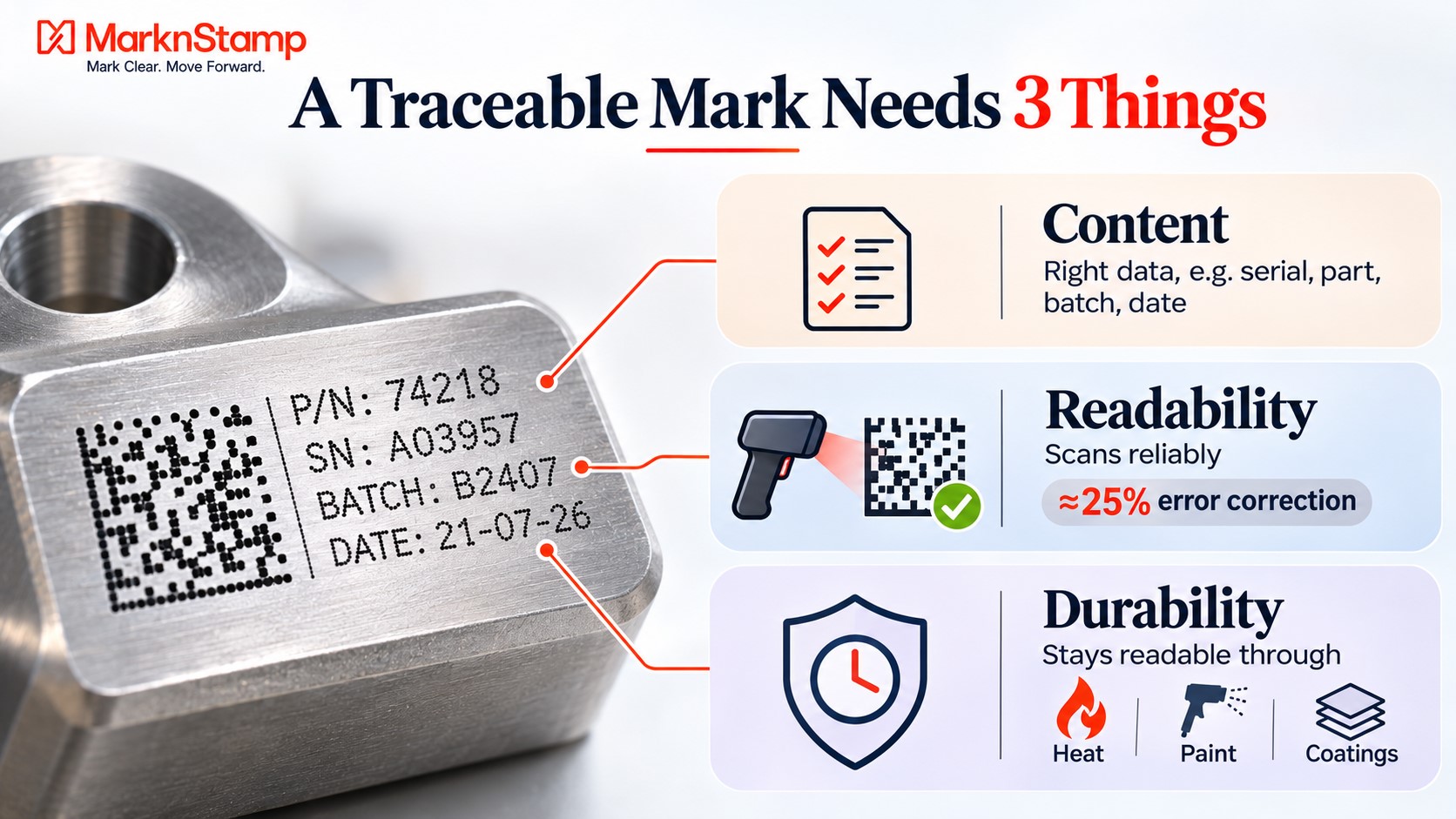
A traceable mark needs three things: it must carry the right data, it must be readable by a scanner or a person, and it must last as long as the part needs tracking. Plenty of marks pass the first two on day one and fail the third.
Content
Most traceability marks carry a serial number, a part number, a batch or heat code, and often a date. Increasingly that’s packed into a 2D Data Matrix code alongside human-readable text, so a scanner and a person can both read it.
Readability
A Data Matrix is forgiving. Its built-in error correction means about 25% of unreadable codewords can be restored without data loss. That buffer is why a slightly scratched code still scans. It isn’t a licence to mark poorly, though. A code that starts weak uses up that buffer before it ever leaves your factory.
Durability
This is where most traceability programmes come unstuck. As Laser Focus World puts it, metal removal, heat treatment, painting and coatings such as rust inhibitors can degrade a mark until it’s unreadable downstream of the marking operation. The mark has to be chosen for the whole route, not for the marking station.
How do dot peen and laser marks differ physically?
They’re made in completely different ways, and that difference decides how each one ages.
| Dot peen | Laser | |
| How the mark forms | A hardened stylus strikes the surface in rapid dots | A focused beam changes, removes or anneals the surface |
| What you’re reading | A physical indentation | A change in colour, contrast or texture |
| Typical depth | Shallow to deep, set by force and stylus | Surface level to shallow engraving |
| Code size | Larger cells, as each cell is a dot | Very small, fine codes possible |
| Consumables | Stylus wears and needs replacing | None for the mark itself |
| Fume extraction | Not needed | Usually needed |
A dot peen mark is a shape
Because each dot is a small crater, the mark has geometry. Paint fills it but doesn’t flatten it. Light grit blasting roughens it but rarely erases it. A scanner with the right lighting can still pick out the pattern of dents under a coating.
A laser mark is mostly contrast
Most laser marks on metal rely on contrast: a dark anneal on stainless, a white mark on anodising, a shallow etch on steel. That contrast is what makes laser codes so crisp and so quick to scan. It’s also what a coating, a blast or heavy machining can wipe out.
Which processes after marking favour dot peen?
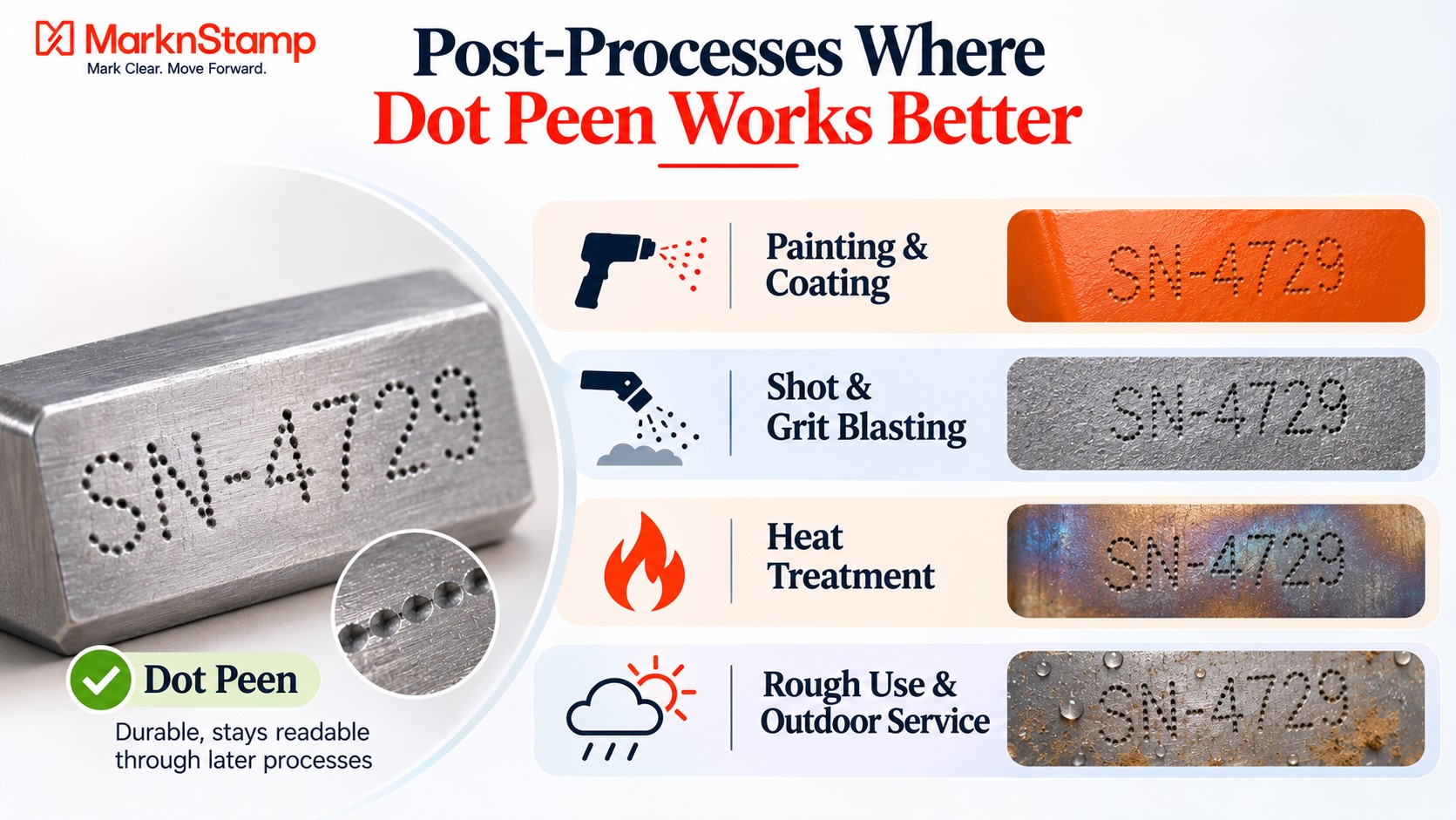
Dot peen is the safer choice whenever the part will be changed after it’s marked. Here are the processes where that matters most.
Painting, powder coating and e-coating
A coating covers a contrast mark completely. A dot peen mark sits under the coating as a readable texture. If the code must be read after painting, mark it with dot peen, or mark it with laser after the paint.
Shot blasting and grit blasting
Blasting is designed to strip and roughen the surface, which is exactly what a laser contrast mark is made of. A deeper dot peen mark gives the blast something it can’t fully remove.
Heat treatment and scale
Scale and discolouration can swamp a laser mark’s contrast. A physical indentation still holds its shape under scale, though it may need cleaning before scanning.
Rough handling and outdoor service
Parts that get dragged, stacked, bolted into equipment and left outdoors for years wear down shallow marks. Deep dot peen holds up far better over a long service life.
Where do laser marking machines win for traceability?
Laser wins when the part is already in its final finish and you need small, high-quality codes quickly. That covers a large share of precision components.
Small parts and small codes
A laser can put a full Data Matrix on a face a few millimetres wide. Dot peen needs bigger cells, so it needs more room.
High-volume lines
Laser marking is fast and non-contact, and it doesn’t wear a stylus. On a line marking thousands of finished parts a shift, that speed and consistency add up.
Finished, sensitive and non-metal parts
Laser leaves no impact force, so it suits thin, delicate or already-machined parts. MOPA, CO2 and UV sources also open up plastics, coatings and other non-metals that dot peen can’t mark cleanly.
Codes that will be graded
If a customer requires your codes to meet a set print-quality grade, laser’s crisp edges and high contrast make a top grade easier to hit, as long as the surface stays as marked.
How do you match the method to your part route?
Write down every process the part goes through after marking, then use this table.
| What happens after marking? | Better choice | Why |
| Nothing, part ships as marked | Laser | Sharpest code, fastest cycle |
| Painted, powder coated or e-coated | Dot peen (or laser after coating) | A coating hides contrast, not shape |
| Shot or grit blasted | Deep dot peen | Blasting strips surface contrast |
| Heat treated | Dot peen, or laser after treatment | Scale swamps contrast |
| Light machining near the mark | Dot peen, marked deep | Depth gives a margin |
| Long outdoor or heavy-duty service | Deep dot peen | Wear removes shallow marks first |
| Tiny parts, small codes needed | Laser | Dot peen cells are too large |
| Thin or delicate parts | Laser | No impact force |
When to mark twice
Some plants run both. A dot peen serial goes on the raw part for in-process tracking, then a laser code goes on after final finish for the customer. It costs an extra station, but it means the part is never untracked.
When to move the marking station
Often the cheapest fix isn’t a new method, it’s a new position on the line. Moving a laser station to after the paint shop can solve a traceability problem without buying anything else.
Which machines fit each approach?
Choose by part size, volume and how the mark is read, then by method.
For laser traceability
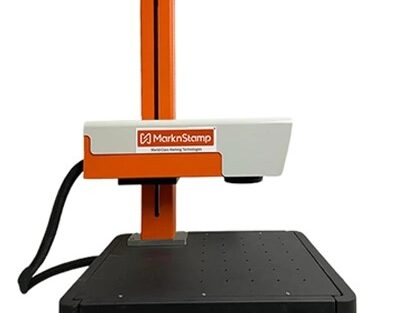
For finished parts in a cell, a self-standing laser such as the Eco-Max offers MOPA power options from 30W to 120W plus CO2 and UV sources, so you can match the source to the material. Where operator safety matters most, an enclosed Class 1 system like the Stallion adds an automatic door and a powered Z axis for parts of different heights. Our guide to matching a laser marking machine to job size goes through the whole range.
For dot peen traceability
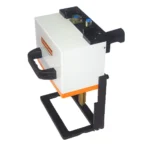
For bench work, the MNS-HTC rigid tabletop machine marks Data Matrix and QR codes, connects to a PC over Ethernet, and takes five inputs for automatic design selection, which makes it easy to tie into a line. For the full side-by-side on speed, cost and maintenance, see our post on the five key differences between dot peen and laser marking.
Not sure which way your parts lean? Send us a sample and a note of what happens to it after marking. Testing on your own parts beats any table.
Why work with Mark N Stamp on traceability?
We build both dot peen and laser marking machines, so we don’t have a reason to push you towards one. That matters on a traceability project, where the right answer often depends on where in the line the mark goes and what happens to the part afterwards.
Our machines are designed and built in India, and our team will test-mark your actual parts, then scan them after your real downstream processes, before you commit.
Wrapping up
Dot peen and laser aren’t rivals so much as tools for different points in a part’s life. Laser gives you speed, precision and beautiful codes on parts that stay as marked. Dot peen gives you a mark that’s still there after the paint, the blast and the years.
Start with the part route, then pick the method. If you’d like help mapping yours, talk to our team and we’ll mark and test your samples.
FAQs
Is laser marking better than dot peen for traceability?
Not always. Laser is better for small, fast, high-contrast codes on parts in their final finish. Dot peen is better when the part is painted, blasted, heat treated or used outdoors after marking, because its physical dents survive.
Can a laser-marked Data Matrix be read after painting?
Usually not. Most laser marks rely on surface contrast, and paint covers it. Either mark the part after painting or use dot peen, whose indentations stay readable as texture under the coating.
Can a dot peen machine mark a Data Matrix code?
Yes. Many dot peen machines, including table top models, mark Data Matrix and QR codes. Because each cell is a dot, codes are larger than laser codes, so the part needs enough flat space.
How much damage can a Data Matrix code take?
About 25% of its codewords can be restored without data loss, thanks to built-in error correction. That margin protects against scratches and dirt, but a code marked poorly at the start uses it up quickly.
Should I mark parts before or after coating?
If you use laser, mark after coating where possible. If you need to mark before coating for in-process tracking, use dot peen, which leaves a physical mark the coating can’t erase.
Do some factories use both dot peen and laser?
Yes. A common setup is a dot peen serial on raw parts for in-process tracking, followed by a laser code after final finish for the customer. That keeps the part traceable through every stage.