
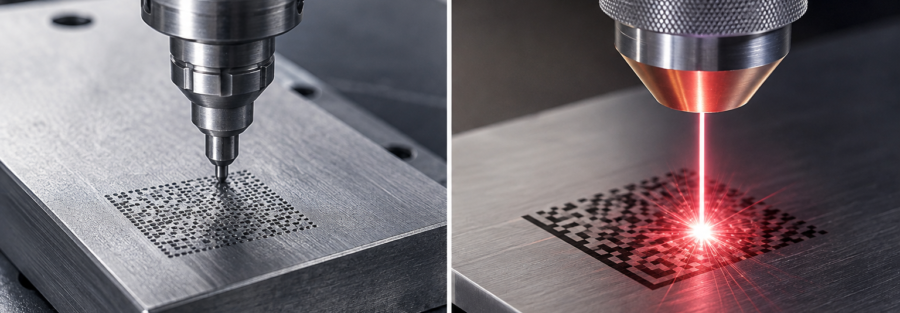
Summary: Dot peen and laser marking differ most in how the mark is created, how deep it goes, how fast it runs, what it costs to maintain, and which materials it suits best. Dot peen physically displaces metal for deep, rugged marks ideal for heavy parts facing coating or sandblasting. Laser marking alters the surface with a focused beam for fine, fast, high-contrast codes ideal for electronics and high-volume production. Neither technology is universally better, the right choice depends on your material, required depth, and production speed.
Buyers comparing dot peen and laser marking usually start by asking which one is “better,” and that’s the wrong question. Both are genuinely excellent technologies, built for different jobs. The right question is which one actually fits your parts.
Here are the five differences that should actually decide your choice.
What are the five key differences?
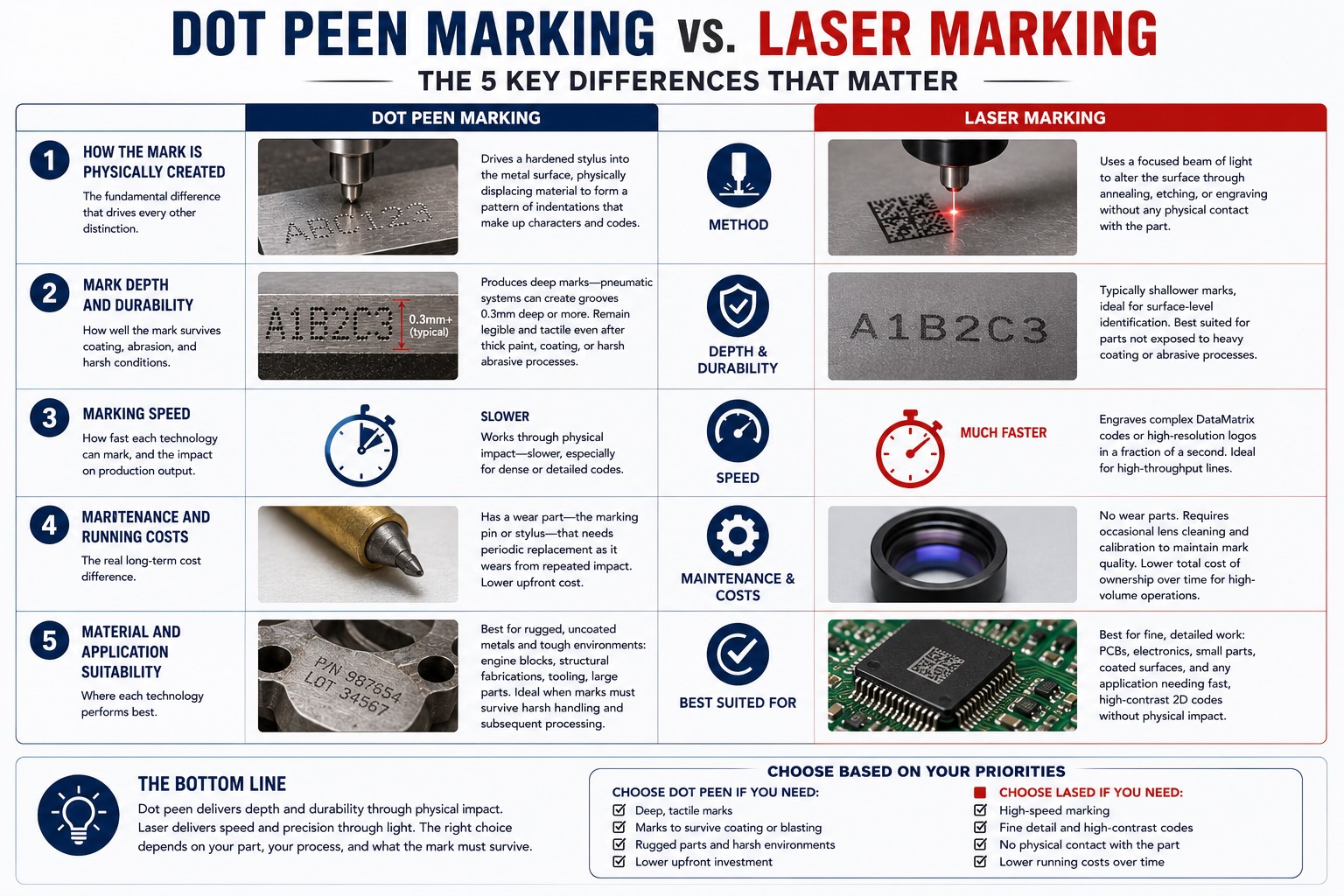
Difference 1: How the mark is physically created
Dot peen marking drives a hardened stylus into the metal surface, physically displacing material to form a pattern of indentations that make up characters and codes. Laser marking uses a focused beam to alter the surface itself, through annealing, etching, or engraving, without any physical contact with the part.
This mechanical difference is the root of almost every other distinction between the two technologies. Dot peen is fundamentally a contact process. Laser marking is fundamentally a light-based one, and that changes everything from mark depth to noise level to maintenance needs.
Difference 2: Mark depth and durability
Dot peen produces genuinely deep marks, a pneumatic dot peen system can forge grooves 0.3mm deep or more, remaining legible and tactile even after a thick layer of paint or a protective coating is applied over it. Laser marks are typically shallower, better suited to surface-level identification than to marks that need to survive heavy coating or abrasive processes afterward.
For parts headed for sandblasting, powder coating, or rough handling, dot peen’s depth is a genuine advantage. For parts needing fine, high-contrast codes that won’t be coated over, laser’s shallower mark is more than sufficient and considerably faster to produce.
Difference 3: Marking speed
Laser marking is substantially faster than dot peen for most applications. A laser can engrave a complex datamatrix code or high-resolution logo in a fraction of a second, which matters considerably on high-throughput production lines where marking speed directly affects overall line output.
Dot peen, working through physical impact, simply can’t match that speed, particularly for dense or detailed codes. On lower-volume or varied-part production, this speed gap matters less. On a fast in-line production process, it can become the deciding factor.
Difference 4: Maintenance and running costs
The two technologies carry genuinely different long-term cost profiles. Dot peen systems have a wear part, the marking pin or stylus, that needs periodic replacement as it wears down from repeated impact. Laser systems have no equivalent wear part, though they do need occasional lens cleaning and calibration to maintain mark quality.
According to industrial marking specialists, dot peen systems are generally more affordable upfront, but a laser system’s total cost of ownership can work out lower over time once the ongoing expense of replacing worn mechanical components is factored in. For high-volume operations running years of continuous marking, that difference in running cost adds up considerably.
Difference 5: Material and application suitability
Dot peen suits rugged, uncoated metal parts, engine components, structural fabrications, tooling, where a physically displaced mark holds up to harsh handling and subsequent processing. Laser marking suits fine, detailed work: PCBs, small components, coated surfaces where physical impact risks damage, and any application needing fast, high-contrast 2D codes.
Here’s how the two compare across the factors that actually matter for choosing between them:
| Factor | Dot Peen | Laser Marking |
| Mark depth | Deep (up to 0.3mm+) | Shallow to moderate |
| Speed | Slower | Fast |
| Best for | Heavy, uncoated metal parts | Fine detail, coated or delicate parts |
| Wear parts | Yes, stylus needs replacement | No, minimal maintenance |
| Upfront cost | Generally lower | Generally higher |
| Ideal environment | Rugged, harsh handling | High-volume, precision production |
So which one should you actually choose?
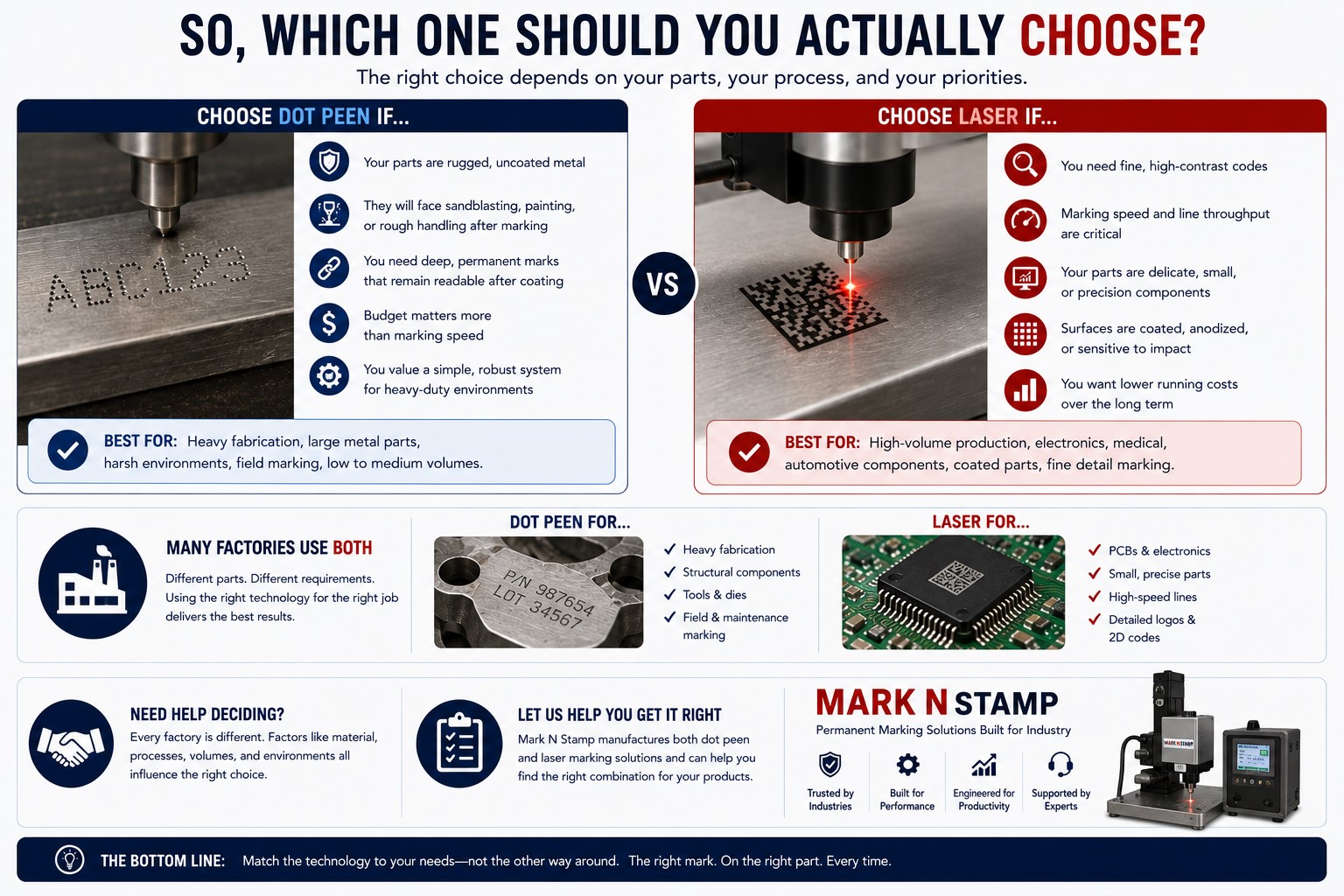
Choose dot peen if your parts are rugged, uncoated metal that will face sandblasting, painting, or rough handling after marking, and budget matters more than marking speed. Choose laser if you need fine, high-contrast codes at high speed, your parts are delicate or coated, or your production line’s throughput depends on fast marking cycles.
Many factories genuinely use both, dot peen for heavy fabrication and field marking, laser for fine, high-volume production identification, rather than forcing every part through one technology. Mark N Stamp manufactures both technologies and can walk through which combination genuinely fits your product range.
Testing both on your own parts
Neither technology is right or wrong in the abstract. The only reliable way to know which suits your specific parts is testing both against your actual material, required depth, and production speed, since a demo on a generic sample tells you far less than a test on your own components.
Mark N Stamp manufactures both dot peen and laser marking systems, and helps buyers test both technologies against their own parts before committing to either.
Frequently asked questions
Is laser marking always better than dot peen? No. Laser marking is faster and better suited to fine detail, but dot peen produces deeper, more durable marks for parts facing heavy coating or rough handling. The better choice depends on your material and application.
Which is cheaper, dot peen or laser marking? Dot peen systems typically cost less upfront, but laser systems can have a lower total cost of ownership over time since they have no wear parts needing regular replacement.
Can dot peen marks survive sandblasting? Yes. Dot peen’s physically displaced, deep marks are specifically suited to surviving sandblasting, powder coating, and other abrasive or coating processes that would remove a shallower surface mark.
Is laser marking suitable for heavy industrial metal parts? Yes, for identification purposes, though dot peen is often preferred when parts will face rough handling or thick coating afterward, since laser marks are generally shallower than dot peen indentations.
Do I have to choose only one marking technology for my factory? No. Many manufacturers run both technologies for different parts of their operation, dot peen for rugged, heavy components and laser for fine, high-volume production marking.
Choosing between dot peen and laser marking comes down to your actual parts, not a general preference for one technology over the other. Talk to our team today and test both technologies on your own components before deciding.