
Summary: A factory needs a marking machine upgrade when mark quality has degraded, downtime has become frequent, the machine can’t keep pace with production volume, replacement parts are getting harder to source, or compliance requirements have outgrown the equipment’s capability. Aging marking equipment is a leading cause of unplanned downtime, and delaying an upgrade past these signs typically costs more in lost production than the upgrade itself. This guide covers the five signs worth acting on.
Most factories don’t replace a marking machine until it actually breaks down mid-shift. That’s usually the most expensive way to make the decision, since the cost of unplanned downtime almost always exceeds the cost of a planned upgrade.
Here are the five signs worth acting on before that happens.
What are the five signs to watch for?
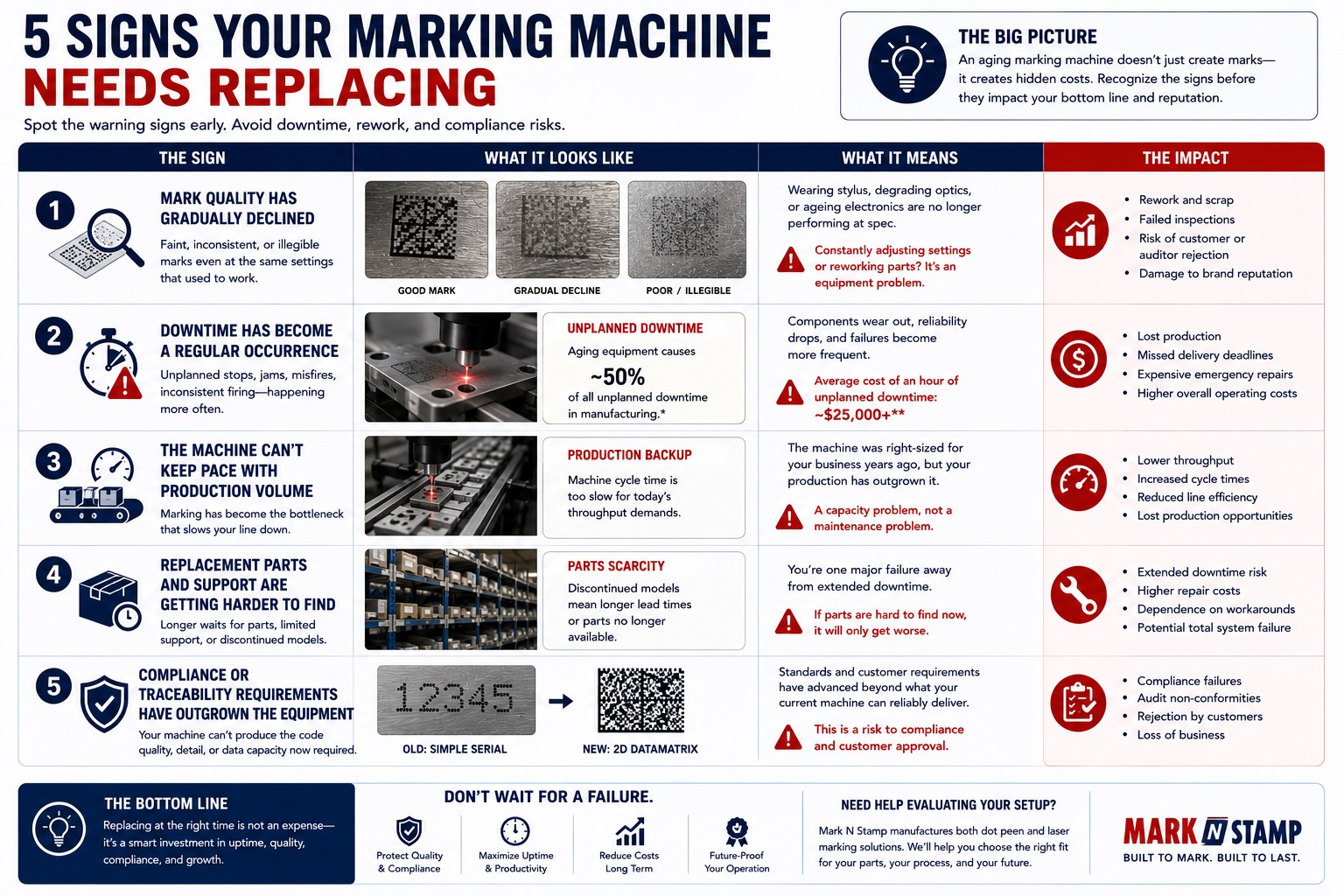
Sign 1: Mark quality has gradually declined
A marking machine producing faint, inconsistent, or illegible marks at the same settings that used to work cleanly is telling you something specific: a wearing stylus, degrading optics, or ageing electronics are no longer performing at spec. This decline is usually gradual, which is exactly why it’s easy to miss until a customer or auditor flags a batch of unreadable codes.
If you’re increasingly adjusting settings just to get an acceptable mark, or reworking parts that fail inspection, that’s not a settings problem anymore. It’s an equipment problem.
Sign 2: Downtime has become a regular occurrence
Unplanned stops at a marking station, jams, misfires, inconsistent firing, are one of the clearest signs equipment is reaching the end of its reliable working life. This isn’t a minor inconvenience industry-wide either. Aging equipment is the leading cause of unplanned downtime in manufacturing, accounting for roughly half of all unplanned stops according to industry surveys, and that downtime carries a real cost well beyond the marking station itself.
The financial impact adds up faster than most factories realise. The average cost of an hour of unplanned downtime is now estimated around $25,000, and can run considerably higher for larger operations, a figure that reframes an upgrade from an expense into a genuine cost-avoidance decision.
Sign 3: The machine can’t keep pace with production volume
A marking station that was sized for your production volume five years ago may simply be too slow for today’s throughput. When marking becomes the bottleneck that slows an otherwise capable production line, that’s a capacity problem no amount of maintenance will fix, since the machine is working as designed, just for a scale of operation you’ve since outgrown.
This is particularly common in growing operations that scaled other parts of their line, faster assembly, more automation, without revisiting whether the marking station scaled alongside it.
Sign 4: Replacement parts and support are getting harder to find
An older machine that’s been discontinued, or whose manufacturer no longer stocks parts readily, puts you one failure away from extended downtime while a part is sourced or fabricated. This risk compounds over time as equipment ages further and parts become scarcer.
If your last few service calls have involved longer waits for parts, or a technician mentioning the model is “getting hard to source components for,” that’s a direct signal the equipment’s practical lifespan is running out, regardless of whether it’s still technically functioning today.
Sign 5: Compliance or traceability requirements have outgrown the equipment
Regulatory and customer traceability requirements tend to tighten over time, not loosen. A marking machine bought to produce a simple serial number may not have the resolution, consistency, or data capacity to produce the dense 2D datamatrix codes now required for full traceability compliance in automotive, aerospace, or medical device supply chains.
If a customer or auditor has recently asked for a level of code detail or consistency your current equipment struggles to deliver reliably, that’s not a training or process issue. It’s a sign the equipment itself has been outpaced by what the job now requires.
What Should You Actually Do Once You Recognise These Signs?
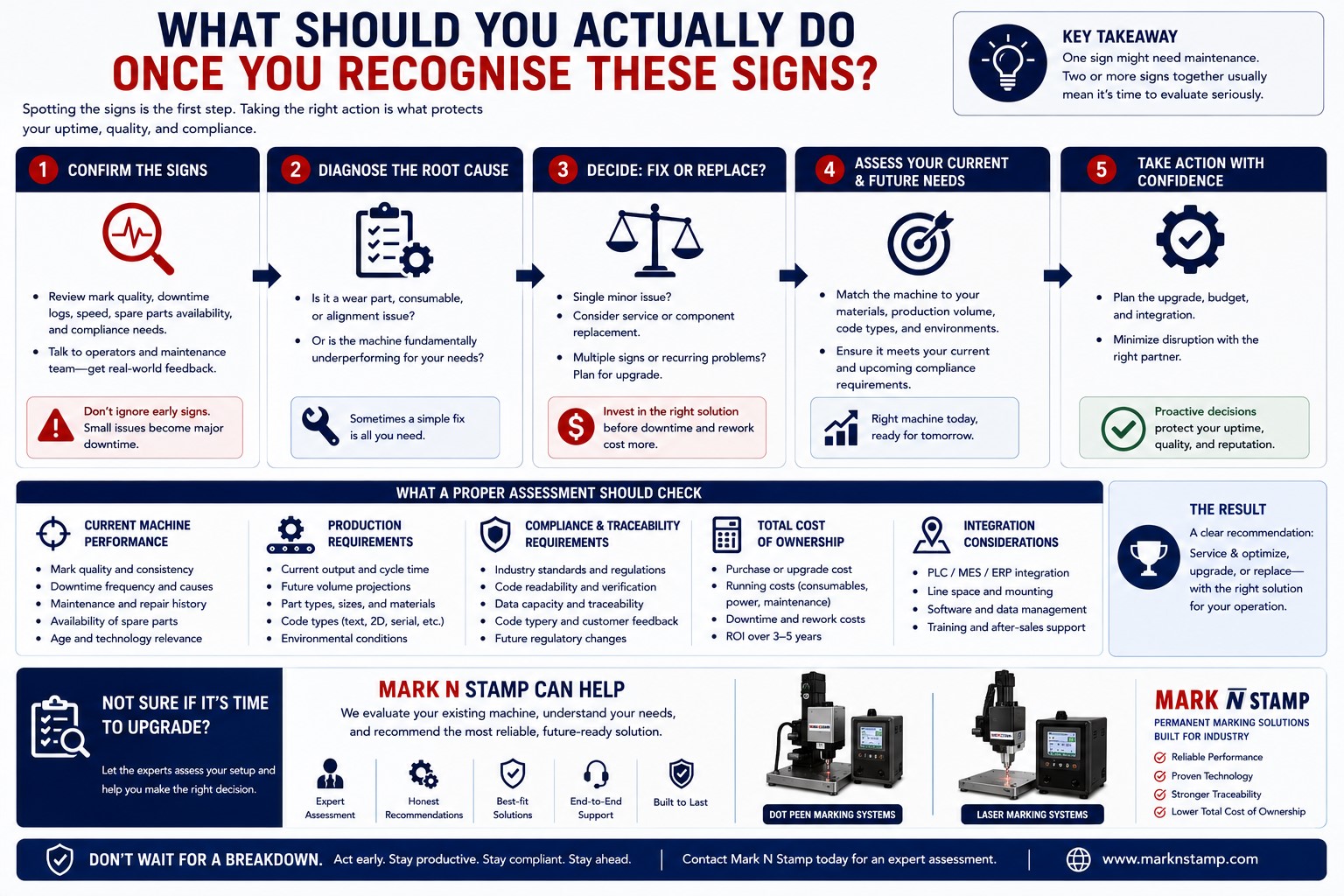
Recognising one of these signs doesn’t necessarily mean an immediate, full replacement. Sometimes a service, recalibration, or component replacement genuinely resolves the issue. But two or more signs appearing together, declining quality plus more frequent downtime, for instance, usually points toward genuine end-of-life rather than a fixable maintenance gap.
A proper assessment against your current production volume, material, and compliance requirements is the right next step, rather than guessing based on how the machine feels day to day. Mark N Stamp offers this kind of assessment directly, checking whether an ageing machine is genuinely at end of life or simply due for service.
Planning an Upgrade Without Disrupting Production
Mark N Stamp helps factories assess whether an ageing marking machine genuinely needs replacement or can be serviced back to reliable performance, matching any upgrade to actual current production volume and compliance requirements rather than selling a bigger machine than necessary.
Reviewing the full range of marking machines available against your current production needs is a useful starting point before committing to a specific upgrade path.
Frequently asked questions
How do I know if my marking machine needs repair or full replacement? If issues are isolated, one worn part, one setting problem, repair is usually sufficient. If you’re seeing two or more signs together, declining quality, frequent downtime, capacity limits, replacement is typically the more cost-effective long-term decision.
How much does unplanned marking machine downtime actually cost? Industry estimates put the average cost of an hour of unplanned manufacturing downtime around $25,000, though this varies significantly by operation size and how central the marking station is to the overall production line.
Can an old marking machine be upgraded instead of replaced? Sometimes, if the core mechanism is sound and only the controller or software is outdated. But if wear parts, optics, or electronics have degraded significantly, replacement usually offers better long-term reliability than repeated servicing.
What’s the first sign a marking machine is nearing end of life? Gradually declining mark quality at previously reliable settings is usually the earliest sign, often appearing well before the machine experiences an outright failure or breakdown.
Should I upgrade before or after a compliance audit flags an issue? Before, if at all possible. Addressing declining mark quality or capacity proactively costs considerably less than scrambling to replace equipment after a failed audit or a rejected batch of parts.
If any of these five signs sound familiar, that’s worth a proper assessment now rather than waiting for a breakdown to force the decision. Talk to our team today about evaluating your current marking equipment against your actual production and compliance needs.