Summary: A portable dot pin marking machine is chosen by four things, marking window, how it is controlled, how long the battery lasts, and whether it needs compressed air. The MNSB-53 and MNSB-155 cover standard battery-operated portable marking. The MNSB-TC adds a built-in 7 inch touch screen so no laptop is needed. The MNSBP-145 is wireless pneumatic, with a 140mm x 50mm window and 4 to 6 hours of battery life for deep marking away from an air supply. Match the machine to the part size and the operator’s working conditions, not to the spec sheet with the most features.
Portable dot peen machines all look broadly similar in a catalogue. A handle, a marking head, a cable, a case.
On the floor they behave nothing alike. One needs a laptop balanced on a crate. One runs a whole shift and one does not. One will mark a rough casting at height and the others will struggle.
This is a straight comparison of four portable machines and the specific job each one is actually built for.
What separates one portable dot pin machine from another?
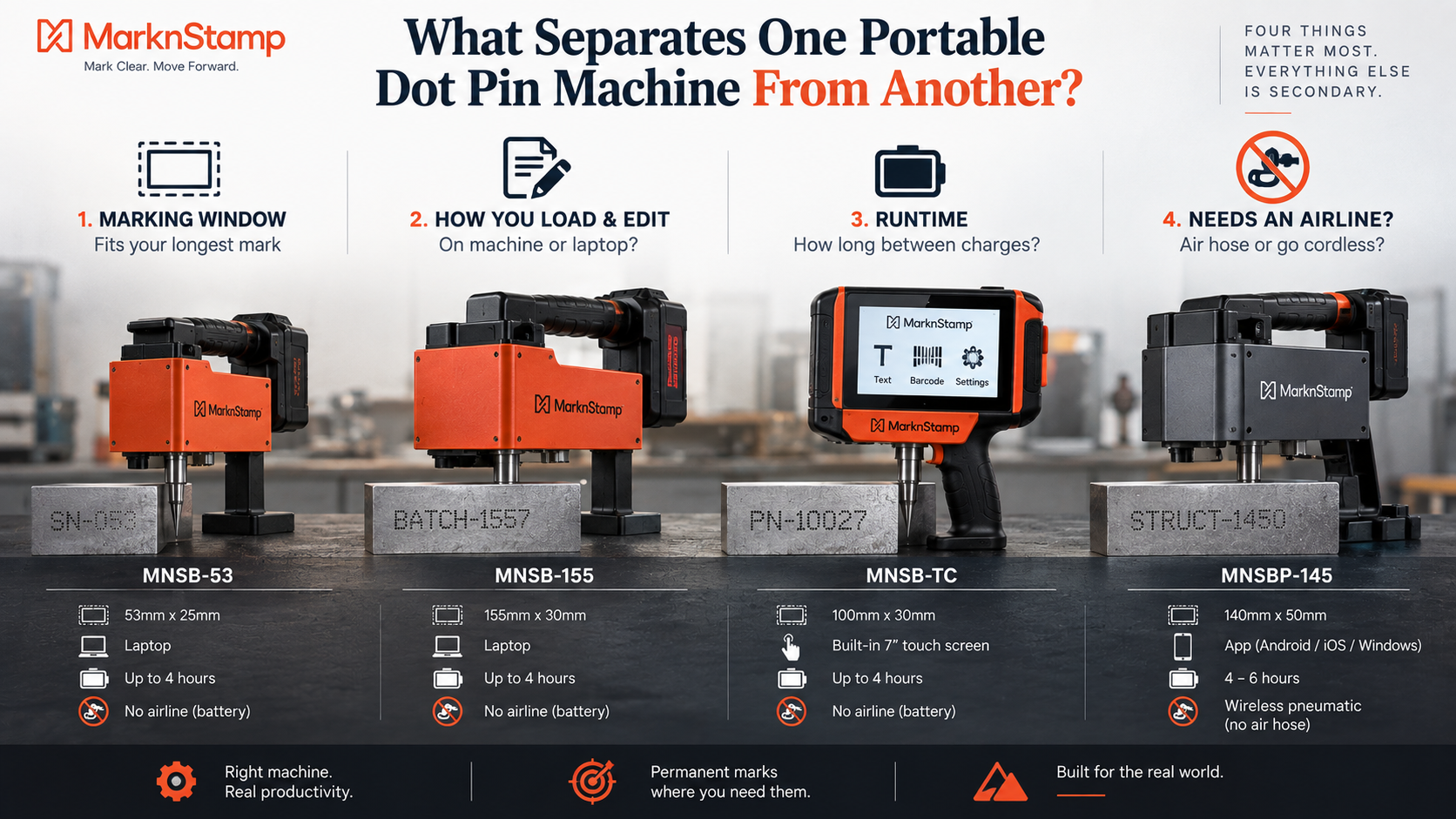
Four things, in this order: the size of the marking window, how the operator loads and edits content, how long the machine runs between charges, and whether it needs an airline. Everything else on a specification sheet is secondary to those four.
Window size is the hard constraint. A 100mm x 30mm window cannot mark a 140mm serial string in one pass, no matter how good the machine is. Start there and you eliminate half the options before you look at anything else.
Control method is the one buyers underrate. A machine that needs a laptop means someone carries a laptop, finds a surface for it, and keeps it charged. That is fine at a bench and genuinely miserable up a ladder.
The battery-operated portable range: MNSB-53 and MNSB-155
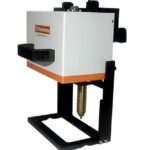
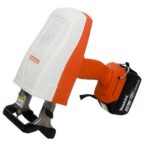
The MNSB-53 and MNSB-155 are the standard battery-operated portable machines, built for permanent marking on parts that cannot come to a marking station. They are the default choice for serial numbers, batch codes and identification marks on accessible metal surfaces.
These are the workhorses of the range. If your marking is routine, your parts are reachable, and you do not need a screen built into the machine itself, this is where most buyers land. Details on window sizes and stylus options for the battery operated portable machines are worth confirming against your longest character string before ordering.
MNSB-TC: the one with the screen built in
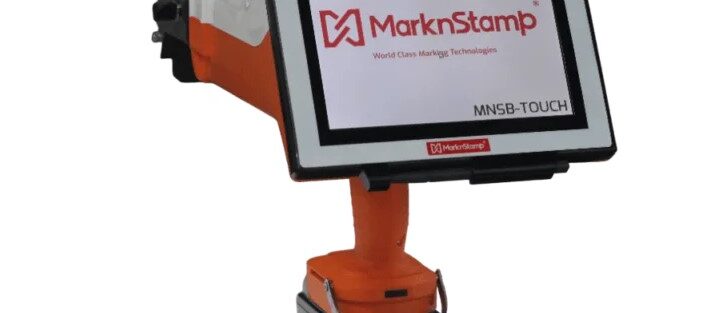
The MNSB-TC is a cordless handheld machine with a 7 inch resistive touch screen integrated into the marking head, so no computer is needed at all. It marks a 100mm x 30mm window, weighs 4.7kg, and runs a lithium battery rated for up to 4 hours of normal working.
The touch screen is the whole point. Content is created, edited and selected on the machine itself, running a Linux-based system with 512MB of storage and an inbuilt launcher application. A USB interface takes a keyboard and mouse, and it supports barcode scanning to import content directly, which removes the most common source of marking errors, someone retyping a serial number by hand.
Two details that matter in daily use:
- Nine force settings to adjust depth, so the same machine can mark thin sheet and solid bar without a stylus change
- A glass-filled nylon, shatterproof body, because portable machines get dropped
For teams marking varied parts across a site, the touch screen handheld machine removes the laptop from the workflow entirely.
MNSBP-145: wireless pneumatic
The MNSBP-145 is the only machine in this group that gets pneumatic force without an air hose. It marks a 140mm x 50mm window, achieves depth up to 1mm depending on material, and runs 4 to 6 hours on its lithium-ion battery, controlled through an app on Android, iOS or Windows.
Mark N Stamp introduced it as the first wireless pneumatic dot peen marker of its kind. This is the machine for deep marking in places a compressor cannot follow. Structural steel on site, pipeline sections, installed plant, large fabrications in a yard.
It also has the largest window of the four, which quietly matters. Long identification strings on big components are exactly the marks that get split across two passes on a smaller machine, and a split mark is a mark that fails a scan.
How long does the battery actually last in practice?
Rated battery life assumes normal working, not continuous marking, so a machine rated for 4 hours will run a full shift of intermittent marking and considerably less under constant use. Deep marks on hard material draw more power per character than light marks on aluminium.
The batteries themselves are standard 18V DC tool packs. The MNSB-TC ships with a 3Ah cell, with 5Ah and 6Ah options in the same physical size and a 9Ah option in a larger body.
Worth planning for: lithium-ion cells lose usable capacity over charge cycles and with calendar ageing, so a machine bought three years ago will not hold the runtime it did when new. Budget for a spare pack rather than a replacement machine.
Which machine handles 2D codes and scanning reliably?
All of these machines mark Data Matrix codes, but code legibility depends far more on dot spacing and contrast than on which machine produced it. Set the dot pitch so individual dots stay distinct rather than merging into a solid line.
There is useful margin built into the format itself. Data Matrix ECC 200 codes use Reed-Solomon error correction, which is why a code with some damage or partial wear still reads. That margin is designed to survive service life, not to compensate for a mark that was poor on day one.
If codes will be scanned by a fixed reader downstream, test the actual reader against the actual mark before committing to a dot pitch.
Which one is right for your parts?
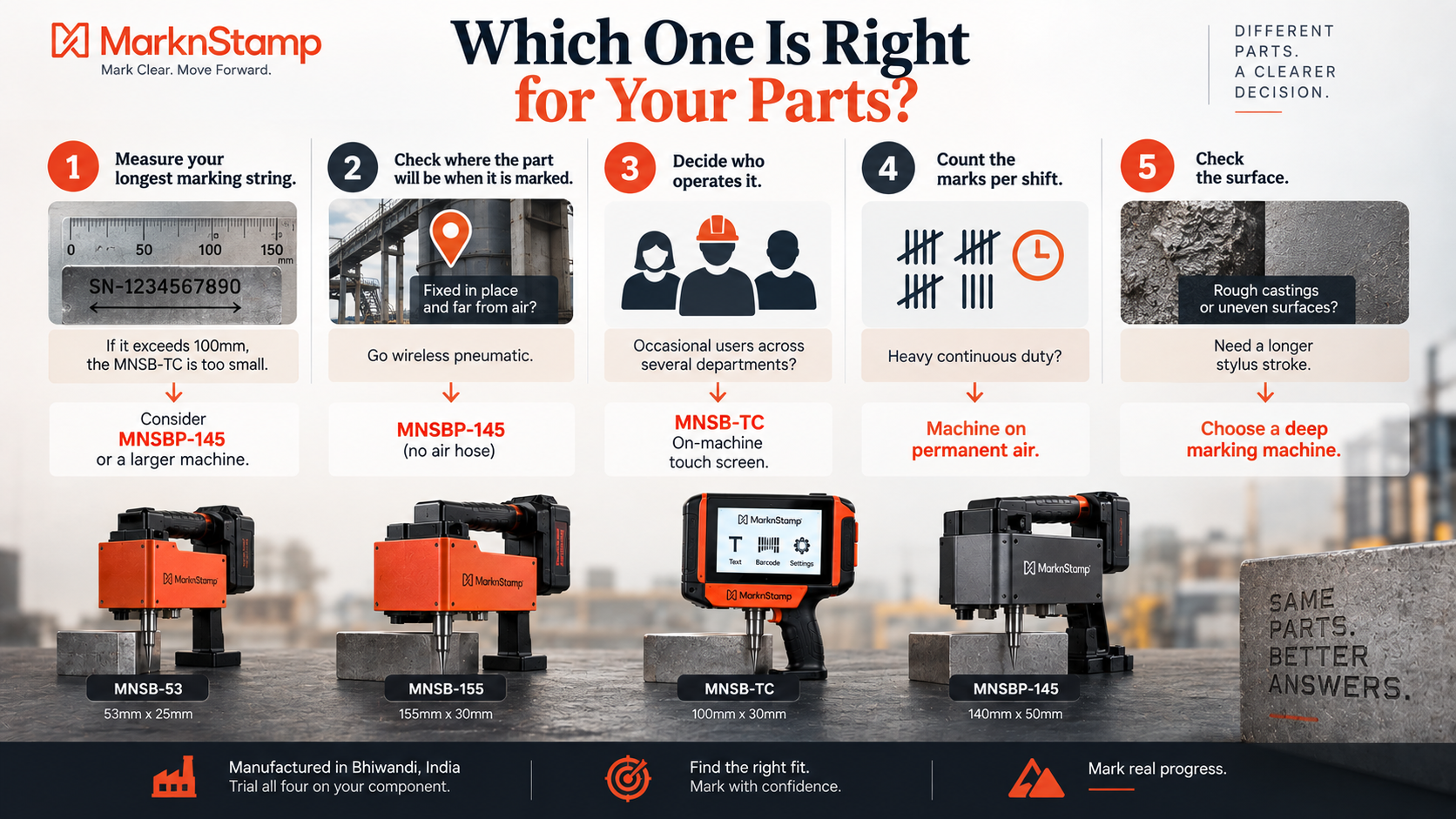
Work through it in this order:
- Measure your longest marking string. If it exceeds 100mm, the MNSB-TC window is too small and you are looking at the MNSBP-145 or a larger machine.
- Check where the part will be when it is marked. Fixed in place and far from air means wireless pneumatic.
- Decide who operates it. Occasional users across several departments do far better with an on-machine touch screen than with laptop software.
- Count the marks per shift. Heavy continuous duty points back towards a machine on permanent air.
- Check the surface. Rough castings need a longer stylus stroke than any standard portable provides.
Mark N Stamp manufactures the full portable range from its Bhiwandi plant, which means a trial can put all four machines against the same component instead of comparing one machine against a brochure.
Frequently asked questions
What is the difference between dot pin marking and dot peen marking? Nothing substantive. Dot pin, dot peen and micropercussion all describe the same process, a stylus striking the surface repeatedly to form characters from indentations. The terms are used interchangeably across the industry.
How long does a portable dot pin machine battery last? Around 4 to 6 hours of normal working, depending on the model and how deep the marks are. Continuous deep marking on hard material drains a pack considerably faster than intermittent light marking.
Can a portable dot pin marking machine mark curved surfaces? Yes, within limits. Gently curved surfaces mark well with a front fixture, while heavily uneven or cast surfaces need a machine with a longer stylus stroke designed for surface irregularity.
Do I need a laptop to run a portable marking machine? Not with a touch screen model. The MNSB-TC has a 7 inch screen built into the head, and other machines in the range can be driven from a mobile, tablet or laptop through the launcher app instead.
Which portable machine has the largest marking window? The MNSBP-145, with a 140mm x 50mm window. That extra width matters for long serial or part-number strings, which would otherwise need two separate passes on a smaller machine and risk a misaligned join.
Portable marking machines are bought on features and regretted on ergonomics, so the machine that suits your longest string, your roughest part and your least experienced operator is the one worth trialling. Check the full product range and bring your own components for a marking trial.