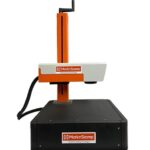
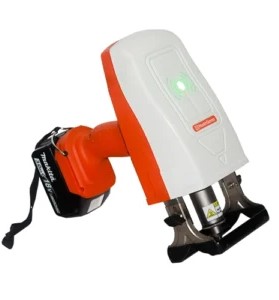
Summary: A manual stamper machine setup, hammer and steel letter punches, costs almost nothing to buy and a great deal to run. Every mark depends on the operator, character alignment drifts, the impact deforms thin parts, and a die set has to be stored, found and maintained. A powered marker such as the Simple Marker replaces the die inventory with a file, holds alignment automatically, and connects over its own Wi-Fi hotspot so no computer is needed. The upgrade is usually justified by rejects and operator time, not by marking speed.
Steel hand stamps have marked parts for more than a century, and plenty of workshops still use them daily. There is nothing wrong with that until volume, traceability or a customer audit turns up.
Then the same three problems appear in the same order. The marks are inconsistent. Nobody can find the 4mm die set. And a component that was fine before marking is now scrap.
Here is what actually changes when a manual stamping bench is replaced with a powered marker, and how to work out whether it is worth doing.
What does a manual stamper machine actually cost to run?
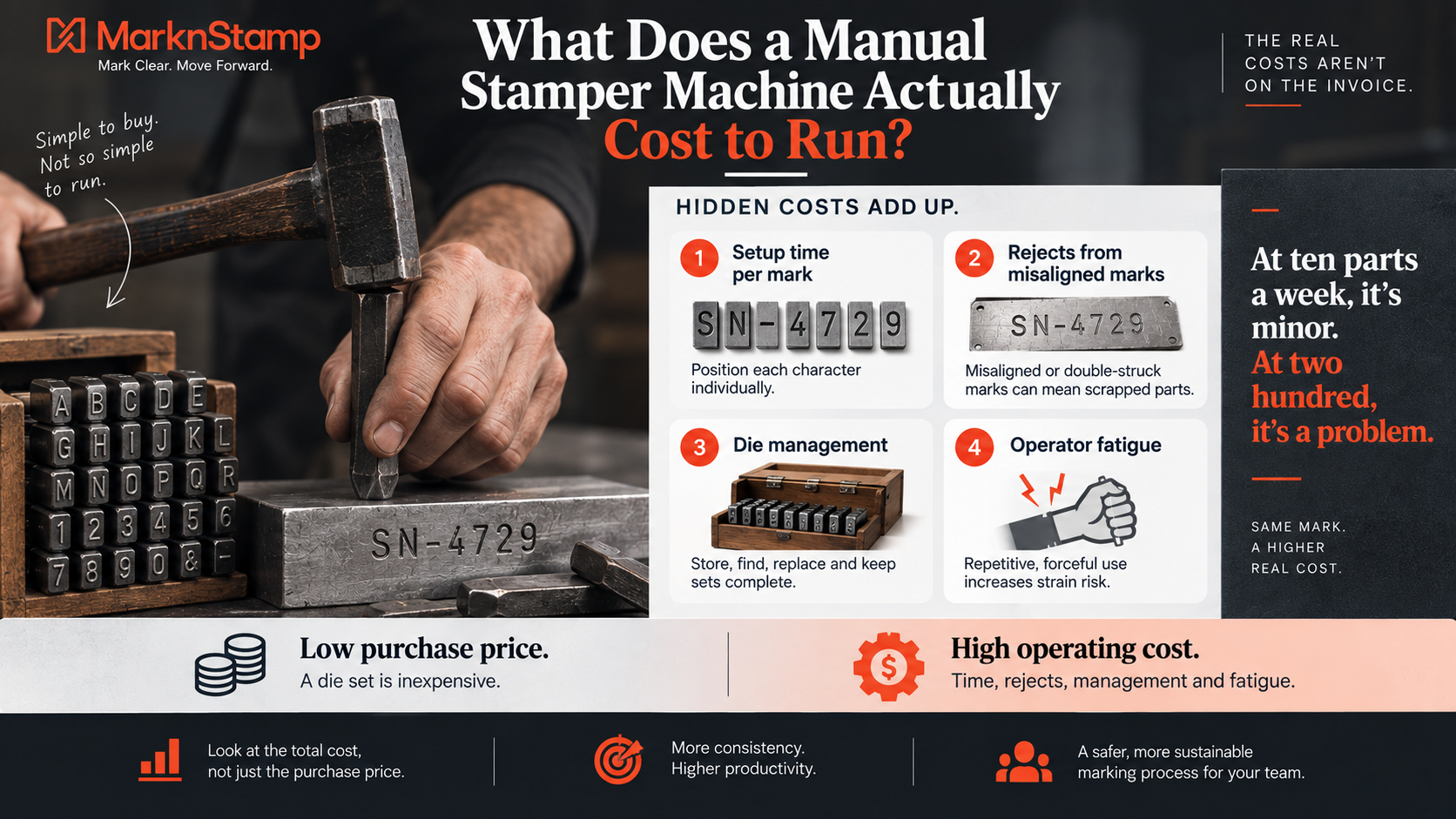
Very little to buy and a lot to operate. The purchase price of a die set is trivial, but each mark consumes operator time, alignment is done by eye, and every strike is a hand-swung impact whose force is never twice the same.
The costs that do not appear on any invoice:
- Setup time per mark, positioning each character individually for a multi-character string
- Rejects from misaligned or double-struck characters, which on a finished part means scrapping the part, not the mark
- Die management, storing, finding, replacing and keeping sets complete across sizes
- Operator fatigue, since repetitive forceful hand tool use is a recognised strain risk and tool weight and load distribution directly affect how long an operator can work accurately
None of these matter at ten parts a week. All of them matter at two hundred.
Why does hand stamping damage some parts?
Because a hammer strike concentrates a large force into a very small area with no control over how much. On thin-wall, hardened or heat-treated components, that concentrated deformation can create a notch that behaves as a stress raiser.
This is well understood in engineering terms. Stress concentration describes how an abrupt change in geometry raises local stress well above the nominal level in the surrounding material, which is exactly why marking placement on critical components is controlled by drawings rather than left to the operator.
A controlled-force dot peen or pneumatic marker addresses this by making the force a setting rather than a swing. The mark still displaces material, but by a known, repeatable amount that can be qualified once and then trusted.
If your parts are thick, uncritical and uncoated, this may never affect you. If they are thin, hardened or safety-related, it is the main reason to move off hand stamps.
What does the Simple Marker change?
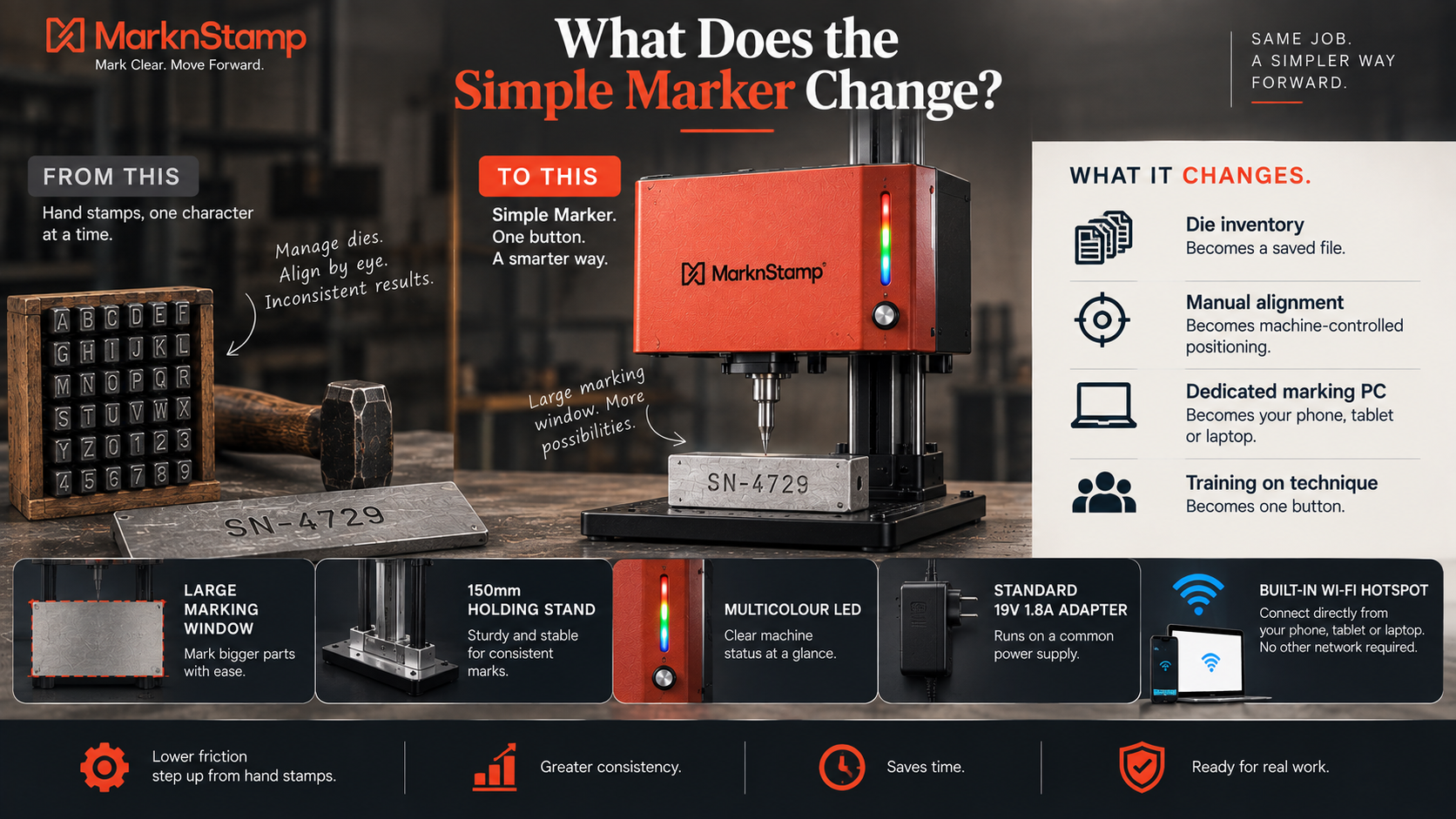
The Simple Marker is a sturdy pneumatic machine with a large marking window, a 150mm holding stand and a multicolour LED that indicates machine status. It runs from a standard 19V 1.8A adapter and is operated with a single button for all operations.
Mark N Stamp builds it as the simplest powered marker in its table top range. The detail that surprises people is connectivity. The machine creates its own Wi-Fi hotspot, so a phone, tablet or laptop connects directly to it with no other network required. That matters in a workshop with no IT support and no spare network points.
What that combination replaces:
- The die inventory becomes a saved file
- Manual character alignment becomes machine-controlled positioning within the window
- A dedicated marking PC becomes whatever device the operator already carries
- Training on stamping technique becomes one button
Accessory drawings are available for download, so fixtures can be prepared before the machine arrives. For a workshop moving off hand stamps, the Simple Marker is the lowest-friction step up because it does not introduce a computer into a process that never had one.
When should you skip it and go straight to a table top machine?
Go straight to a full table top machine if you need 2D codes, multiple axes, or integration with anything else. A rigid table top machine marks a 120mm x 100mm area, comes in electric and pneumatic versions, and is a default 2-axis machine convertible to 3 or 4 axes.
The features that pull buyers up a level are specific:
- Datamatrix and QR code marking, which manual stamping cannot do at all
- Ethernet connection to a PC, for barcode scanning, printing and integration with other machines
- Five inputs for automatic design selection, so the right file is chosen by the fixture rather than by the operator
- Angled and circular marking patterns, alongside straight-line text and logos
If a customer has asked for scannable traceability, that request alone decides it. The rigid tabletop machine is the practical answer rather than the entry-level marker.
How do you justify the change internally?
Count rejects and operator minutes for two weeks before you build a case. Those two numbers carry more weight with a finance team than any specification comparison, because they are already costing money that nobody has attributed to marking.
A workable rough calculation: marks per week, multiplied by minutes per mark, plus rejected parts per month multiplied by part value. Compare that annual figure against the machine cost. Most workshops running more than a couple of hundred marks a week find the answer obvious.
Mark N Stamp manufactures both the entry-level markers and the full table top range at its Bhiwandi plant, and advises buyers to bring sample components for trial marking before committing, which is the only reliable way to see what the change does to your own parts.
Frequently asked questions
Is a stamper machine the same as a dot peen machine? No. A stamper machine presses or strikes a shaped die into the surface to form a whole character at once, while a dot peen machine forms each character from a series of small indentations made by a moving stylus.
Can hand stamping damage a component? It can, on thin, hardened or safety-critical parts. An uncontrolled hammer impact can leave a deeper notch than intended, which acts as a stress raiser in a component that is loaded in service.
Does a powered marker need a computer to run? Not necessarily. The Simple Marker creates its own Wi-Fi hotspot and is operated from a phone, tablet or laptop, and touch screen machines have the interface built into the machine itself.
How many characters can a powered marker do at once? As many as fit the marking window in a single pass, positioned automatically. That is the practical difference from hand stamping, where each character is aligned and struck individually by the operator.
What do I need before switching from hand stamps? A sample of your most awkward part, your longest character string, and your reject count from the last month. Those three pieces of information make both the marking trial and the internal business case straightforward to put together.
Hand stamps are cheap right up to the point where rejects and operator time start costing more than the machine would. Check the marking machine range and bring your components in for a trial before you decide which level you actually need.