Summary: Laser marking machines use a focused beam of light to create permanent, high-contrast marks on metal and other materials without touching the surface. Industries prefer them because they are fast, precise, low-maintenance, and produce marks that never fade, rub off, or corrode. For any business that needs a reliable engraving machine for metal, laser marking delivers cleaner results, lower running costs, and full traceability compared with older mechanical or ink methods.
If you have ever tried to read a smudged serial number or a barcode that has half worn away, you already understand why permanent marking matters.
In manufacturing, a mark that fails is not just untidy. It breaks traceability, fails audits, and can halt a shipment.
That is exactly the problem laser marking was built to solve, and it is why factories across automotive, aerospace, medical, and general engineering keep switching to it.
How does a laser marking machine work?
A laser marking machine works by directing a concentrated beam of light onto a surface, where the heat alters the material to create a permanent mark. Depending on the settings, it can engrave, etch, anneal, or discolour the surface without any physical contact, ink, or consumables.
There is no drill bit, no stylus, and no ink cartridge involved. The beam does all the work.
Because nothing touches the part, there is no tool wear and no distortion of thin or delicate components. That single difference, non-contact marking, is the root of most of the benefits that follow.
It also explains why a laser is such a versatile engraving machine for metal, plastic, and coated surfaces alike, from stainless steel to anodised aluminium.
What are the main benefits of laser marking machines?
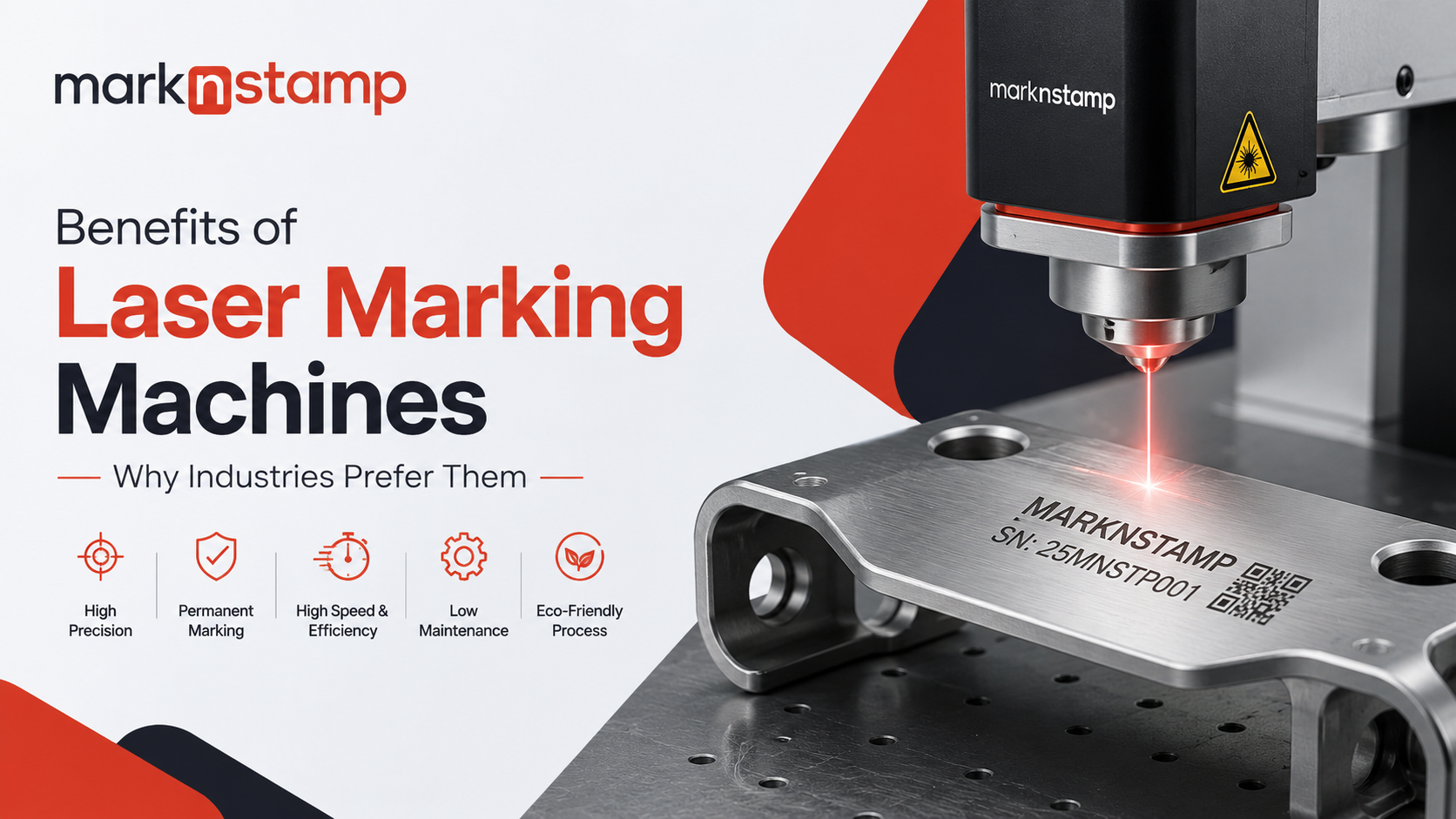
The main benefits of laser marking machines are permanence, speed, precision, low running cost, and zero consumables. Marks resist heat, chemicals, and abrasion, which makes them ideal for parts that must stay identifiable for their entire working life.
Here is what industries value most:
- Permanent marks: they cannot be rubbed off or corroded away, so traceability survives the harshest environments.
- High speed: a serial number or QR code can be marked in under a second, keeping production lines moving.
- Fine precision: intricate logos, tiny data-matrix codes, and micro-text stay sharp and readable.
- No consumables: no inks, acids, or labels to buy, store, or dispose of.
- Low maintenance: solid-state fibre sources run for tens of thousands of hours with little upkeep.
The cost angle is striking too. In one automotive study, laser marking worked out at about $0.02 per mark versus $0.07 to $0.09 for ink or labels.
Over millions of parts, that gap turns into serious savings, which is a big reason procurement teams favour it.
Laser marking vs dot peen and inkjet: which is better?
Laser marking is better for permanent, high-detail, high-speed marking, while dot peen suits deep marks on rough or thick metal and inkjet suits fast, low-cost temporary marking. The right choice depends on the material, the depth needed, and how long the mark must last.
None of these methods is universally “best”. They solve different jobs.
| Method | Mark type | Best for | Consumables |
| Laser | Permanent, fine detail | Serial numbers, QR codes, logos on metal | None |
| Dot peen | Deep, indented | Heavy parts, VIN plates, rough surfaces | None |
| Inkjet | Surface print | Fast temporary coding, packaging | Ink |
For deep mechanical impressions on castings, a robust dot peen marking machine still earns its place.
But when you need crisp, permanent detail at speed, an engraving machine laser system wins on quality and running cost. Many plants actually run both, matching each machine to the part in front of it.
What are the advantages of fiber laser marking specifically?
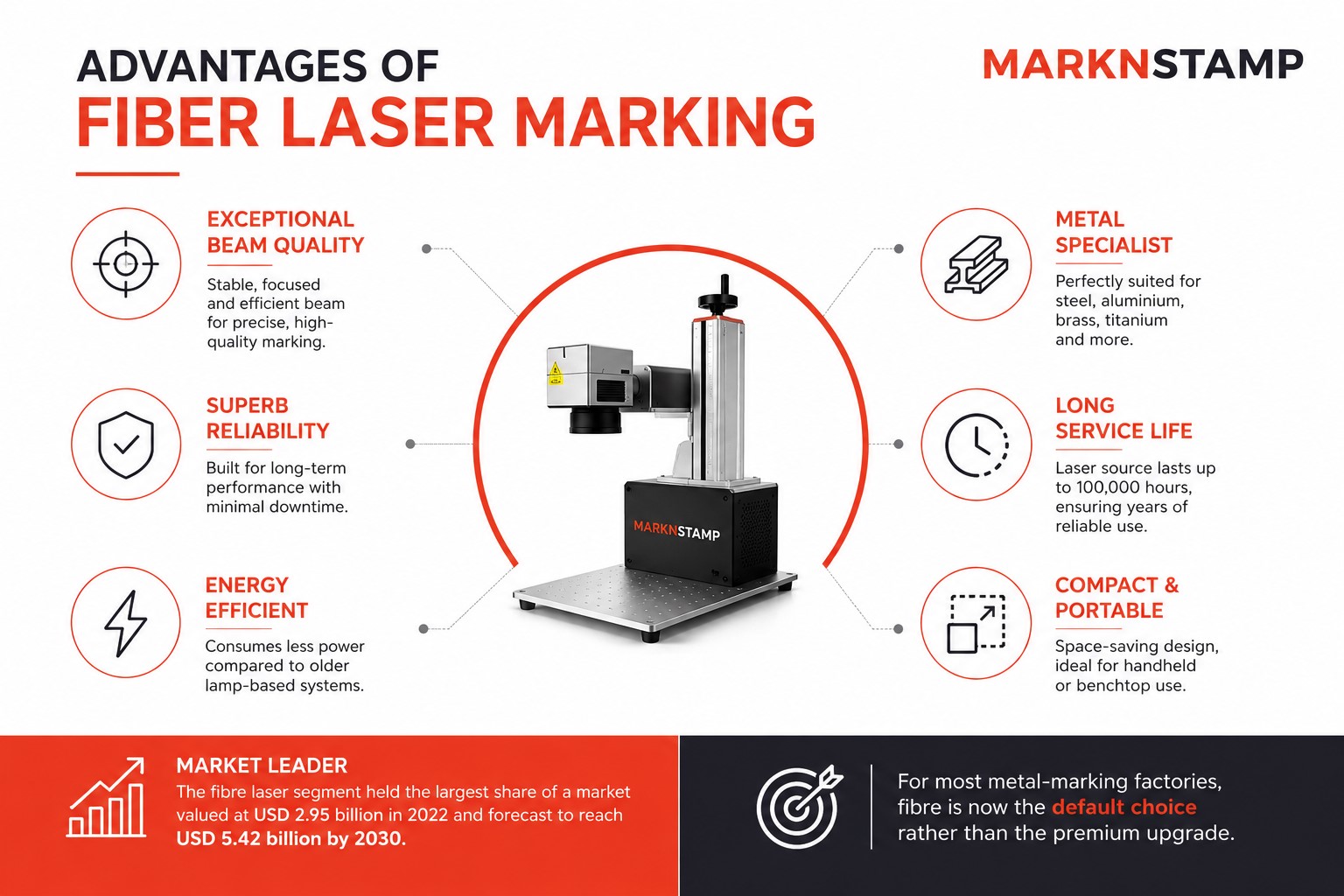
Fiber laser marking advantages include exceptional beam quality, high marking speed, superb reliability, and near-zero maintenance, which is why fibre lasers now dominate metal marking. The fibre laser segment held the largest share of a market valued at USD 2.95 billion in 2022 and forecast to reach USD 5.42 billion by 2030.
Fibre lasers generate their beam inside an optical fibre, which keeps the light stable, focused, and efficient.
That translates into practical wins on the shop floor:
- Metal specialist: fibre wavelengths are absorbed brilliantly by steel, aluminium, brass, and titanium.
- Long service life: the source typically lasts 100,000 hours, so downtime is rare.
- Energy efficient: it draws less power than older lamp-based systems.
- Compact and portable: many units are small enough for handheld or benchtop use.
For most metal-marking factories, fibre is now the default choice rather than the premium upgrade.
Which industries use laser marking machines and why?
Industries that rely on laser marking include automotive, aerospace, medical devices, electronics, and general metal engineering, all of which need permanent, traceable marks that survive tough conditions. Regulatory traceability and part authentication are the common drivers.
A few concrete examples make it clear.
In automotive, engine and chassis components carry laser-marked VINs and part codes that must remain legible after years of heat, oil, and vibration. In medical devices, surgical instruments are laser-annealed with codes that survive repeated autoclave sterilisation without corroding.
Aerospace parts face extreme temperature swings and friction, yet the mark has to outlast the component. Electronics manufacturers use fine laser marks to fit serial data onto tiny circuit boards where nothing else fits.
Across all of them, the same requirement repeats: a mark that simply does not fail. If your production sits in any of these fields, exploring the right range of marking machines is a sensible next step.
Frequently asked questions
Is laser marking permanent on metal? Yes. Laser marking permanently alters the metal surface through engraving, etching, or annealing, so the mark resists heat, chemicals, and abrasion. It will not fade, smudge, or rub off over the part’s working life.
Can a laser engraving machine mark all metals? Yes, fibre laser systems mark almost all common metals, including stainless steel, mild steel, aluminium, brass, copper, and titanium. Results vary slightly by material, but fibre wavelengths are absorbed exceptionally well by metal surfaces.
Is laser marking safe for factory use? Yes, when operated with proper enclosures, eye protection, and safety guidelines. Laser marking is non-contact and produces minimal debris, but correct shielding and trained operators are essential to keep the workspace safe.
How fast is a laser marking machine? Very fast. Most machines mark a serial number, logo, or QR code in under a second. Fibre lasers can raise production speeds significantly compared with mechanical engraving, keeping high-volume lines running smoothly.
Does laser marking need consumables? No. Laser marking uses only a beam of light, so there are no inks, acids, labels, or tool bits to replace. This keeps running costs low and removes the mess and storage that ink methods demand.
Why manufacturers choose Mark N Stamp
Choosing the right marking partner matters as much as choosing the technology, and this is where Mark N Stamp stands out.
With a full range of marking and engraving solutions built for Indian industrial conditions, the team helps manufacturers match the right machine to the right job, whether that is fibre laser, dot peen, or portable marking. The focus is on durable, low-maintenance equipment backed by real technical support, not just a sale.
That practical, industry-first approach is what makes the brand a trusted name for permanent part marking across automotive, engineering, and manufacturing sectors.
Laser marking has moved from a nice-to-have to a genuine competitive edge, cutting costs, protecting traceability, and delivering marks that last a lifetime. If you are weighing up an upgrade or your first system, the smartest move is to speak to specialists who can assess your parts and volumes. Talk to our team today and explore the marking machines built to keep your production sharp, compliant, and running.