
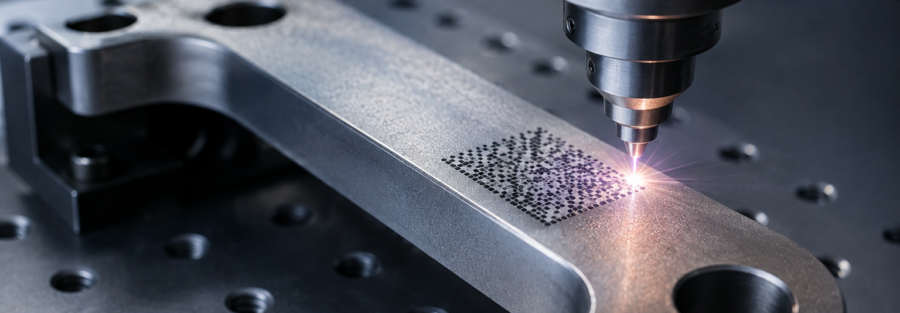
Summary: Direct part marking (DPM) is the permanent application of a serial number, code, or logo straight onto a component’s surface, rather than onto a separate label. It’s created through dot peen, pneumatic, laser, or electrochemical methods, and its readability is measured against formal grading standards like ISO/IEC TR 29158 rather than judged by eye. This guide focuses on how DPM is actually verified for quality and how manufacturers implement it into real production lines, the two parts of DPM most buying guides skip over.
Most explanations of direct part marking stop at “it’s permanent and it’s used for traceability.” True, but incomplete. Two questions matter just as much once you’re actually running DPM in production: how do you know a mark is genuinely good enough, and how do you roll it out without disrupting the line you already have.
This guide covers both, alongside the fundamentals.
What is direct part marking, in practical terms?
Direct part marking places an identifier, a serial number, batch code, logo, or 2D datamatrix, directly onto a component’s surface using a physical or optical process, so the mark becomes structurally part of the item rather than something attached to it. Because the identifier can’t peel, fall off, or be swapped, it survives whatever the part goes through afterward: machining, heat treatment, painting, and years of service.
The four methods used to create a DPM mark are dot peen and pneumatic marking, which physically displace metal to form indentations, laser marking, which alters the surface using a focused beam with no contact, and electrochemical etching, which uses a low-voltage current to mark conductive metals with a shallow, precise result.
How is DPM mark quality actually measured?
DPM mark quality isn’t judged by whether a human can read it. It’s measured against formal grading standards designed specifically for marks on raw material surfaces rather than printed labels, because a mark that looks fine to the eye can still fail a scanner reading it under production conditions.
The standard most commonly used for this is ISO/IEC TR 29158, also known as AIM-DPM, a quality guideline developed specifically to assess 2D codes marked directly onto metal, plastic, and glass surfaces, adapting the general ISO/IEC 15415 barcode grading standard to the demanding, varied substrates DPM actually involves. Automotive applications lean heavily on this standard, while aerospace commonly applies the related AS9132 standard instead.
Grading under AIM-DPM assesses parameters including contrast, cell fill, and axial non-uniformity, producing a letter grade (A through F) that reflects how reliably a scanner can actually read the mark, not just whether a person looking at it can make out the characters. This distinction matters considerably in practice. According to marking technology specialists, symbols typically receive noticeably higher grades under AIM-DPM than under standard ISO 15415 grading, which is exactly why AIM-DPM should only be applied when it’s the standard actually called for in your application specification, rather than used loosely to make any mark look better on paper.
Why does grading matter more for DPM than for printed labels?
Because a printed barcode on a flat white label starts from a clean, consistent, high-contrast baseline. A DPM mark doesn’t. It’s created on a curved, textured, reflective, or inconsistently coloured metal surface, conditions that make consistent, scannable quality something you have to actively verify rather than assume.
A mark that scans perfectly on a bench-top verifier under controlled lighting can behave completely differently on a factory floor, under different lighting, with a different scanner, at a different angle. This is exactly why formal grading against a real standard, rather than a visual check, is what separates a DPM programme that holds up under audit from one that quietly fails the first time a customer’s receiving inspection scans a batch.
How do manufacturers actually implement DPM into a production line?
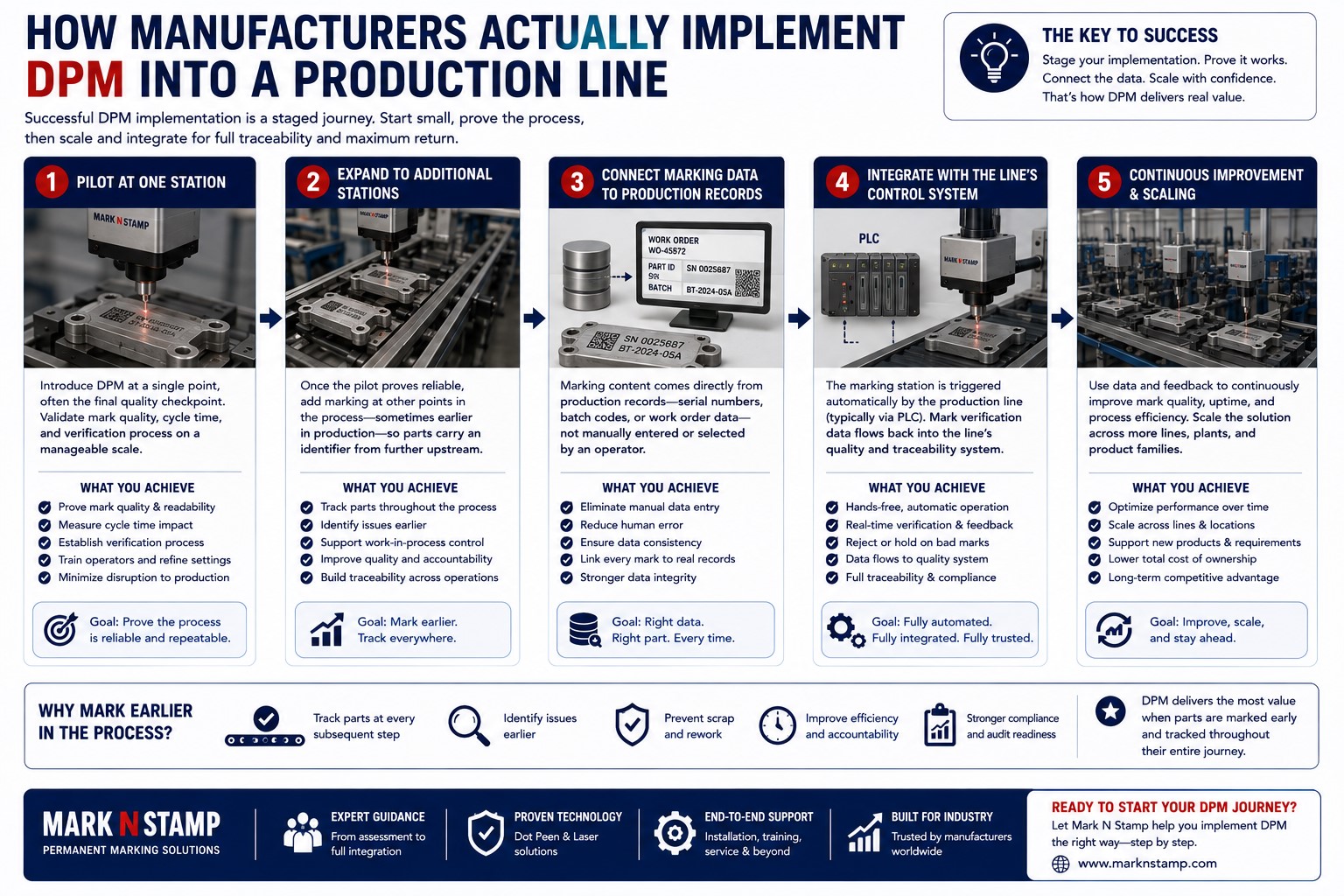
Successful DPM implementation generally follows a staged approach rather than converting an entire facility at once. It typically starts at a single production cell or line, proving out the marking process, settings, and verification workflow on a manageable scale before expanding further.
From there, implementation usually scales in a few recognisable stages:
- Pilot at one station. Marking is introduced at a single point, often the final quality checkpoint, to validate mark quality, cycle time, and verification process without disrupting the wider operation.
- Expand to additional stations. Once the pilot proves reliable, marking is added at other points in the process, sometimes earlier in production, so parts carry an identifier from further upstream.
- Connect marking data to production records. Rather than an operator manually entering or selecting what gets marked, the system pulls serial numbers, batch codes, or work order data directly from existing production records.
- Integrate with the line’s control system. At full maturity, the marking station is triggered automatically by the production line itself, typically through a PLC connection, with mark verification data flowing back into the broader quality and traceability system.
Marking parts earlier in the production sequence, rather than only at final inspection, tends to pay off considerably. It allows in-process tracking at every subsequent stage, rather than only assigning identity to a part once it’s already finished. Mark N Stamp typically recommends this staged rollout when scoping a DPM programme with a factory for the first time.
What Should You Verify Before Committing to a DPM Method?
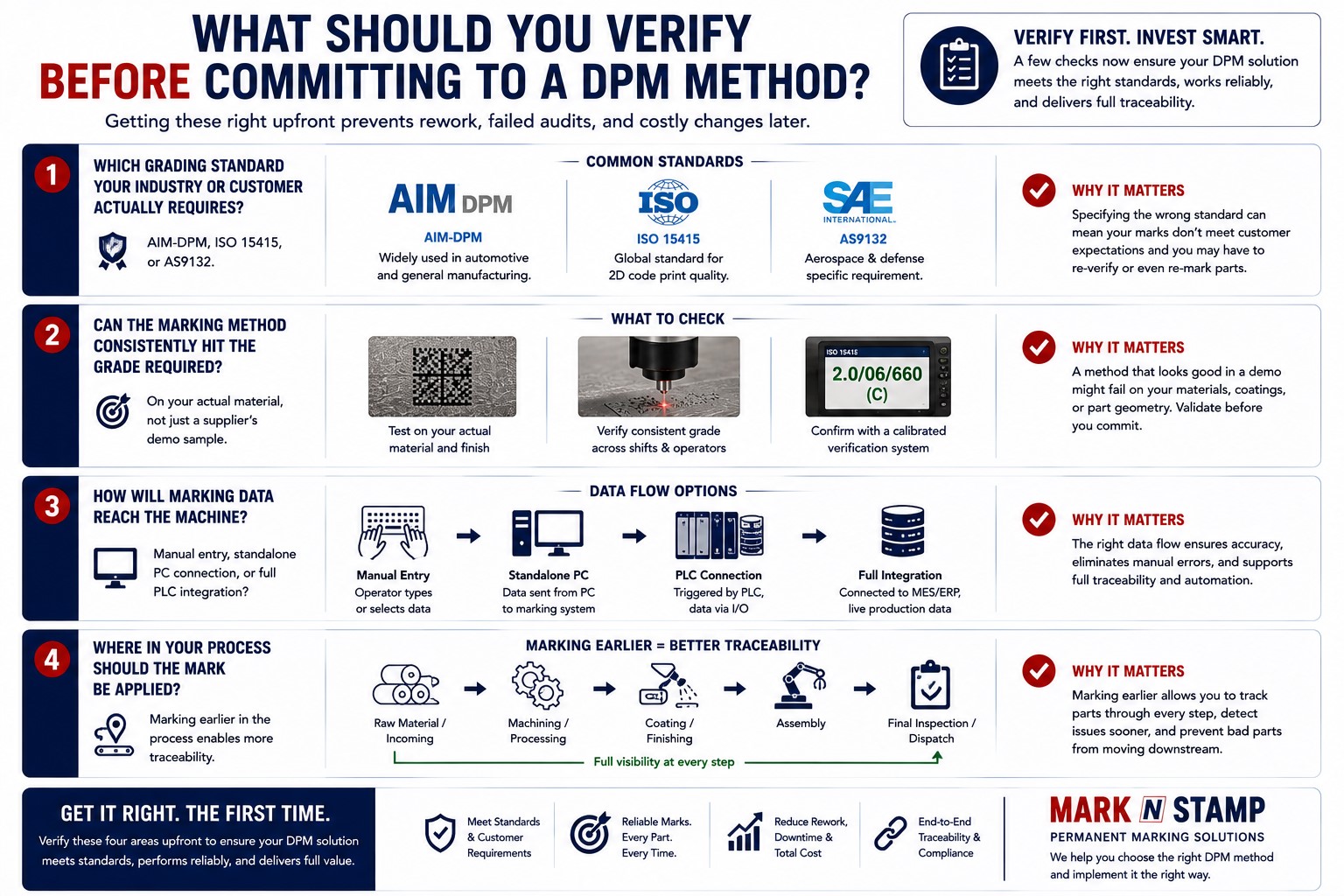
A few checks matter more than they might seem to at first glance:
- Which grading standard your industry or customer actually requires, AIM-DPM, ISO 15415, or AS9132, since specifying the wrong one can mean re-verifying marks later
- Whether your chosen marking method can consistently hit the grade required, on your actual material, not just a supplier’s demo sample
- How marking data will reach the machine, manual entry, a standalone PC connection, or full PLC integration with your production records
- Where in your process the mark should be applied, since marking earlier generally enables more traceability than marking only at final inspection
Getting DPM Verification and Implementation Right
Mark N Stamp works with manufacturers to implement direct part marking properly, from choosing the right method and settings to reach the grading standard your industry requires, through to phased rollout across a production line.
Reviewing aerospace and defence part marking requirements alongside your own industry’s specific grading standard is a useful next step if compliance is driving your DPM decision.
Frequently asked questions
What is the difference between DPM and a printed barcode label? DPM marks the identifier permanently into or onto the component itself, surviving heat, cleaning, and years of wear. A printed label sits on top of the part and can peel, fade, or be swapped.
What is ISO/IEC TR 29158 and do I need to comply with it? It’s the AIM-DPM quality grading standard for codes marked directly onto raw material surfaces. Compliance is typically required when a customer or industry standard, common in automotive, specifies it in your marking specification.
Can a DPM mark fail even if it looks readable to a person? Yes. A mark can look fine to the eye but still fail formal scanner-based grading due to poor contrast, uneven cell fill, or surface inconsistency, which is exactly why verification against a real standard matters.
Should DPM be applied at the start or end of production? Marking earlier in the process generally enables more complete in-process traceability, since the part carries an identifier through more of its manufacturing journey rather than only at final inspection.
Do I need a PLC connection to implement DPM properly? Not initially. Many manufacturers start with manual or PC-based marking and add PLC integration later as the programme matures and the value of full automation becomes clear.
DPM is only as useful as the verification behind it, a permanent mark that can’t be reliably scanned defeats the purpose just as thoroughly as no mark at all. Talk to our team today about choosing a DPM method that meets your required grading standard and fits into your actual production line.