Summary
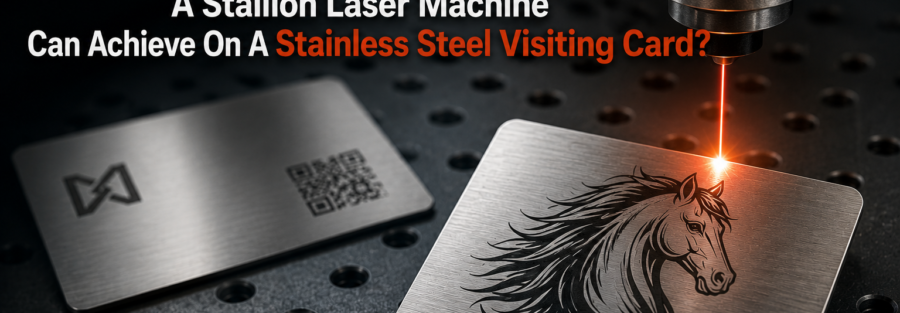
Stallion is MarknStamp’s automated laser system for precise, high-resolution marking. It is built for metals, plastics, and ceramics. MarknStamp does not publish a single micron value for “finest detail” on the product page. The practical answer depends on lens, focus, file quality, and steel finish. On a stainless steel visiting card, Stallion is best for micro-text, thin logos, serial marks, and crisp QR codes.
Introduction
Personalised metal cards sell well because buyers want detail. A 2024 BCG survey found four-fifths of consumers were comfortable with personalised experiences. That keeps pressure high on precision engraving work.
That matters for stainless steel visiting cards. The surface is small, reflective, and unforgiving. A weak machine leaves fuzzy text. A stronger laser keeps the edges crisp.
This guide explains the finest detail Stallion can realistically achieve. It also shows what affects the result, where it fits best, and when a stamper machine is the wrong tool.
What does the Stallion laser machine actually promise?
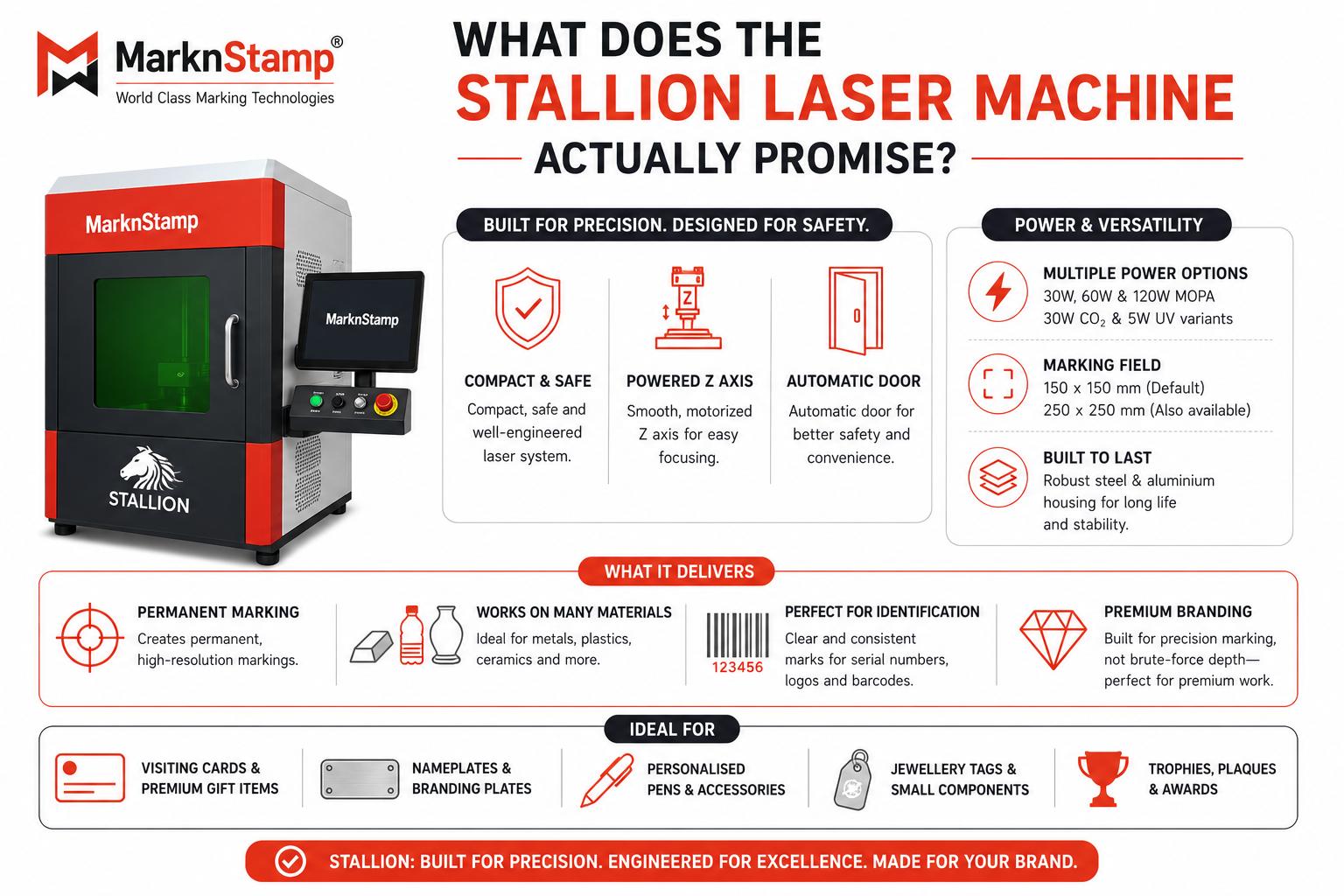
MarknStamp describes Stallion as a compact, safe, well-engineered laser system. It has a robust steel and aluminium housing, a powered Z axis, and an automatic door.
Its technical listing includes 30W, 60W, and 120W MOPA options, plus 30W CO2 and 5W UV variants. The default marking field is 150 x 150 mm, with 250 x 250 mm also available.
The company also states that Stallion makes permanent, high-resolution markings on metals, plastics, and ceramics. It says the marks stay clear and consistent for serial numbers, logos, and barcodes.
That is the key point for a visiting card. The machine is built for precision marking, not brute-force depth. So it suits premium branding work very well.
How fine can the detail be on a stainless steel visiting card?
MarknStamp does not publish a fixed minimum line-width or micron figure for Stallion.
What the brand does promise is high-resolution marking. That means the practical finest detail is usually micro-text, thin vector lines, tiny logos, and compact QR codes.
On stainless steel visiting cards, the result depends on the laser setup. Focus quality, lens selection, file resolution, and surface finish all affect the final mark. That is why two jobs can look different on the same machine.
For a premium card, the safe expectation is very fine visual detail rather than deep carving. In real shop-floor use, that usually means clean lettering and sharp graphics.
What detail level is realistic?
- Very small names and job titles
- Thin logos and border lines
- QR codes for digital contact sharing
- Serial numbers or brand codes
- Decorative patterns on polished steel cards
Why does stainless steel need the right engraving machine laser?
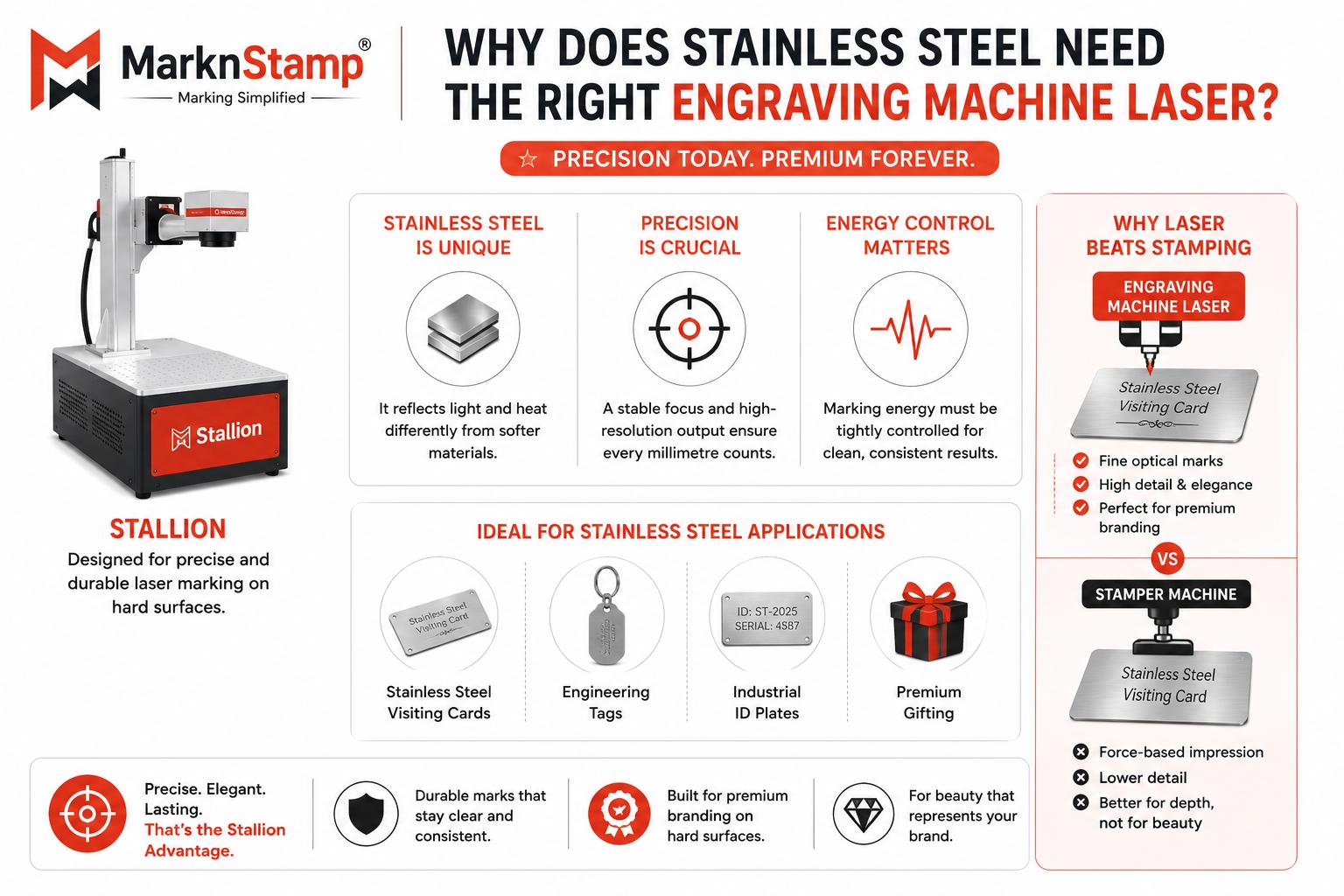
Stainless steel reflects light and heat differently from softer materials. That is why the machine must keep marking energy tightly controlled. MarknStamp’s Stallion is designed for precise and durable laser marking on hard surfaces.
A visiting card also has limited space. Every millimetre matters. A machine with a stable focus and high-resolution output is far better than a heavy-impact tool.
That is where an engraving machine laser beats a stamper machine. A stamper machine creates force-based impressions. Stallion creates fine optical marks. The first is stronger for depth. The second is stronger for beauty and detail.
For engineering tools, that difference matters too. Engineering tags often need durable IDs. But stainless steel visiting cards need elegance first. Stallion fits the premium side of that job.
What affects the smallest readable text?
The smallest readable text is not decided by the machine alone. It is affected by the artwork file, the focus height, the lens, and the card’s surface finish. MarknStamp’s Stallion setup includes a powered Z axis, which helps with adjustment.
A polished stainless steel surface can look stunning. But it can also reveal errors fast. That is why test samples are important before bulk production. Even a tiny focus shift can change sharpness.
The default 150 x 150 mm field also matters. It gives comfortable room for a visiting card layout. Yet the smallest text should still stay simple and bold enough to read.
Best practices for fine results
- Use vector artwork, not low-resolution images
- Keep fonts clean and sans-serif
- Avoid ultra-thin strokes
- Test on the same steel finish
- Check readability under normal light
Is Stallion a good choice for Indian visiting card businesses?
Yes, especially for premium and custom work. MarknStamp lists Stallion under gifting and accessories applications, which matches the visiting card market well. The machine also supports large marking flexibility for nameplates and parts.
That helps businesses in Mumbai, Pune, Thane, and other Indian design hubs. These cities have strong demand for corporate gifts, luxury branding, and personalised metal products. MarknStamp also lists domestic offices in Thane and Pune.
The machine is also useful when you need repeatable output across batches. That is important for corporate orders, wedding gifts, and branded stainless steel cards. Consistency often matters more than dramatic depth.
For a laser marking machine used in India, support and service matter too. MarknStamp’s local presence makes ownership easier for workshop teams and production users.
What are people asking before buying Stallion?
Can Stallion mark very small text on stainless steel?
Yes. MarknStamp says Stallion produces high-resolution marks, so very small text is realistic when the file, focus, and surface are right.
Is Stallion better than a stamper machine for visiting cards?
Yes, for visual detail. A stamper machine suits deep impact marks, while Stallion is better for fine logos, QR codes, and premium text.
Does Stallion only work on metal?
No. MarknStamp says it marks metals, plastics, and ceramics. That gives more flexibility for mixed product lines.
Can it handle corporate visiting card batches?
Yes. The machine is built for precise, repeatable marking, which suits batch work and branded card production.
Is there an official micron-level detail figure?
No public micron figure appears on the product page. The brand instead emphasises high-resolution output and precise marking.
Conclusion
The finest engraving detail Stallion can deliver on a stainless steel visiting card is best described as high-resolution micro-detail. MarknStamp does not publish a single micron number, so the real result depends on setup and material.
For premium cards, the machine is a strong fit. It is built for clean text, sharp logos, and precise branding on steel. For deep impact marks, a stamper machine is the better choice. For elegant card engraving, Stallion leads.
For workshops, designers, and engineering tools businesses in India, it offers a practical route to premium output. Check Products at MarknStamp or Talk to Expert for the right setup.