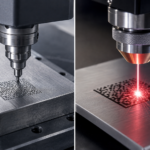

Summary: Permanent part marking is essential across automotive, aerospace and defence, medical devices, oil and gas, electronics, general engineering, and heavy machinery manufacturing, industries where a component must remain identifiable and traceable for its entire working life. Each sector is driven by a mix of regulatory requirement and genuine operational need: recalls, safety audits, warranty claims, and counterfeit prevention all depend on a mark that survives heat, chemicals, and years of service. This guide covers what each industry actually requires and why labels and printed codes fall short.
Ask why a part needs permanent marking, and the honest answer is usually a regulation, a recall, or a warranty claim that happened once and was expensive enough that nobody wants to repeat it. Different industries arrived at that lesson through different routes, but they all landed on the same solution.
Here’s where permanent part marking is genuinely non-negotiable, and what each sector actually needs from it.
Which industries actually require permanent part marking?
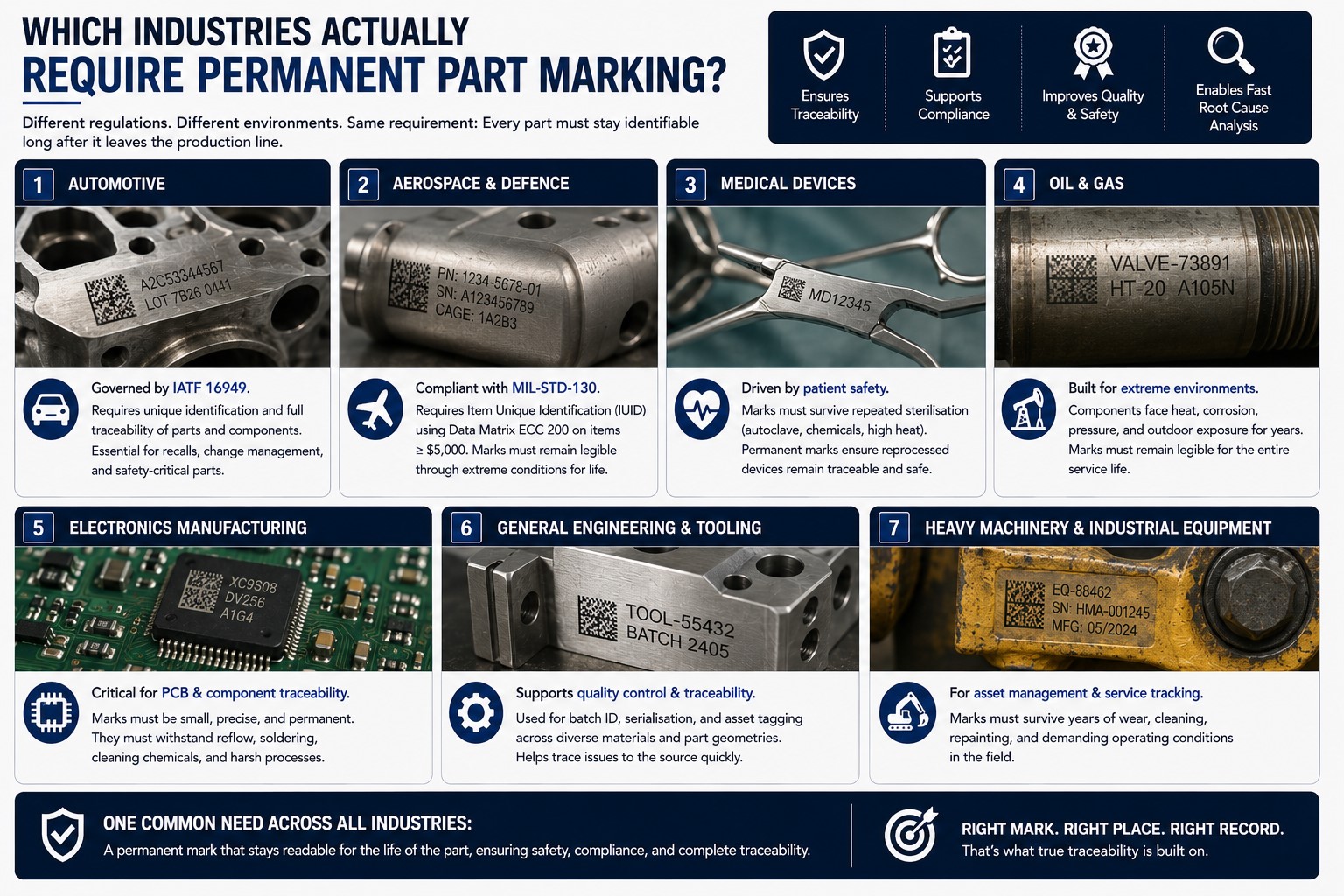
The industries that rely most heavily on permanent part marking are automotive, aerospace and defence, medical devices, oil and gas, electronics manufacturing, general engineering, and heavy machinery. Each has its own regulatory driver, but the underlying need is identical: a part has to stay identifiable long after it leaves the production line.
1. Automotive
Automotive manufacturing runs on traceability standards that go well beyond general quality requirements. IATF 16949’s supplementary requirements go further than the general ISO baseline, elevating identification and traceability to a structured framework covering unique identifiers on components and accurate change-management documentation for safety-critical parts, since a single untraceable defective part can trigger a recall covering thousands of vehicles.
2. Aerospace and defence
Aerospace and defence marking runs on some of the strictest standards in any industry. The US Department of Defense’s MIL-STD-130 standard requires Item Unique Identification on every delivered item where the unit acquisition cost is $5,000 or more, encoded as a Data Matrix ECC 200 symbol that must remain legible through extreme environmental exposure over the component’s entire service life.
3. Medical devices
Medical device marking is driven by patient safety as much as regulation. Reusable, reprocessed devices need identifiers that survive repeated sterilisation cycles, autoclaving, chemical disinfection, that would destroy a printed label within a handful of cycles. A permanent mark is often the only option that genuinely holds up.
4. Oil and gas
Equipment in oil and gas operates in some of the harshest conditions any marked component faces: extreme temperature swings, corrosive environments, and years of outdoor exposure on pipelines, valves, and structural components. A mark here has to remain legible after conditions that would fade or dissolve a printed identifier within a season.
5. Electronics manufacturing
Electronics traceability has intensified considerably as PCB and component-level identification requirements have expanded. Boards and components need marks fine enough to fit compact surfaces without damaging sensitive circuitry, while surviving reflow soldering temperatures and cleaning chemicals that would compromise a label instantly.
6. General engineering and tooling
Custom fabrication and tooling manufacturers rely on permanent marking for asset tagging, batch identification, and part serialisation, often across highly varied part geometries and materials. This sector’s requirement is less about a single regulation and more about internal quality control, knowing exactly which batch a part came from when something needs investigating.
7. Heavy machinery and industrial equipment
Machinery and equipment manufacturers mark components for warranty tracking, maintenance history, and asset management across equipment that’s expected to remain in service for decades. A mark here needs to survive not just manufacturing processes but years of operational wear, cleaning, and repainting.
Why can’t these industries just use labels or printed codes?
Because none of the conditions these industries actually operate under are kind to a printed or adhesive identifier. Heat treatment, sterilisation, chemical exposure, outdoor weathering, and mechanical wear all degrade labels and ink well before a component’s useful life ends, exactly the point at which traceability matters most.
The common failure point across every one of these sectors is identical: a label falls off, fades, or becomes illegible right when a recall, an audit, or a warranty claim needs it to work.
What do these industries actually have in common?
Despite covering wildly different products, from aircraft components to surgical instruments, these seven sectors share the same underlying requirement: a permanent identifier that survives the specific stresses of that industry’s manufacturing and service environment.
| Industry | Primary driver | Toughest condition the mark must survive |
| Automotive | IATF 16949 traceability | Heat treatment, coating, road exposure |
| Aerospace & defence | MIL-STD-130 UID | Extreme environmental exposure |
| Medical devices | Sterilisation survival | Repeated autoclaving |
| Oil & gas | Asset identification | Corrosion, extreme temperature |
| Electronics | Component traceability | Reflow soldering, cleaning chemicals |
| General engineering | Batch quality control | Varied materials and geometries |
| Heavy machinery | Warranty & maintenance tracking | Decades of operational wear |
How do you know which marking method suits your industry?
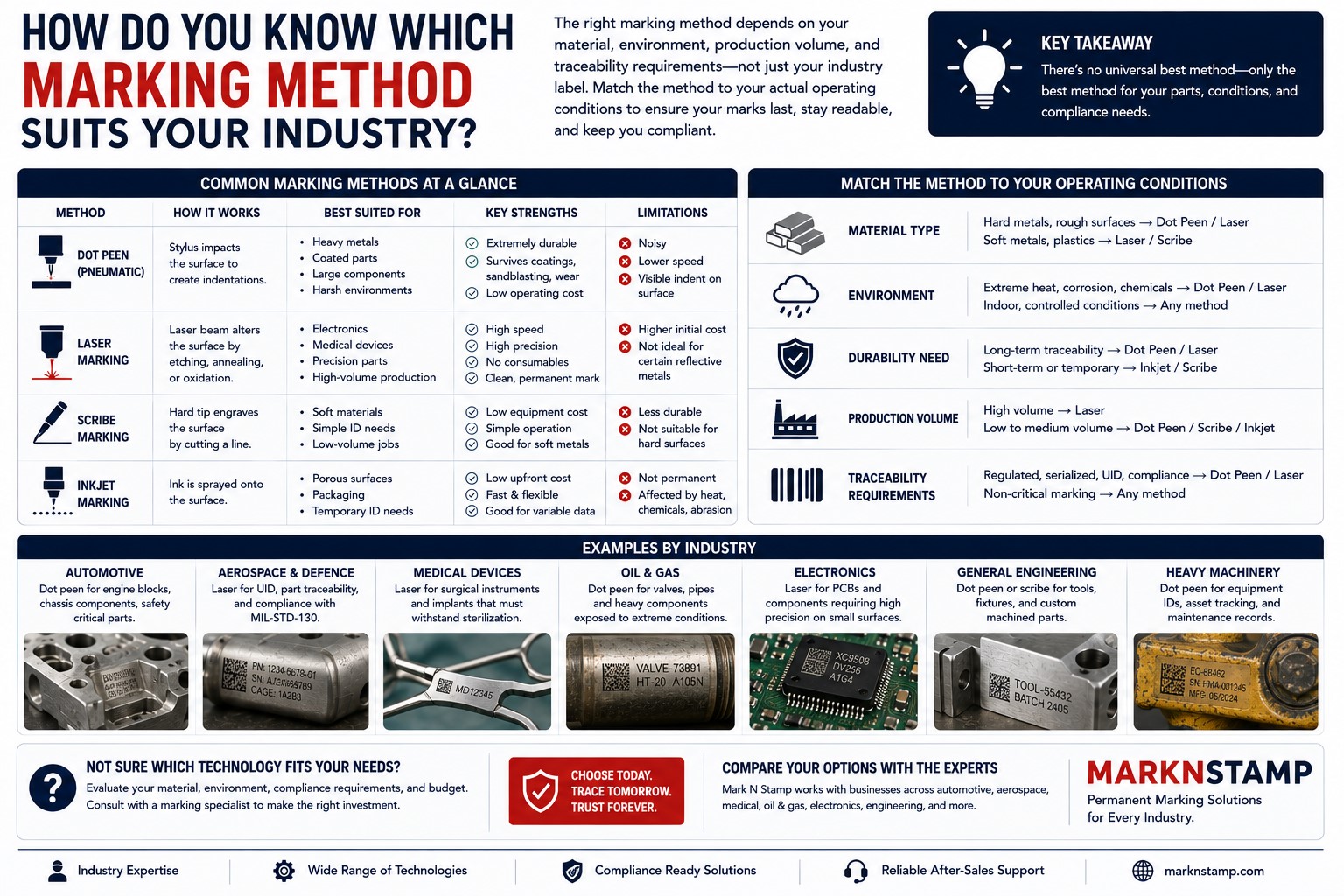
The right method depends on your material and the specific condition your parts need to survive, not a generic industry default. Dot peen and pneumatic marking suit heavy metal parts facing coating or sandblasting. Laser marking suits fine, high-volume identification on electronics and precision components. Matching the method to your actual operating conditions, not just your industry label, is what makes a marking programme actually hold up.
If you’re unsure which technology fits your sector’s specific requirements, comparing your options against a supplier like Mark N Stamp, who works across multiple regulated industries, is worth doing before committing to equipment.
Choosing the right marking partner for your industry
Mark N Stamp supplies dot peen, pneumatic, and laser marking equipment to manufacturers across automotive, aerospace, engineering, and general industrial sectors, helping buyers match the right technology to their industry’s specific regulatory and environmental demands rather than a one-size-fits-all recommendation.
Understanding the full range of marking machines available is the fastest way to see which technology genuinely fits your industry’s requirements.
Frequently asked questions
Which industry has the strictest part marking requirements? Aerospace and defence generally set the strictest standards, through MIL-STD-130 and Item Unique Identification rules, requiring permanent, machine-readable marks that survive extreme environmental conditions throughout a component’s service life.
Do all industries need the same type of permanent marking? No. The right method depends on the material and conditions involved, dot peen and pneumatic marking suit rugged metal parts, while laser marking suits fine, high-volume identification on electronics and precision components.
Can small manufacturers in these industries use the same marking technology as large plants? Yes, portable and table-top marking machines give smaller operations access to the same permanent marking technology, scaled to lower volumes and tighter budgets than large in-line production systems.
Is permanent marking always a legal requirement? Not always, but it’s mandatory in several regulated sectors, including automotive safety-critical parts, aerospace and defence UID items, and reusable medical devices, while remaining strong best practice elsewhere for quality control and traceability.
How do I know if my industry needs permanent marking? If your parts face recall risk, warranty claims, regulatory audits, or need traceability through harsh manufacturing or service conditions, permanent marking is worth implementing regardless of whether a specific regulation mandates it yet.
Every regulated industry eventually arrives at the same conclusion about part marking, usually after a recall or an audit makes the cost of not having it clear. Talk to our team today to find the right marking technology for your industry’s specific requirements before that lesson gets expensive.