
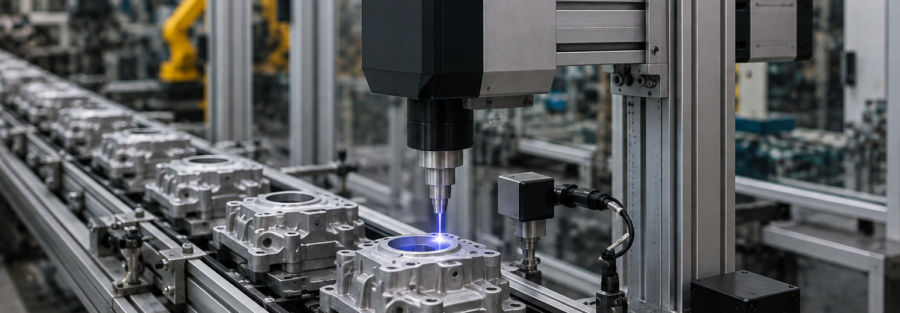
Summary: Integrating a marking machine into an existing production line means connecting it to your PLC for physical triggers and timing, and often to your MES or ERP system so marking data comes directly from production records rather than manual entry. Done properly, this reduces incorrect codes, removes manual marking steps, and links every mark back to full production genealogy for traceability. This guide covers what integration actually involves and the mistakes that turn it into a bottleneck instead of an efficiency gain.
Bolting a new marking machine onto an existing line and hoping it fits rarely works well. Integration done properly is a genuine engineering exercise, connecting control systems, timing, and data flow, not just placing a new machine at a convenient gap on the line.
Here’s what actually needs to happen for that integration to work.
What does “integrating” a marking machine actually mean?
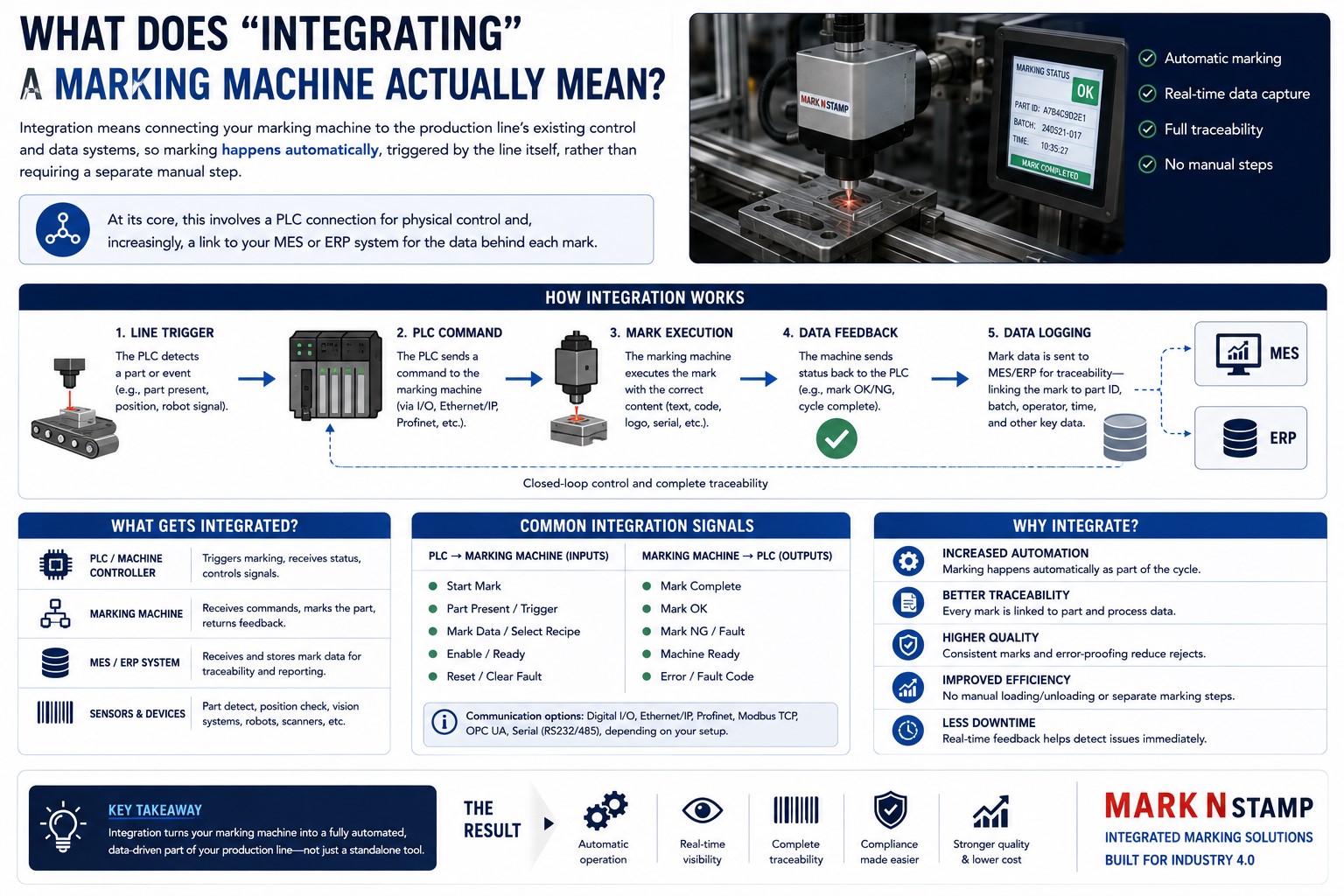
Integration means connecting your marking machine to the production line’s existing control and data systems, so marking happens automatically, triggered by the line itself, rather than requiring a separate manual step. At its core, this involves a PLC connection for physical control and, increasingly, a link to your MES or ERP system for the data behind each mark.
According to industrial automation specialists, PLC integration of a marking system describes the direct connection of the marking equipment to a Programmable Logic Controller, making it possible to control the marking process directly through the machine’s existing control logic rather than as a standalone, manually operated station.
Why connect the marking machine to a PLC specifically?
Because a PLC handles the physical timing and triggers that make automatic marking possible, when to fire, how to synchronise with part movement on a conveyor, and how to coordinate with upstream and downstream stations. Without this connection, marking either requires manual triggering, which slows the line and introduces human error, or runs on a fixed timer disconnected from the actual production flow, which risks marking the wrong part or missing parts entirely.
A properly PLC-integrated marking station becomes an invisible part of the line’s rhythm rather than a separate manual checkpoint that operators have to actively manage.
Why does connecting to MES or ERP matter beyond just the PLC?
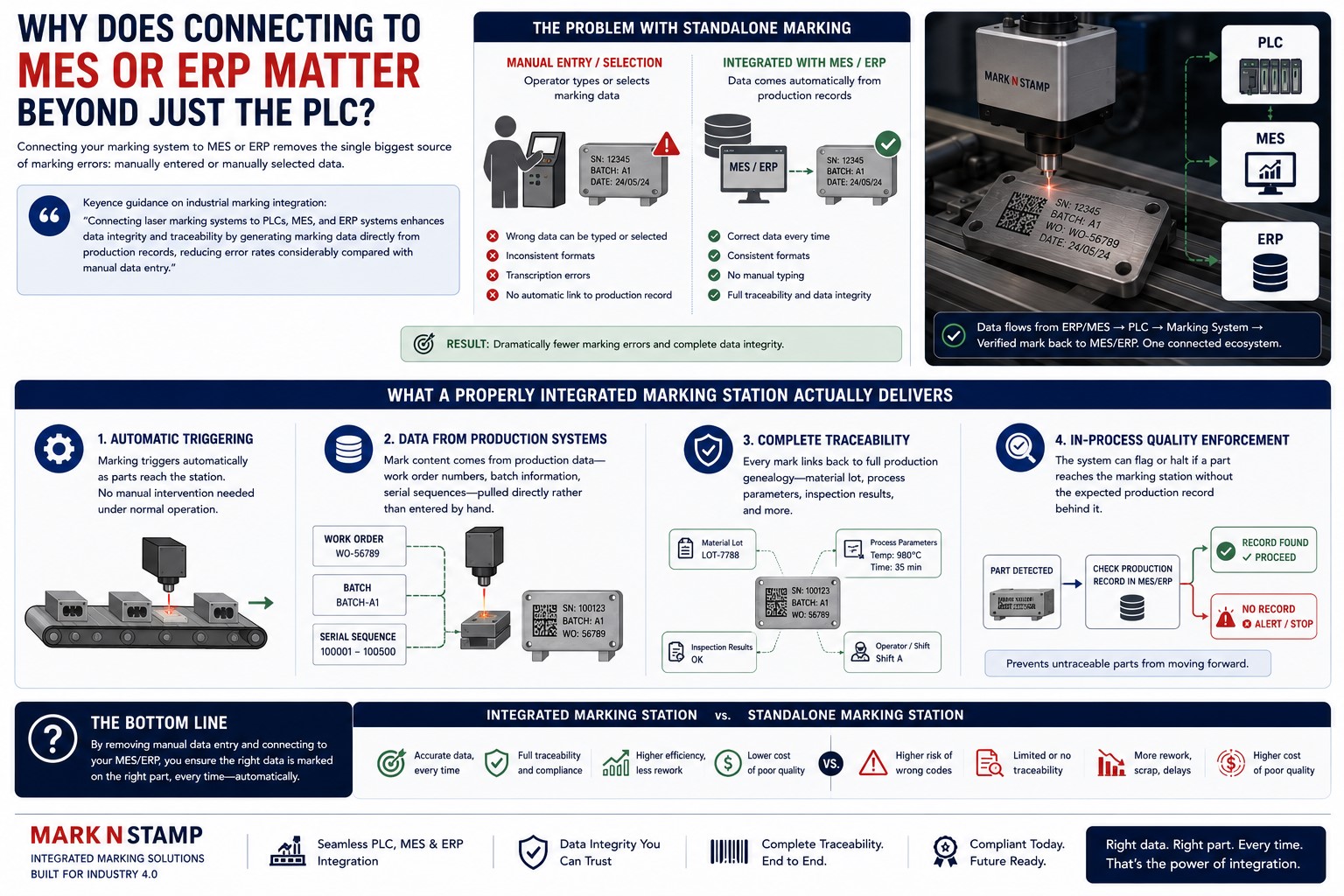
Because it removes the single biggest source of marking errors: manually entered or manually selected marking data. According to Keyence’s guidance on industrial marking integration, connecting laser marking systems to PLCs, MES, and ERP systems enhances data integrity and traceability by generating marking data directly from production records, reducing error rates considerably compared with manual data entry.
In practice, this means the serial number, batch code, or datamatrix content marked onto a part comes automatically from the work order or production record already in your system, rather than an operator selecting or typing it in at the marking station. That single change removes a meaningful share of the “wrong code marked on the wrong part” errors that plague marking stations running as standalone islands.
That’s what a properly integrated marking station actually delivers, a few concrete benefits that separate it from standalone marking:
- Marking triggers automatically as parts reach the station, with no manual intervention needed under normal operation
- Mark content comes from production data, work order numbers, batch information, serial sequences, pulled directly rather than entered by hand
- Every mark links back to full production genealogy, connecting the physical identifier to material lot, process parameters, and inspection results
- In-process quality checks can be enforced, with the system able to flag or halt if a part reaches the marking station without the expected production record behind it
What Goes Wrong When Integration Is Done Poorly?
A few recurring mistakes turn integration into a bottleneck rather than an improvement.
Treating the marking station as an afterthought in the line design. Bolting a marking machine into a tight, poorly planned gap on an existing line often means awkward part positioning, inconsistent timing, or a station that becomes the line’s slowest point.
Skipping the MES/ERP connection and settling for PLC-only integration. This still automates the physical marking trigger but leaves data entry manual, keeping the biggest error source in place even after the mechanical integration is done.
Underestimating commissioning time. Integration involves genuine engineering, control logic, timing synchronisation, data mapping, and rushing this phase to minimise production downtime often creates instability that causes more downtime later than a properly planned commissioning window would have.
Not planning for future line changes. A tightly, rigidly integrated system can be expensive to modify later if line speed, part variety, or layout changes. Building in some flexibility during initial integration saves considerably more than optimising purely for the current configuration.
How Long Does a Typical Integration Actually Take?
This varies considerably based on complexity, a straightforward PLC connection for simple trigger control can be commissioned in days, while a full MES/ERP-integrated system with in-process quality enforcement typically takes weeks, accounting for control logic development, data mapping, and thorough testing before going live on a production line.
Planning integration during a scheduled maintenance window or a planned line changeover, rather than squeezing it into normal production time, generally produces a smoother result with less pressure to cut corners on testing. Mark N Stamp typically recommends this approach when scoping an integration project with a factory’s engineering team.
Getting Integration Right the First Time
Mark N Stamp works with manufacturers to integrate marking machines into existing production lines, from straightforward PLC-triggered installations through to fully MES-connected systems pulling marking data directly from production records.
Reviewing the full range of marking machines built for line integration is a useful starting point before planning how a new station fits into your existing control architecture.
Frequently asked questions
Does every marking machine integration need to connect to MES or ERP? No. A simple PLC connection for automatic triggering is sufficient for many operations, MES/ERP integration adds most value when reducing manual data entry errors and building full traceability genealogy matters to your compliance requirements.
How long does marking machine integration typically take? A basic PLC-triggered integration can take days, while a full MES/ERP-connected system with quality enforcement typically takes several weeks to properly commission and test.
Can an existing marking machine be integrated later, or does it need to be planned from purchase? Many existing marking machines can be retrofitted with PLC and MES connectivity, though planning integration from initial purchase generally produces a cleaner, less costly result than retrofitting later.
What’s the biggest mistake factories make when integrating a marking machine? Treating the marking station as a standalone afterthought rather than planning its timing, positioning, and data connections as part of the overall line design from the start.
Does integration slow down the marking process itself? No, properly integrated marking is typically faster than manual operation, since the machine triggers automatically from the line’s existing flow rather than waiting for manual initiation.
Integration is what turns a marking machine from a manually operated station into a genuine part of your production line’s automated flow. Talk to our team today about planning integration for your specific line and control systems.