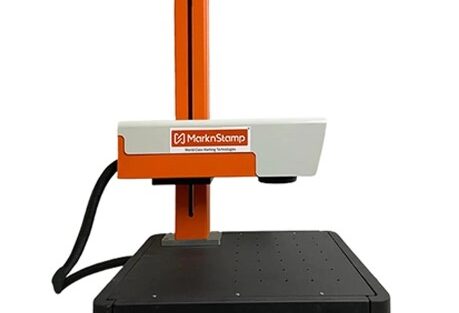
Summary: Laser marking machines should be selected by part size, batch pattern and automation level, not by wattage. An ECO laser suits mixed small-part work on a bench. An Eco-Max covers higher-speed production and offers different source types for different materials. A Stallion system suits automated, repeatable production marking. A Stallion XL Station handles physically large components inside an enclosed workstation. Decide where the part sits and how it arrives at the machine, and the shortlist usually reduces to one.
Almost every laser marking enquiry opens the same way. Someone asks for a price on a 30W machine, or a 60W one, because a competitor quoted that number and it feels like the thing to compare.
Wattage is a real specification. It is just not the one that decides whether a machine fits your factory.
The questions that actually decide it are duller and far more useful: how big is the part, how does it get to the machine, and does someone load it by hand every time?
Why is wattage the wrong starting point?
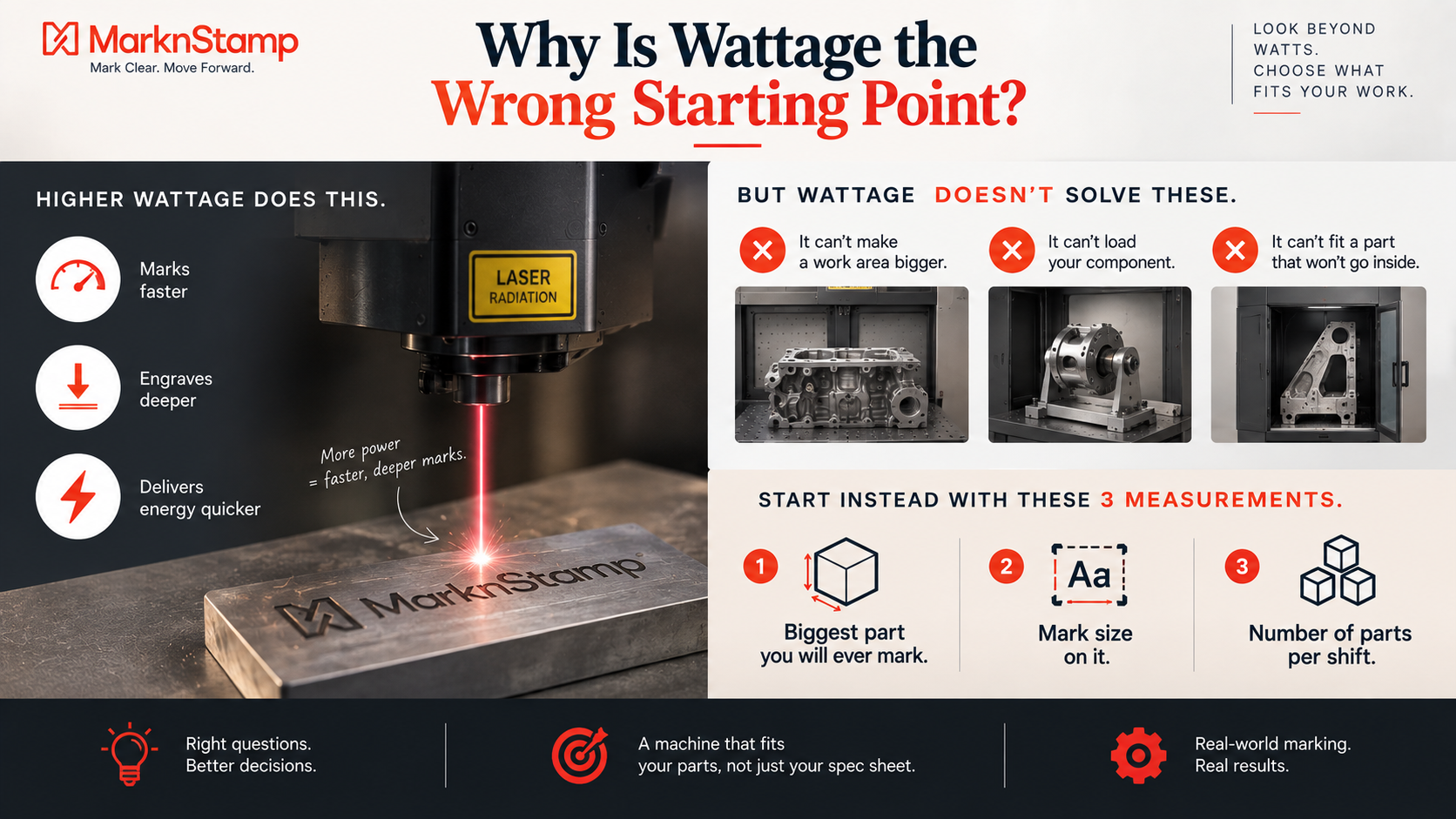
Wattage sets how quickly a laser delivers energy, not whether the machine physically suits your parts. A higher-power source marks faster and engraves deeper, but it cannot make a work area bigger, load a component, or fit a part that does not physically go inside the machine.
Power also interacts with settings rather than replacing them. Speed, frequency and pulse settings do much of the work in determining how a mark actually looks, which is why two machines at the same wattage can produce visibly different results on the same material.
So a buyer who fixates on watts often ends up with a fast machine that cannot hold their largest part. That is an expensive way to learn the lesson.
Start instead with three measurements: the biggest part you will ever mark, the mark size on it, and the number of parts per shift.
Which laser suits mixed small-part work?
An ECO laser marking machine suits varied, lower-volume marking on small components where an operator loads each part by hand. Tools, fittings, small assemblies, nameplates and gifting or engraving work all sit comfortably in this category.
Mark N Stamp positions it as the entry point to its laser range for exactly this kind of work. The defining trait is variety rather than volume. A workshop marking fifty different part numbers a week needs quick file changes and easy setup far more than it needs raw speed.
This is also the honest entry point for a business proving out laser marking before committing to production integration. Starting with the ECO laser machine and moving up later is a rational sequence, not a compromise.
When does the Eco-Max make more sense?
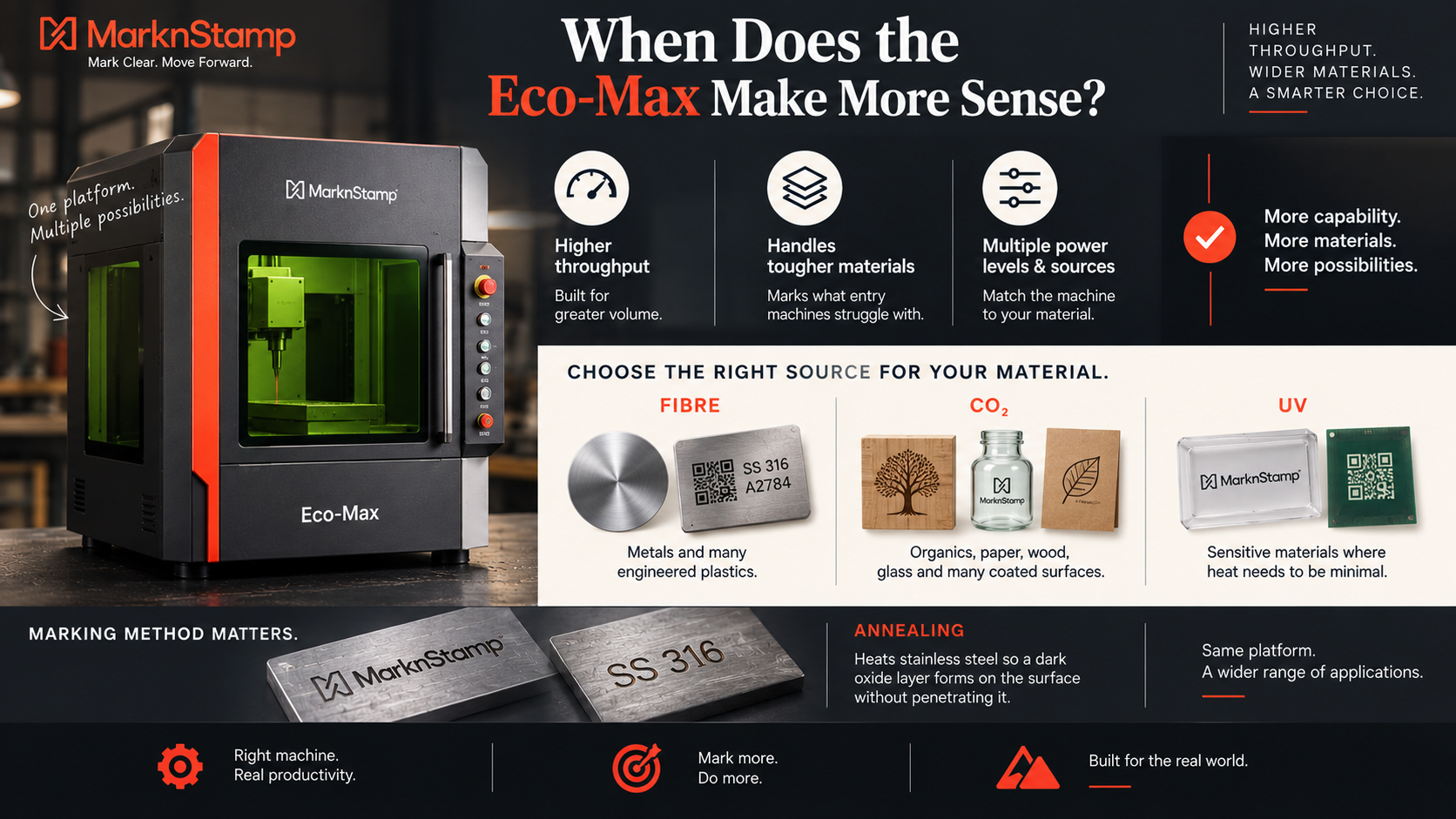
The Eco-Max is the step up for higher-throughput marking and for materials an entry machine handles poorly. It is available in different power levels and source types, so the machine can be matched to the material rather than the material being forced onto the machine.
Source type matters more than most buyers realise:
- Fibre sources suit metals and many engineered plastics, which covers most industrial part marking
- CO2 sources suit organics, paper, wood, glass and many coated surfaces
- UV sources suit sensitive materials where heat needs to be kept to a minimum
Marking method matters as much as source. Annealing, for example, heats stainless steel so a dark oxide layer forms on the surface without penetrating it, which is why medical and food equipment marks that way rather than by engraving. The Eco-Max laser machine covers that spread of source options in one platform.
What does a Stallion system add?
A Stallion laser system is built for automated, repeatable production marking rather than hand-loaded bench work. It suits a line where the same part arrives in the same orientation, over and over, and the marking cycle needs to keep pace with everything upstream.
The value here is consistency and cycle time, not flexibility. Automation rewards repetition and punishes variety, so a Stallion is the right answer when part numbers are few and volumes are high, and the wrong one when every job is different.
If your marking station is currently the slowest step on a line, this is the category to look at. The Stallion laser marking machine is specified around that problem.
What is the XL Station actually for?
The Stallion XL Station exists for parts that are too large for a standard marking enclosure. It is a full workstation built around the component rather than a machine the component has to fit inside.
Large fabrications, long assemblies, aerospace and heavy engineering components all end up here, usually because the alternative is portable marking that cannot hold the tolerance the drawing asks for.
There is a safety dimension too, and it is not optional. Enclosing the beam is what allows a system to be operated safely without personal eye protection for every person in the area, since laser safety classification depends on accessible emission during normal operation. A properly enclosed XL station handles that containment as part of the machine rather than as a procedure someone has to remember.
How to shortlist in ten minutes
Answer these four in order and the choice usually makes itself:
- What is the largest component you will mark? If it will not fit a standard enclosure, you are looking at an XL station and the rest of the list is irrelevant.
- How many different parts per week? High variety points to ECO or Eco-Max, low variety and high volume points to Stallion.
- What materials? Metals only means fibre. Plastics, glass or organics in the mix means a CO2 or UV source belongs in the conversation.
- Who loads the part? A person every time means a bench machine. A fixture or conveyor means automation.
Mark N Stamp manufactures all four laser formats alongside its dot peen range, which is worth knowing for one specific reason: it makes it possible to test whether your job even needs a laser before you buy one.
Frequently asked questions
Does a higher wattage laser always mark faster? Not always usefully. Higher power delivers energy faster and helps with deep engraving, but marking speed also depends on the material, the marking method and the settings, so more watts can simply mean more heat.
Which laser source should I choose for metal? A fibre source for almost all metal marking. CO2 suits organics, glass and coated surfaces, and UV suits heat-sensitive materials where a cold-mark process is needed to avoid damaging the part.
Can one laser machine handle both metal and plastic? Sometimes, depending on the plastic. Many engineering plastics mark well with a fibre source, but clear, soft or heat-sensitive polymers usually need a CO2 or UV source to mark cleanly without melting.
What is annealing in laser marking? Annealing heats the metal so a dark oxide layer forms on the surface without cutting into it. It produces a high-contrast permanent mark while leaving the surface finish and corrosion resistance intact.
Do I need an enclosure for a laser marking machine? In almost all industrial settings, yes. An enclosure contains the beam so the system can be operated safely, and it also keeps fume and debris away from the operator and the optics.
Choosing a laser marking machine on wattage alone is how factories end up with a fast machine that cannot hold their biggest part. Check the full laser range and book a marking trial with your own components before you shortlist on price.