Summary
Yes, MARKNSTAMP positions its machines for automotive and auto-ancillary traceability and says its laser marking systems handle serial numbers, barcodes, QR codes, and fine-detail industrial marking. For automotive parts, reliability depends on whether you need high-contrast surface marking or deep, abrasion-resistant identification. A laser is strong for precision; dot peen is often better for deeper marks. Automotive laser marking is widely used for part traceability, recalls, and compliance support.
Introduction
According to recent industry guidance, automotive manufacturers use laser marking to create durable part identity and traceability across the full vehicle lifecycle. That matters because every part must stay readable through production, assembly, and service.
If you keep seeing MARKNSTAMP machines at manufacturing expos, the real question is not visibility. It is whether they suit automotive conditions like heat, oil, abrasion, and high-volume production. That is where the marking technology matters most.
This guide explains when MARKNSTAMP laser marking machines are reliable, when another marking method may be better, and what automotive buyers in Mumbai and Thane should check before buying.
What makes a laser marking machine reliable for automotive parts?
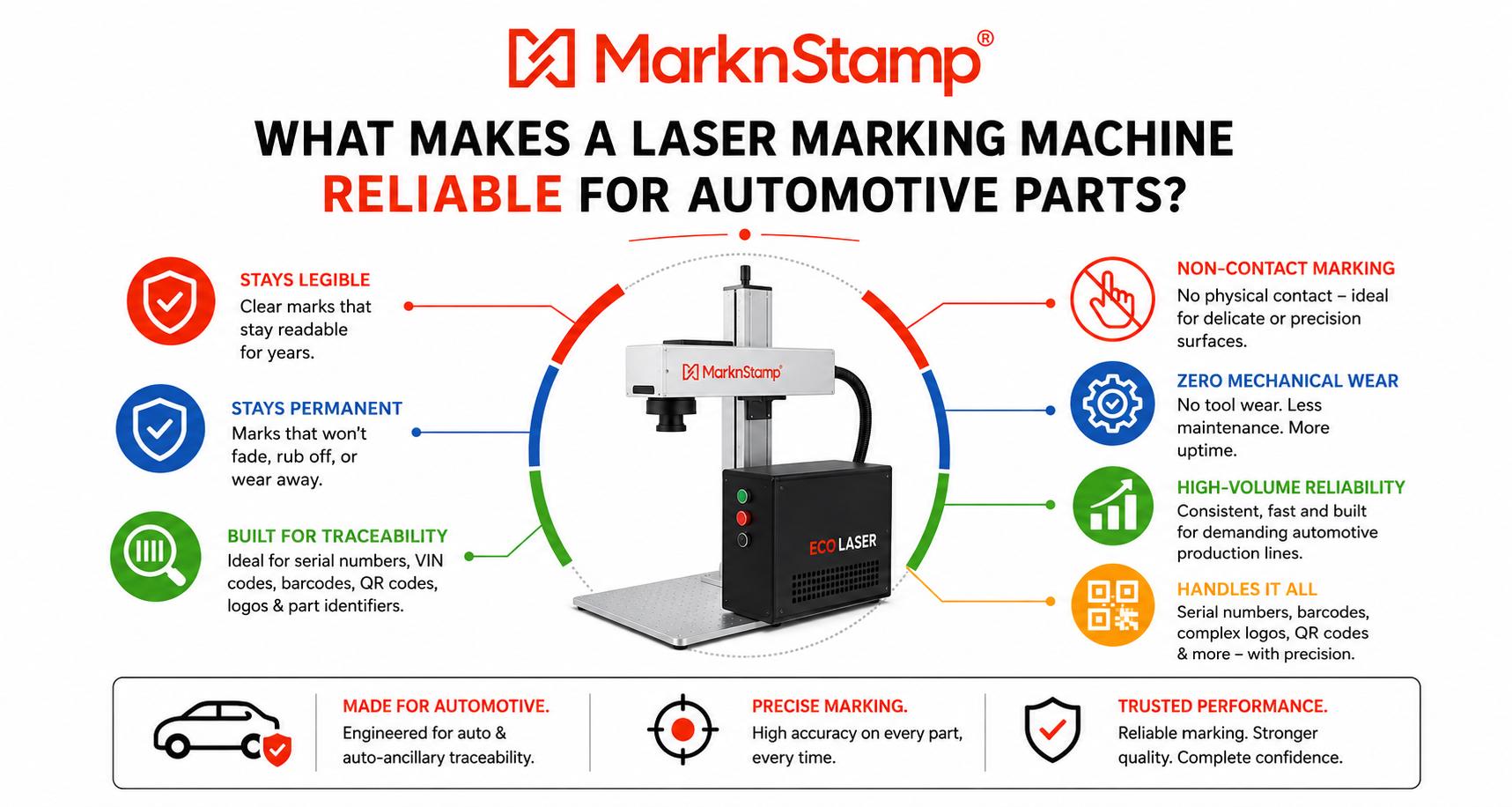
A reliable automotive marking machine must create marks that stay legible, stay permanent, and support traceability. In automotive use, that usually means serial numbers, VIN-related codes, QR codes, logos, and part identifiers.
MARKNSTAMP says its machines mainly serve automotive and auto-ancillary traceability needs. It also says its ECO Laser handles serial numbers, barcodes, complex logos, and QR codes without physical contact.
That non-contact approach is useful for delicate surfaces. It also reduces mechanical wear inside the marking process. For high-volume production, that is a practical reliability benefit.
Why do automotive manufacturers use laser marking machines?
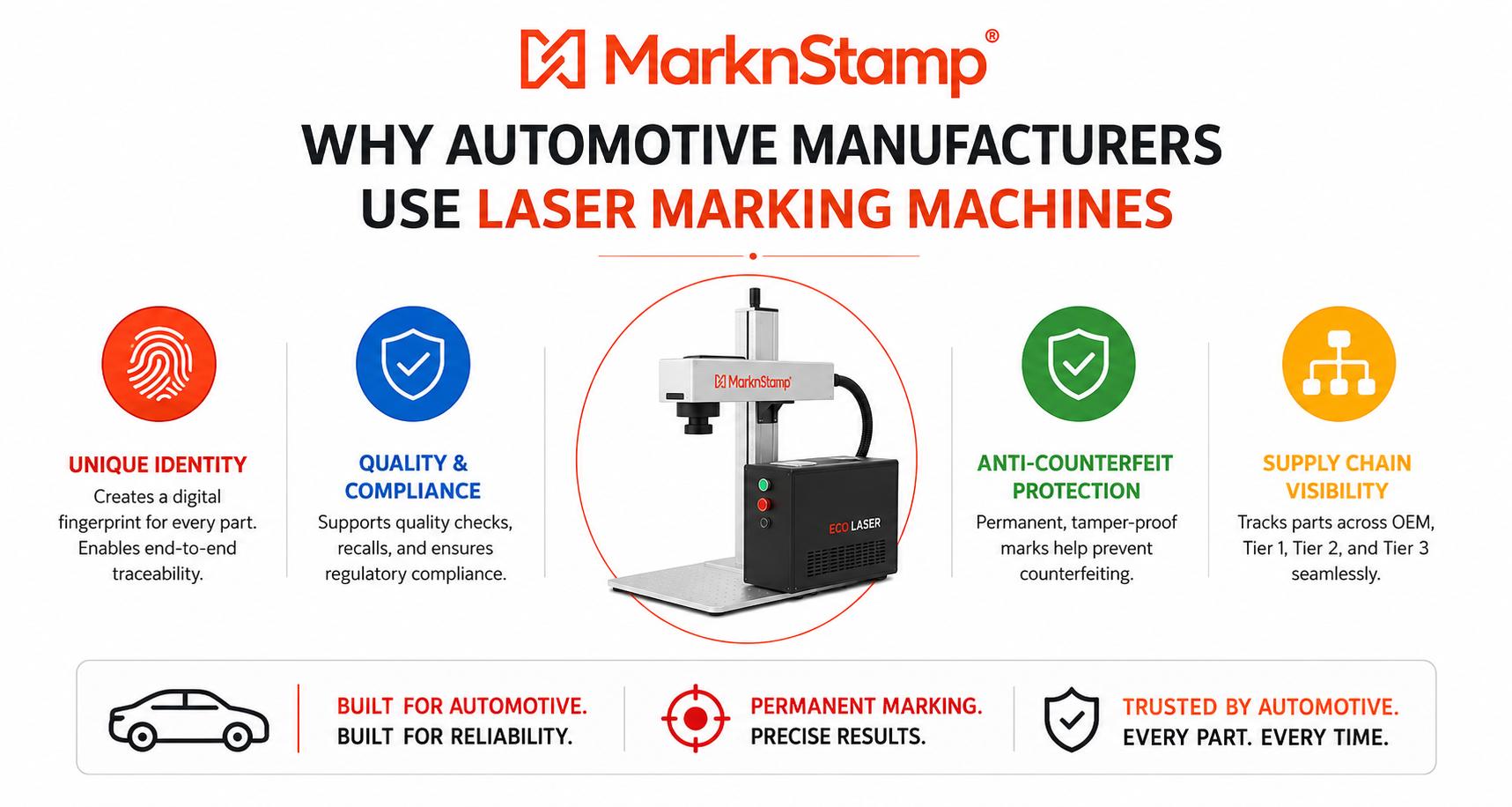
Automotive manufacturers use laser marking because every part needs identity. Industry guidance says laser marking creates a digital fingerprint for each component, which helps track parts from production to the finished vehicle.
That traceability supports recalls, quality checks, and anti-counterfeit control. It also helps suppliers track parts across OEM, Tier 1, Tier 2, and Tier 3 workflows.
MARKNSTAMP’s own automotive page says laser and dot peen marking are both widely used in the sector for permanent identification, traceability, and quality control. That is a strong signal that the brand is built around industrial marking, not general-purpose engraving.
Which automotive parts are a good fit for MARKNSTAMP machines?
MARKNSTAMP says its ECO Laser is suitable for metal, plastic, and other industrial materials. It also says the machine can handle demanding automotive marking tasks like serial numbers and VIN codes.
That makes laser marking a good fit for:
- Engine components
- Metal brackets and housings
- Plastic interior parts
- Nameplates and tags
- Small coded components
For parts where the mark must be highly visible and precise, laser marking is a strong option. Gravotech also notes that automotive laser marking gives high-contrast, permanent marking on both metallic and plastic components.
Where can laser marking fall short in automotive work?
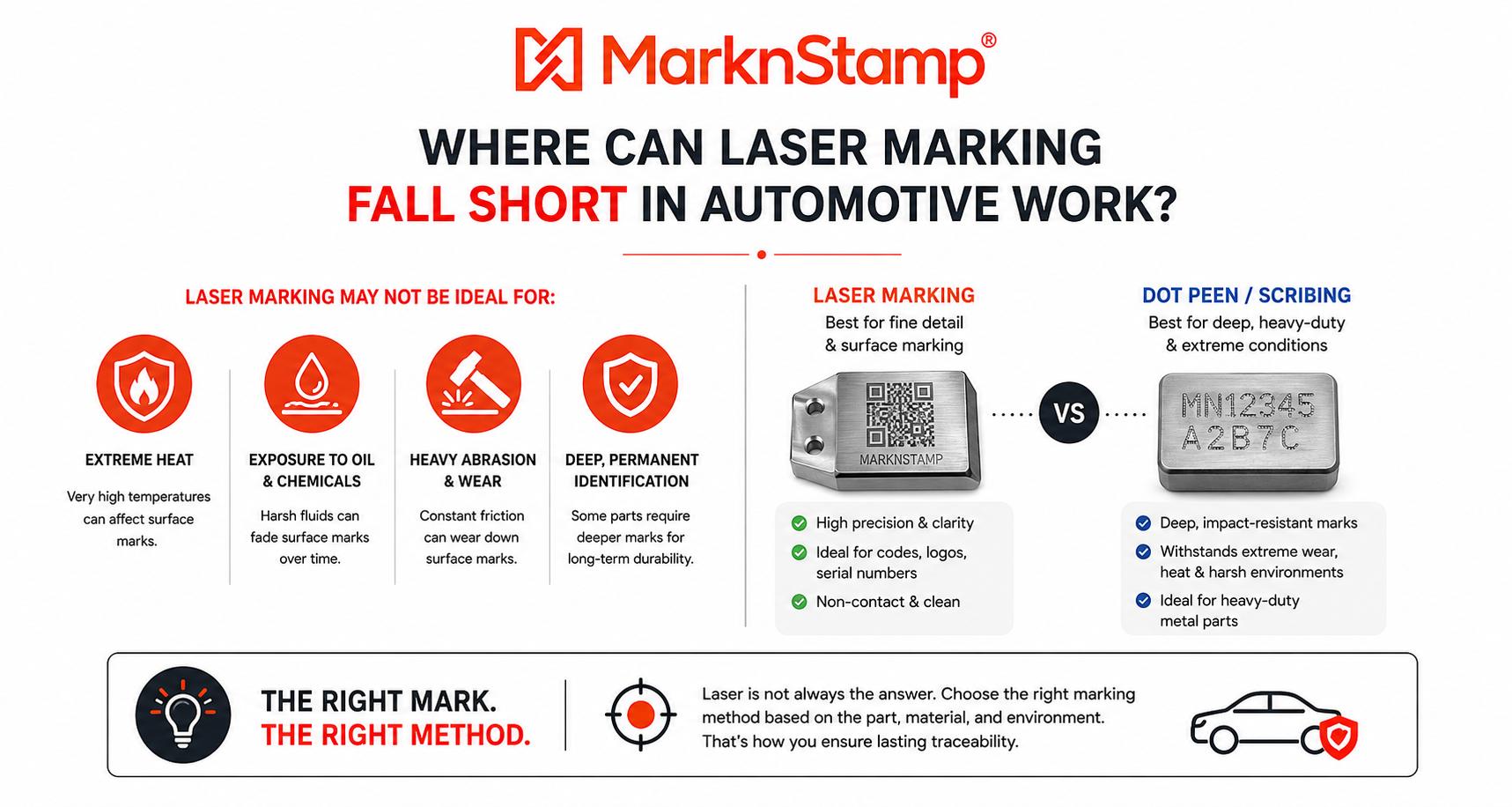
Laser marking is not always the best answer. Some automotive parts need a deeper mark for extreme wear, heat, oil, or abrasion. In those cases, dot peen or scribing may be more durable.
MARKNSTAMP itself says dot peen is strong for heavy-duty metal marking and rugged environments. Its buyer’s guide also says laser is best for fine detail, while dot peen is tough for deep, heavy-duty marks.
That means the better question is not “Is laser reliable?” The better question is “Is laser the right marking method for this specific part?” On hard metal parts with harsh exposure, deep marking can outperform surface marking.
How does MARKNSTAMP compare with the usual automotive marking needs in Mumbai?
In Mumbai and Thane, automotive suppliers usually need three things: stable marking quality, quick integration, and responsive service. MARKNSTAMP says it has its head office in Thane, and that it supports industrial marking across automotive and allied sectors.
That local presence matters because industrial marking systems need installation, calibration, and maintenance. MARKNSTAMP’s maintenance guidance says regular inspection, cleaning, calibration, and troubleshooting extend machine life and help maintain standard-compliant marks.
Here is a simple comparison for buyers.
| Buyer need | Laser marking fit | Dot peen fit | Better choice |
| Fine text and codes | Strong | Good | Laser |
| Deep, rugged marks | Moderate | Strong | Dot peen |
| Plastic parts | Strong | Limited | Laser |
| Harsh wear exposure | Depends on depth | Strong | Dot peen |
What should you check before buying a MARKNSTAMP machine?
Ask for a sample mark on your actual part. That is the fastest way to judge contrast, depth, readability, and surface compatibility. MARKNSTAMP’s own buyer guide recommends demos or samples before selection.
Also check these points:
- Material type and surface finish
- Required code size and readability
- Production volume and cycle time
- Need for automation or ERP integration
- After-sales support and maintenance access
If your parts need traceability across the full vehicle life cycle, a permanent code is essential. If your parts are delicate or plastic, laser is often the better fit. If your parts are hardened metal and exposed to abuse, deep marking may be safer.
What is the final verdict for automotive buyers?
MARKNSTAMP machines look credible for automotive parts when the job calls for precision, traceability, and clean permanent codes. The brand’s official content places automotive traceability at the centre of its offering.
For many automotive applications, laser marking machines are reliable and practical. They are especially strong for serial numbers, QR codes, logos, and compact part identification.
For deep, high-abrasion marking, you should compare laser with dot peen before deciding. That choice often matters more than the brand name itself.
People also ask
Are MARKNSTAMP laser marking machines good for serial numbers on auto parts?
Yes. MARKNSTAMP says its ECO Laser handles serial numbers, barcodes, and QR codes well. That makes it useful for part identity and traceability.
Do laser marking machines last on automotive components?
They can, when the mark depth and material match the application. Automotive industry sources say laser marks are used for permanent traceability on vehicle parts.
Should I choose laser or dot peen for auto-ancillary parts?
Choose laser for fine detail and clean coding. Choose dot peen for deeper marks on rugged metal parts. MarknStamp says both are used in automotive work.
Is MARKNSTAMP based in India?
Yes. Its site lists a head office in Thane, Maharashtra, and a branch office in Pune.
Can laser marking support compliance in automotive manufacturing?
Yes. Industry sources say laser marking helps with traceability, quality control, and safety-related identification across the vehicle lifecycle.
Conclusion
Yes, MARKNSTAMP laser marking machines can be reliable for automotive parts, especially where precision, traceability, and clean permanent coding matter most. The brand’s own material shows strong automotive focus, and its laser systems are designed for fine-detail industrial marking.
The best final choice depends on the part itself. For delicate or coded parts, laser is a strong option. For harsh, deep, high-wear marks, dot peen may be the better fit.
Schedule Appointment