Summary
Buying a dot peen machine usually wins when marking is frequent, permanent, and part of daily production. Dot peen is rugged, low on consumables, and suitable for automotive, aerospace, and heavy machinery work. Outsourcing is usually better for low-volume work, irregular jobs, or very early-stage production. Entry-level machines suit low duty cycles under 100 parts per day. The ROI formula is simple: ROI = Net Gains from Investment / Cost of Investment × 100. The real answer depends on cost savings, throughput, quality, and reduced downtime.
Introduction
ROI is not just about the purchase price. It also includes productivity gains, lower operating costs, improved quality, and any new revenue the machine helps create.
That is why this choice matters. A cheaper outsourcing bill can still cost more over time. A machine can look expensive at first, but pay back faster than expected.
This guide breaks down the real ROI question in plain language. You will see when buying a dot peen machine, stamper machine, or even an engraving machine laser makes more sense than outsourcing.
When does buying a dot peen machine beat outsourcing?
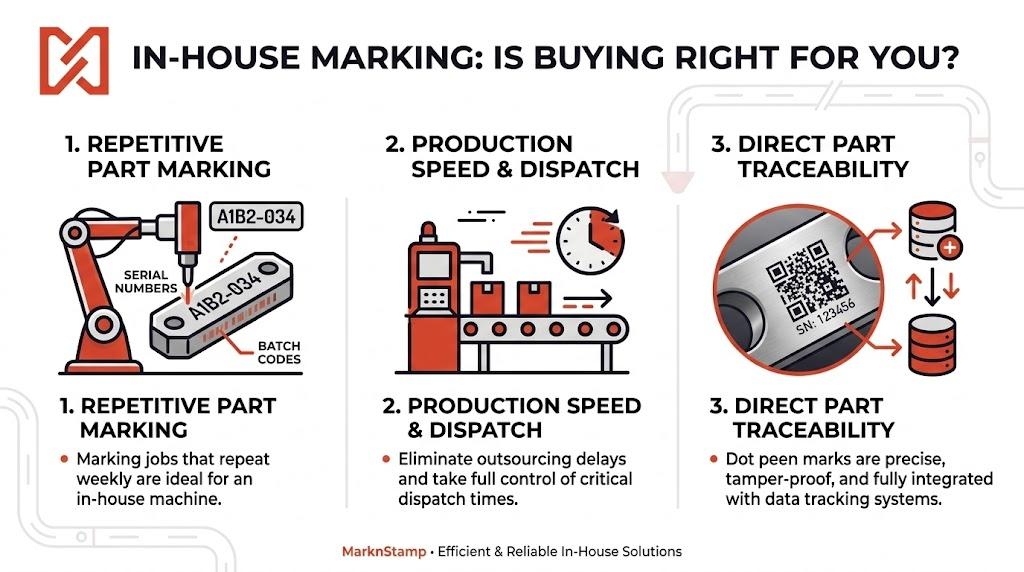
Buying usually wins when part marking is repetitive. It also wins when every delay affects dispatch. Dot peen is used widely in industries that need permanent, tamper-proof marks.
That makes sense in plants handling serial numbers, batch codes, QR codes, and direct part traceability. Dot peen marks are permanent, precise, and integrated with data systems for tracking.
Buying becomes stronger when the same marking job repeats every week. It also works better when you need in-house control for urgent jobs, irregular part sizes, or awkward geometries. Portable dot peen machines are useful for large, heavy, or hard-to-access parts.
What costs should you count in the ROI calculation?
ROI should not be judged by machine price alone. You must weigh purchase price, maintenance, operating cost, productivity, quality, and new revenue.
| Cost item | Buying a dot peen machine | Outsourcing marking |
| Upfront spend | High | Low |
| Per-part cost | Low after setup | Ongoing fee per part |
| Maintenance | Needs upkeep, but low consumables | Usually handled by vendor |
| Downtime risk | Lower once in-house | Higher if vendor is delayed |
| Flexibility | High | Depends on vendor capacity |
| Traceability control | Strong | Shared with third party |
Dot peen has virtually no consumable costs and minimal maintenance. That gives it an edge in long-run operating economics.
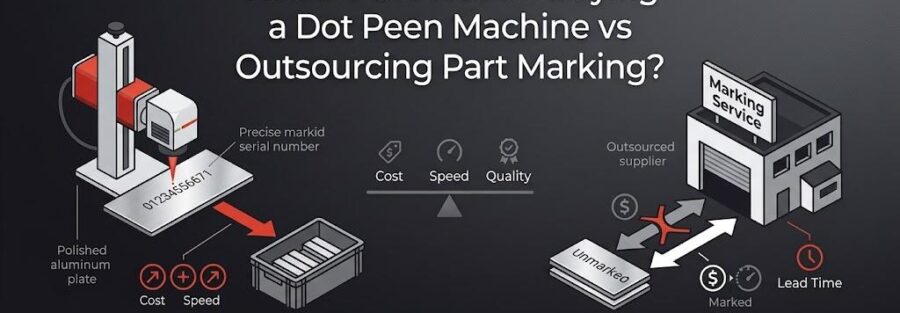
Outsourcing still has value. It avoids capital investment and suits low-volume or temporary projects. But each outsourced piece keeps carrying a recurring cost. That is where the crossover point appears.
How do you calculate the break-even point?
The quickest method is to compare monthly savings against machine cost. MarknStamp gives the ROI formula, and that is enough to build a practical payback model.
Use this simple framework:
Monthly savings = outsourcing cost per part – in-house cost per part
Payback period = machine cost / monthly savings
ROI = net gains / total cost × 100
Here is a realistic example.
If outsourcing costs ₹40 per part, and in-house marking costs ₹8 per part, you save ₹32 per part. At 500 parts a month, that is ₹16,000 monthly savings. If the machine costs ₹3,20,000, the payback is about 20 months. This is an example calculation, not a quoted market price. It shows the method, not a live offer.
Now the comparison gets sharper. If production rises to 1,000 parts a month, monthly savings double. The machine can then pay back much faster. That is why volume matters more than the sticker price.
When is outsourcing still the smarter choice?
Outsourcing still makes sense in three cases. The first is low volume. Entry-level machines suit low duty cycles under 100 parts per day.
The second is unpredictable demand. If part marking happens only sometimes, a vendor may be cheaper than owning a machine. The third is early-stage testing. Outsourcing lets you validate demand before buying engineering tools or a stamper machine.
| Situation | Better option | Why |
| Under 100 parts per day | Outsource or use entry-level gear | Lower capital risk. |
| High repeat volume | Buy dot peen | Lower cost per part. |
| Harsh industrial environments | Buy dot peen | Rugged, durable, and traceable. |
| Large, heavy parts | Buy portable dot peen | Easier access and flexibility. |
| Short-term jobs | Outsource | No idle machine cost. |
How does dot peen compare with an engraving machine laser?
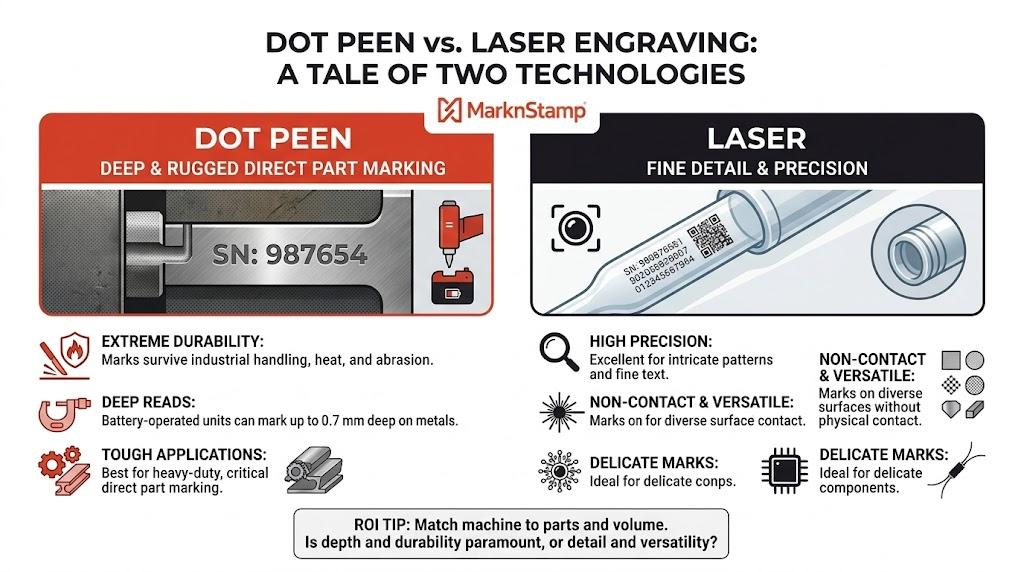
Laser and dot peen solve different problems. Laser is excellent for fine detail. Dot peen is tougher and better for heavy-duty deep reads.
For ROI, the question is not which machine is “better”. The question is which one matches your parts and volume. A laser can be the right engraving machine laser for delicate marks. A dot peen machine can be stronger for deep, rugged direct part marking.
Its battery-operated dot peen machine can mark up to 0.7 mm deep on metals. That depth can be useful when readability must survive abrasion, heat, and industrial handling.
What does a practical ROI decision look like for manufacturers in Thane and Mumbai?
For manufacturers in Thane and Mumbai, the local decision often comes down to service speed and production control.
That matters when marking sits inside the production flow. If a part waits for outsourcing, dispatch may slow down. If marking happens in-house, the line stays under your control.
Regular inspection and cleaning to keep the machine running smoothly.
A useful rule is simple. Buy when marking is frequent, permanent, and tied to traceability. Outsource when the volume is low, the demand is temporary, or the project is still being tested.
People also ask
Is a dot peen machine cheaper than outsourcing part marking?
Usually yes over time, if the volume is steady. The upfront cost is higher, but dot peen has low consumables and minimal maintenance.
How fast is the ROI on a dot peen machine?
It depends on monthly part volume and outsourcing cost. The more repeated the marking job, the faster the payback. ROI should include productivity and quality gains too.
When should I outsource instead of buying?
Outsource when marking volume is low or irregular. low-duty operations under 100 parts per day may suit entry-level or outsourced handling better.
Can a dot peen machine replace laser marking?
Not always. Laser is better for fine detail, while dot peen is better for deep, rugged marks on industrial parts.
Conclusion
The ROI on buying a dot peen machine is strongest when marking is frequent, permanent, and tied to traceability. Outsourcing is simpler at low volume, but it keeps the cost per part alive forever.
For many manufacturers, the smart answer is not “buy or outsource” in general. It is “which option gives lower total cost over your real production volume?” MarknStamp’s dot peen range, local support, and industrial focus make that comparison easier to test with a live sample or demo.
Check Products.