
Summary: Direct part marking (DPM) is the process of permanently applying a code, serial number, or identifier directly onto a component, rather than onto a label or tag attached to it. It is used for traceability, quality control, and regulatory compliance across automotive, aerospace, medical, and electronics manufacturing. The main DPM methods are dot peen, pneumatic, laser, and electrochemical marking, each creating a permanent mark that lasts the full life of the part.
Labels fall off. Ink fades. Tags get swapped.
For any part that has to be tracked for years, none of those are good enough, and that is precisely the problem direct part marking solves.
This guide explains what DPM is, why manufacturers rely on it, the methods used to create it, and how to choose the right system for your parts.
What is direct part marking (DPM)?
Direct part marking is the permanent application of an identifier straight onto the surface of a component, with no label, sticker, or tag involved. The mark becomes a physical part of the item, so it cannot fall off, be swapped, or wear away, unlike printed labels.
The word “direct” is the whole point. The information lives on the part itself.
That mark is usually a serial number, batch code, logo, or a 2D data matrix code that a scanner can read. Because it is permanent, it stays legible through machining, heat, cleaning, and years of service.
In short, DPM turns the component into its own identity document, which is exactly what modern traceability demands.
Why is direct part marking important?
Direct part marking is important because it enables permanent traceability, supports quality control, and meets strict regulatory requirements in safety-critical industries. When a part can be traced from raw material to end use, manufacturers can manage recalls, prove authenticity, and pass audits.
Regulation is often the deciding factor.
In medical devices, for example, the FDA requires that reusable, reprocessed devices carry a permanent UDI marked directly on the device under rule 21 CFR 801.45. A label simply will not survive repeated sterilisation, so direct marking is the only compliant option.
Aerospace and defence follow similar logic through standards like MIL-STD-130, which mandate permanent 2D codes on critical parts.
The commercial pull is just as real. The direct part marking machine market was valued at around USD 2.1 billion in 2023 and is forecast to reach USD 4.5 billion by 2032, driven by rising traceability demands across manufacturing.
What are the main direct part marking methods?
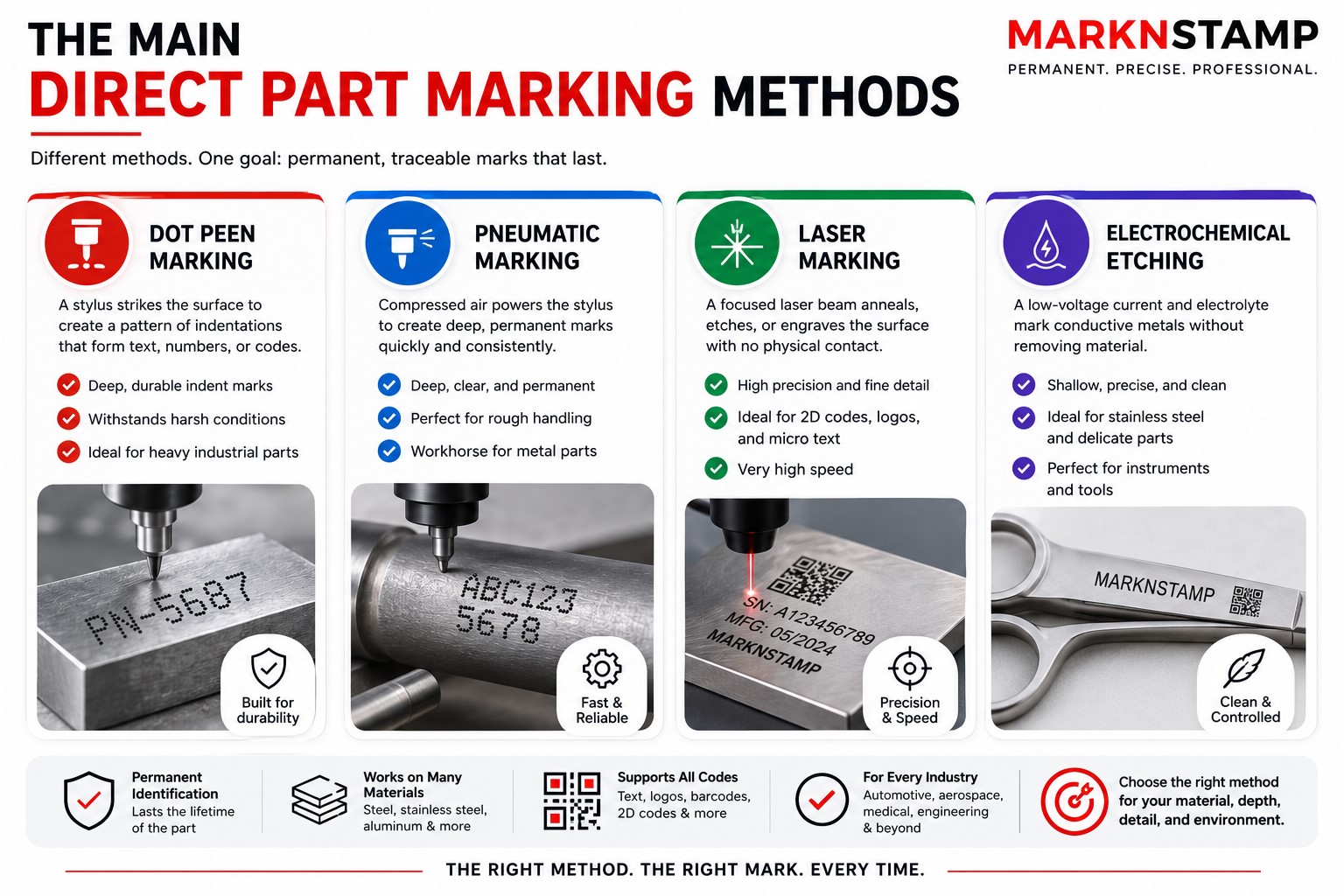
The main direct part marking methods are dot peen, pneumatic, laser, and electrochemical marking. Each applies a permanent mark using a different physical process, so the right choice depends on the material, the depth needed, and the production environment.
Here is how they differ.
Dot peen and pneumatic marking
Dot peen machines drive a stylus to punch a pattern of indentations that form characters and codes. A pneumatic marking machine uses compressed air to power that stylus, delivering deep, durable marks that survive shot blasting, painting, and rough handling. It is the workhorse for heavy metal parts.
Laser marking
Laser systems anneal, etch, or engrave the surface with a focused beam and no contact. They produce the finest detail and highest speed, making them ideal for tiny data matrix codes, logos, and micro-serial numbers on metal.
Electrochemical etching
Electrochemical etch uses a low-voltage current and electrolyte to mark conductive metals. It creates shallow, precise marks and is popular for stainless steel tools and surgical instruments where a light, clean mark is enough.
What can direct part marking encode, and how is it verified?
Direct part marking can encode human-readable text, serial numbers, logos, and 2D data matrix codes that scanners read automatically. The mark quality is then verified through grading systems that check contrast and readability, ensuring the code can be scanned reliably for the life of the part.
Data matrix codes are the DPM favourite because they pack a lot into a tiny mark.
Two things usually appear together on a compliant part: a plain-text version a person can read, and an automatic identification and data capture (AIDC) code a machine can scan. This dual format is what regulations like the FDA UDI rule expect.
Verification matters just as much as marking. A code that scans at the factory but fails after wear is useless, which is why quality-focused producers grade their marks rather than assume they are readable.
How do you choose a direct part marking machine?
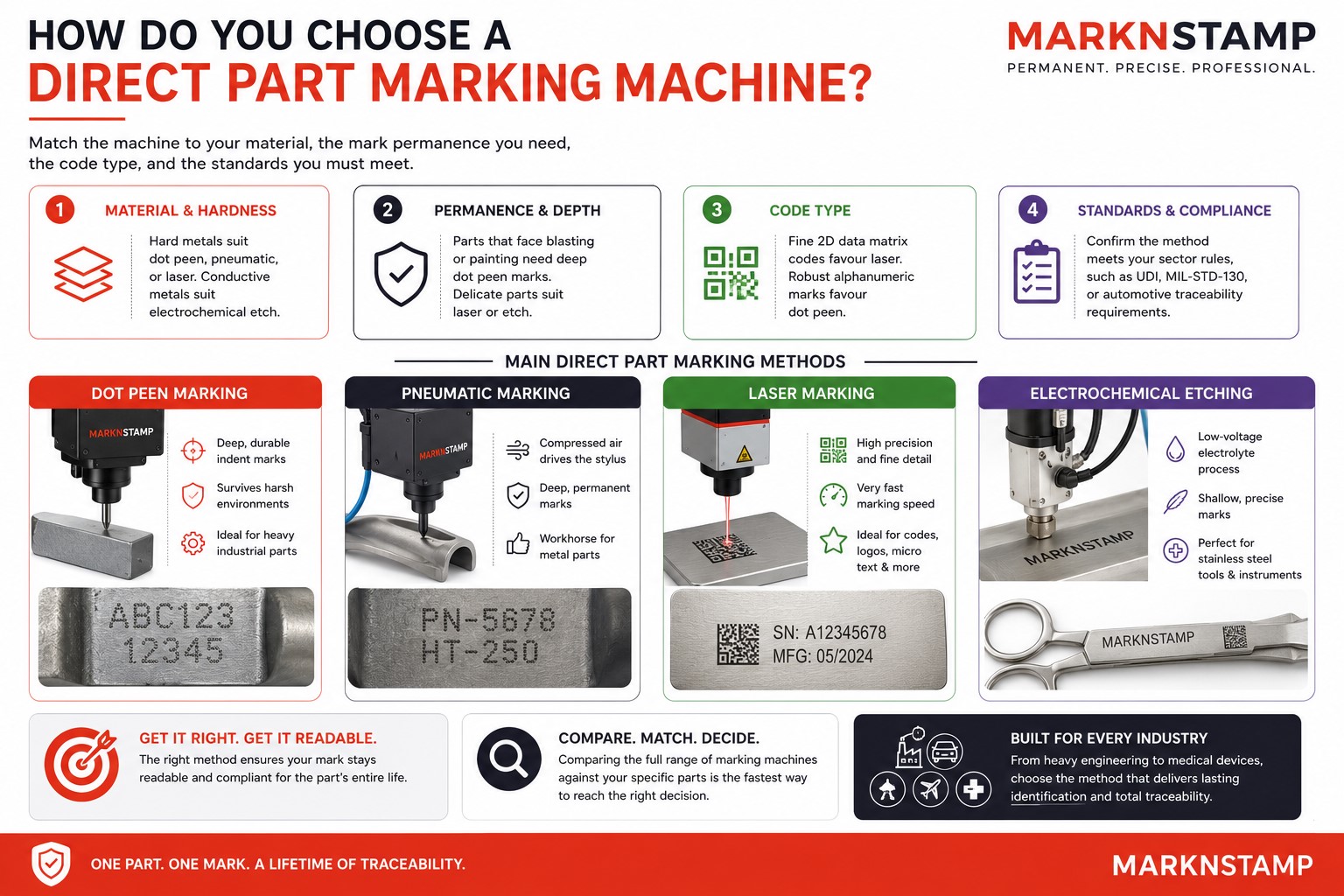
Choose a direct part marking machine by matching it to your material, the mark permanence you need, the code type, and any regulatory standard you must meet. Getting these four right ensures the mark stays readable and compliant for the part’s entire life.
Work through them in order:
- Material and hardness: hard metals suit dot peen, pneumatic, or laser; conductive metals suit electrochemical etch.
- Permanence and depth: parts that face blasting or painting need deep dot peen marks; delicate parts suit laser or etch.
- Code type: fine 2D data matrix codes favour laser, while robust alphanumeric marks favour dot peen.
- Standards: confirm the method meets your sector’s rules, such as UDI, MIL-STD-130, or automotive traceability requirements.
If you are weighing these factors, comparing the full range of marking machines against your specific parts is the fastest way to reach the right decision.
Frequently asked questions
What is direct part marking used for?
Direct part marking is used for permanent traceability, quality control, and regulatory compliance. It lets manufacturers track components from production to end use, manage recalls, prove authenticity, and meet standards in automotive, aerospace, medical, and electronics industries.
What is the difference between DPM and labelling?
DPM marks the identifier permanently onto the part itself, while labelling attaches a printed sticker or tag. Labels can peel, fade, or be swapped, whereas direct marks survive heat, cleaning, and wear for the part’s full life.
Which DPM method is most permanent?
Dot peen and pneumatic marking create the most durable marks, as the indentations survive shot blasting, painting, and rough handling. Laser engraving is also highly permanent, while electrochemical etching gives shallower marks suited to lighter-duty parts.
Can direct part marking be read automatically?
Yes. Most DPM codes, especially 2D data matrix codes, are designed for automatic identification and data capture. Handheld or fixed scanners read them instantly, which is why they are used for high-speed traceability on production lines.
Is direct part marking required by law?
In some sectors, yes. Medical device makers must directly mark reusable devices under FDA UDI rules, and aerospace and defence suppliers follow standards like MIL-STD-130. Requirements depend on the industry and the criticality of the part.
Why manufacturers choose Mark N Stamp
Getting direct part marking right means matching the method to the material, the code, and the regulation, and this is exactly where Mark N Stamp adds value.
The team helps manufacturers select the correct DPM technology, from pneumatic and dot peen to laser systems, all built for demanding Indian industrial conditions. The focus is on permanent, reliable marks backed by genuine technical support rather than a one-size sales pitch, so your traceability holds up under audit and in the field.
That practical, compliance-aware approach is what makes the brand a trusted name for direct part marking across automotive, engineering, medical, and manufacturing sectors.
Direct part marking has become the backbone of modern traceability, turning every component into a permanent, scannable record of its own history. Whether you are meeting a regulation or simply future-proofing your quality system, the right DPM method makes all the difference. Talk to our team today and explore the direct part marking machines built to keep your production permanent, compliant, and fully traceable.