Summary
Yes, a portable pneumatic marking machine can mark uneven or rough cast surfaces. MarknStamp says dot peen works on flat, curved, and uneven surfaces. Mark quality still depends on fixturing, surface condition, and stylus choice. Rough, oily, or dirty surfaces can cause skips or inconsistent marks. MarknStamp’s portable pneumatic machine uses linear X and Y axes for consistent depth. It also offers several stylus assemblies and cable lengths. For Indian factories, this matters in automotive, aerospace, oil and gas, and engineering tools. MarknStamp lists those as key industries served.
Introduction
Rough cast parts are hard to mark cleanly. That is why many buyers ask whether a portable pneumatic marking machine can handle them. A 2025 market report valued industrial marking equipment at about USD 34.1 billion, and projected USD 54.6 billion by 2035. Demand is rising because manufacturers want precise, traceable marks.
The challenge is real on cast surfaces. They are often textured, uneven, and inconsistent. That can affect mark depth, clarity, and repeatability. Buyers in India need a machine that works on real shop-floor parts, not perfect sample plates.
This guide explains the answer in plain language. You will see when a pneumatic marking machine works well on rough castings, what limits to expect, and how MarknStamp’s portable system helps in Indian industrial use.
Can a portable pneumatic marking machine mark uneven or rough cast surfaces?
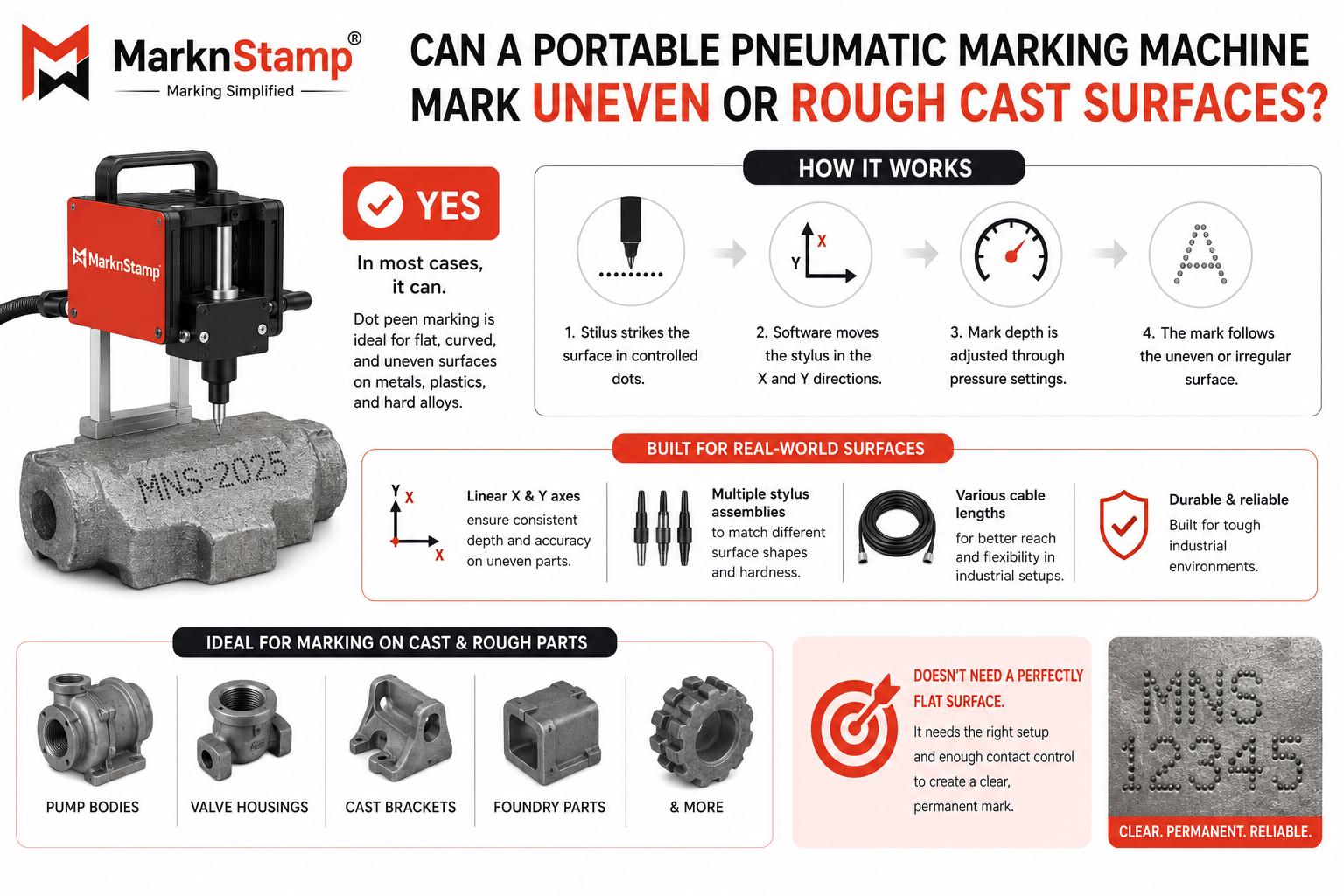
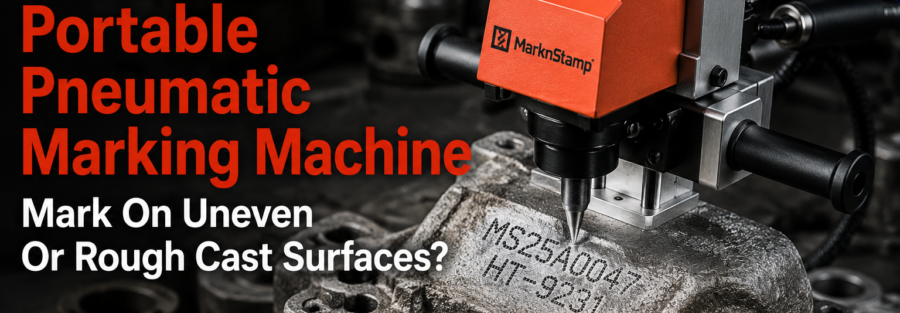
Yes, in most cases it can. MarknStamp says dot peen marking is ideal for flat, curved, and uneven surfaces on metals, plastics, and hard alloys. That makes it suitable for many cast parts.
The reason is simple. The stylus strikes the surface in controlled dots. The machine’s software moves the stylus in the X and Y directions. Mark depth is also adjusted through pressure settings. That combination helps the mark follow irregular geometry.
MarknStamp’s portable pneumatic machine also uses linear X and Y axes for consistent depth. It comes with several stylus assemblies and cable lengths. That makes it easier to adapt to different industrial parts and layouts.
For foundry parts, pump bodies, valve housings, and cast brackets, that is useful. The machine does not need a perfectly flat finish to create a readable mark. It needs the right setup and enough contact control.
What affects mark quality on rough castings?
Surface condition is the first factor. MarknStamp says poor fixturing, oily surfaces, dirty parts, or rough surfaces can make the stylus skip or mark inconsistently. So rough cast parts are possible, but they need better preparation.
Stylus choice matters too. MarknStamp lists LP-10 for steel marking and LP-06 for aluminium marking in the portable pneumatic machine’s technical details. The correct stylus helps maintain clear marks on harder materials and tougher textures.
Depth settings also matter. A rough casting may need a stronger, more visible mark than a smooth plate. But too much force can distort the area. The goal is balance, not maximum pressure.
A practical test is always best. Try a sample mark on the same casting finish first. That is the safest way to judge visibility, depth, and readability before full production.
Which cast parts and industries benefit most in India?
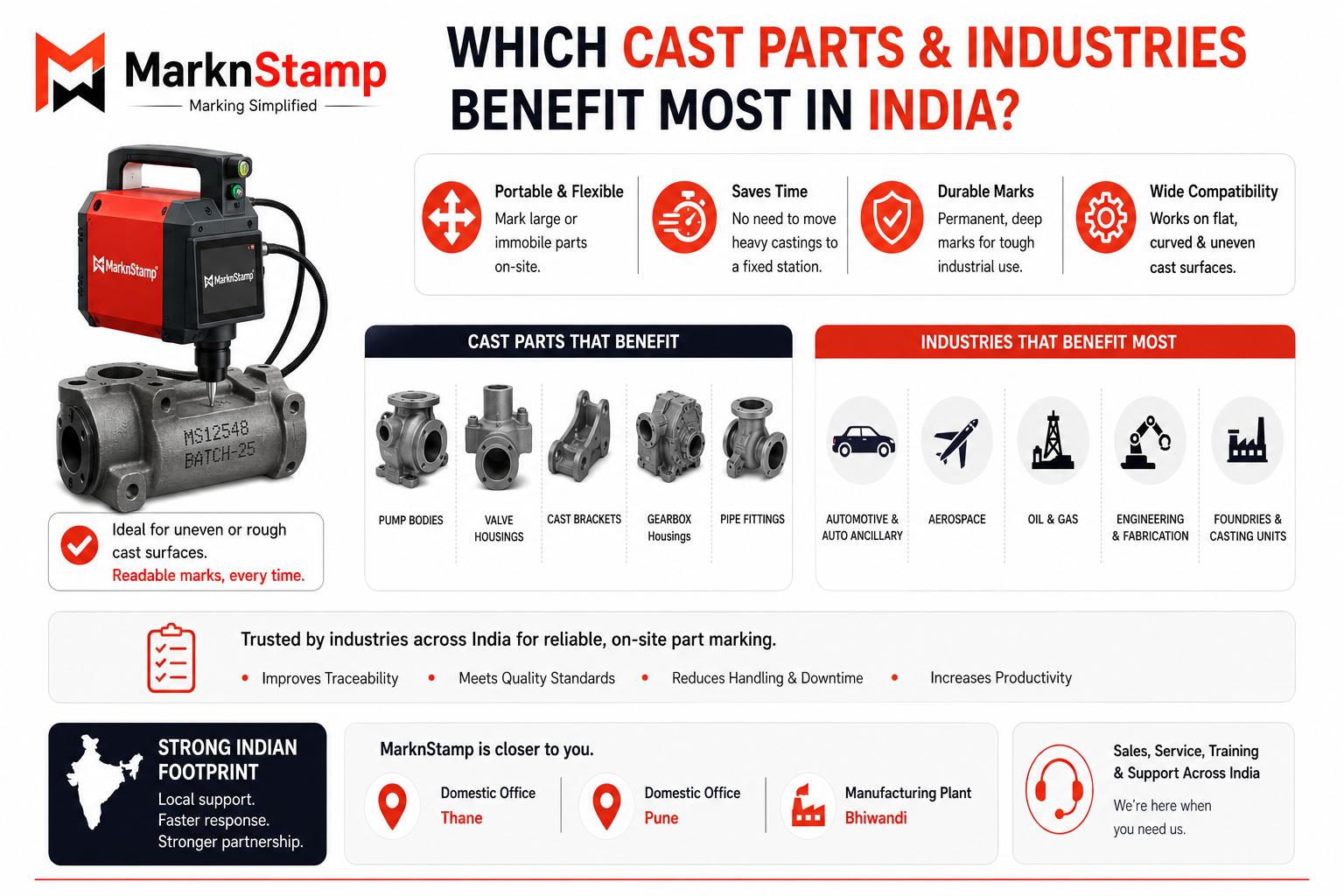
Portable pneumatic marking is especially useful when parts are large or immobile. MarknStamp says portable marking machines are meant for flexible, mobile use and are heavily relied on in automotive, aerospace, and oil and gas work.
That fits many Indian use cases. A foundry in Pune may need serial numbers on cast housings. An engineering tools unit in Thane may need batch IDs on rough components. An oil and gas supplier may need durable part codes on heavy fittings.
MarknStamp also lists domestic offices in Thane and Pune, plus a manufacturing plant in Bhiwandi. For buyers in Maharashtra and across India, that local footprint can matter for service, training, and support.
The main advantage is workflow. You do not need to move a heavy casting to a fixed station every time. You can bring the portable pneumatic marking machine to the part instead. That reduces handling and saves time.
When should you choose a different machine?
Choose a different machine when the job is very simple. MarknStamp says a pneumatic stamp punching machine works well for simple deep impressions. That can be enough for low-detail marks on rugged metal parts.
Choose portable dot peen or pneumatic marking when traceability matters more. MarknStamp positions dot peen for serials, logos, and QR support. It also says dot peen is the best all-round choice for most metal-marking jobs in India.
That makes the choice clear. If the cast part needs a deep punch and nothing else, a stamper machine can be enough. If the part needs readable data and repeatability, a pneumatic marking machine is stronger.
For engineering tools, automotive components, and industrial tags, the portable pneumatic option is usually the more flexible one. It gives better control on uneven geometry and more consistent identity marking.
How can you get better results on rough cast surfaces?
Start with cleaning. Dust, oil, and loose sand can interfere with the stylus. MarknStamp says surface preparation and proper fixturing are important for consistent dot peen marks.
Then match the stylus to the material. Harder cast parts need a tougher stylus choice. Softer surfaces need a gentler setup. The right setup helps the mark stay clear without excessive wear.
Next, test the mark before production. Check the mark from normal viewing distance. On cast surfaces, readability matters more than perfection. A mark that stays legible under shop-floor conditions is the real goal.
Finally, use the portable design to your advantage. MarknStamp’s machine is built for diverse industrial applications and can be adapted to a tabletop version. That flexibility helps in workshops handling mixed part sizes.
What do people usually ask before buying one?
Can a portable pneumatic marking machine work on rough cast iron?
Yes, usually. Dot peen is suitable for uneven and rough surfaces, but surface cleaning and proper fixturing improve the result a lot.
Will the mark stay readable on a casting with texture?
Often yes. The mark may need a deeper or clearer setup, but dot peen is designed for permanent, legible marks on difficult surfaces.
Do I need a flat surface for pneumatic marking?
No. MarknStamp says dot peen can work on curved and uneven surfaces. Flat surfaces are easier, but they are not required.
Is a stamper machine better for rough cast parts?
Only for simple deep impressions. For serial numbers, logos, and traceability, dot peen or portable pneumatic marking is usually the better choice.
Conclusion
Yes, a portable pneumatic marking machine can mark uneven or rough cast surfaces. MarknStamp’s dot peen technology is designed for flat, curved, and uneven parts. Its portable pneumatic machine also adds consistent depth control and flexible stylus options.
The real limitation is not the machine alone. It is the surface condition, fixturing, and stylus choice. With proper setup, the machine can produce durable marks on many cast components used across Indian industry.
For foundries, engineering tools units, and OEM suppliers, that is a practical advantage. Check products at MarknStamp or talk to expert support before choosing the final setup.