Summary: Fiber laser marking uses a beam generated inside a rare-earth-doped optical fibre to create permanent, high-contrast marks on metal and hard plastics without touching the surface. It is preferred over other laser marking machines because it is more energy efficient, longer lasting, and ideal for metal. Fibre lasers are used to mark serial numbers, barcodes, logos, and traceability codes across automotive, aerospace, medical, and electronics manufacturing.
Walk through any modern factory and you will find fibre lasers quietly marking thousands of parts a day.
They have become the default technology for permanent metal marking, and for good reason.
This guide explains exactly how fibre laser marking works, where its advantages come from, and which applications it suits best, so you can judge whether it fits your production line.
How does fiber laser marking work?
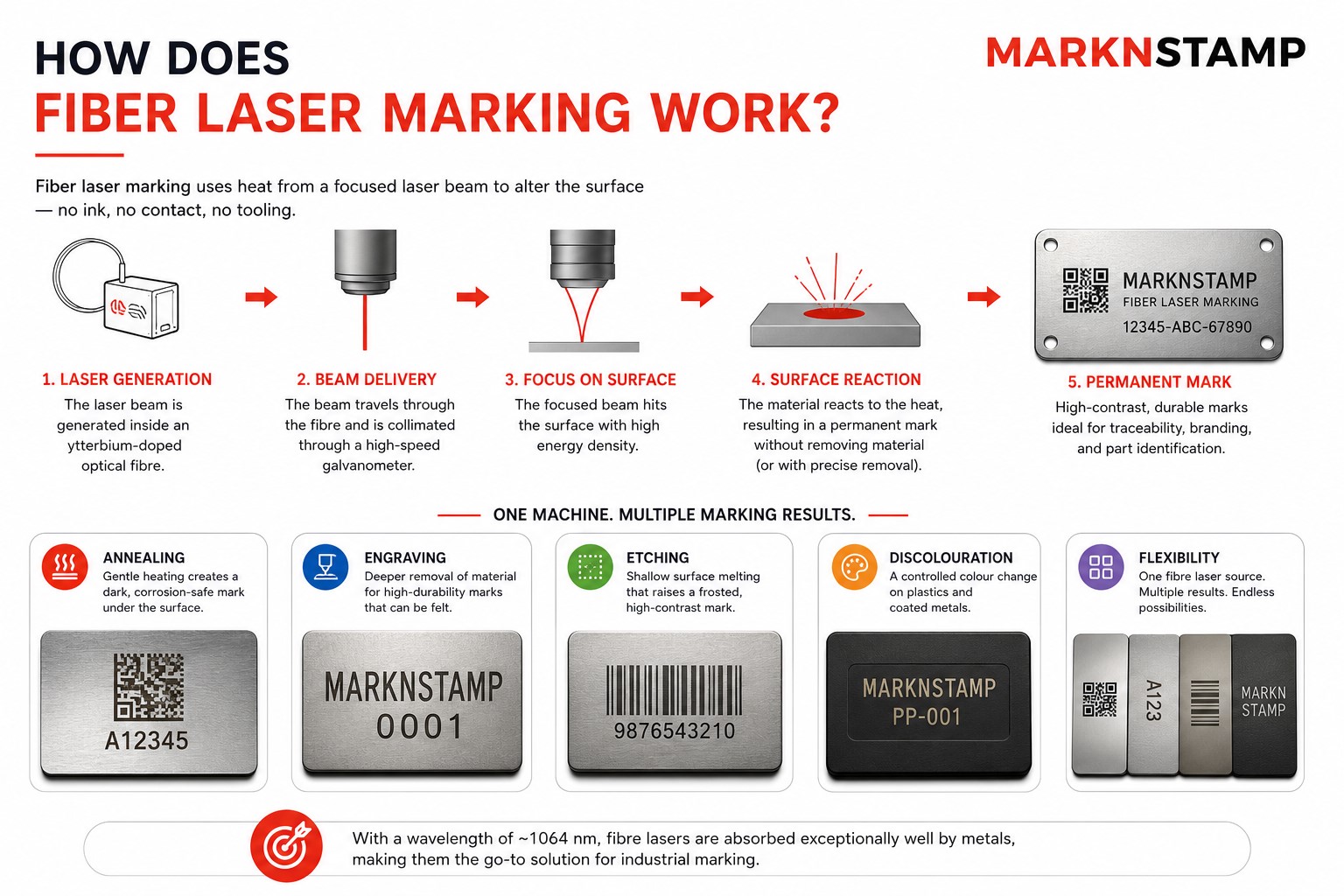
Fiber laser marking works by generating a laser beam inside an optical fibre doped with a rare-earth element, usually ytterbium, then focusing that beam onto a surface to alter it with heat. The mark is created by the material’s reaction to the beam, with no ink, contact, or tooling involved.
The beam sits at a wavelength of around 1064 nanometres, which metals absorb extremely well.
Depending on the power and speed settings, the same machine can produce several different marks:
- Annealing: gentle heating that creates a dark, corrosion-safe mark under the surface, ideal for stainless steel.
- Engraving: deeper removal of material for high-durability marks that can be felt.
- Etching: shallow surface melting that raises a frosted, high-contrast mark.
- Discolouration: a controlled colour change on plastics and coated metals.
That flexibility from one source is a big reason fibre systems have replaced so many single-purpose tools.
What are the advantages of fiber laser marking?
The advantages of fiber laser marking include high energy efficiency, long service life, low maintenance, and outstanding results on metal. These same strengths sit behind the wider benefits of laser marking machines: permanent, traceable marks produced at speed with no consumables.
Here is what sets fibre apart:
- Energy efficient: it converts far more electricity into useful beam than older technologies.
- Long lasting: the solid-state source commonly runs for around 100,000 hours.
- Low upkeep: no gas, no mirrors to align, and no consumables to reorder.
- Metal specialist: steel, aluminium, brass, copper, and titanium all mark cleanly.
- Compact: many units are small enough for benchtop or handheld use.
The efficiency point is not marketing fluff. Fibre lasers reach a wall-plug efficiency of 30% to 50%, against roughly 10% to 15% for CO2 lasers.
Over a full production year, that difference shows up directly on the electricity bill. It also helps explain the technology’s momentum: the global fibre laser market is projected to grow from USD 7.70 billion in 2024 to USD 12.82 billion by 2029, driven largely by manufacturing automation.
Fiber laser vs CO2 laser: what is the difference?
The main difference is that fibre lasers excel at marking metal and are far more energy efficient, while CO2 lasers suit organic materials like wood, paper, glass, and some plastics. Choosing between them comes down to the material you mark most often.
They are complementary tools, not rivals for the same job.
| Feature | Fibre laser | CO2 laser |
| Best materials | Metals, hard plastics | Wood, glass, paper, leather |
| Wavelength | ~1064 nm | ~10,600 nm |
| Efficiency | 30 to 50% | 10 to 15% |
| Maintenance | Very low | Higher (gas, optics) |
| Lifespan | ~100,000 hours | Shorter |
For a metal-marking factory, fibre wins on nearly every count. If your work is mostly non-metal, a CO2 system may serve you better, which is why it helps to review the full range of marking machines before committing.
What are the applications of fiber laser marking?
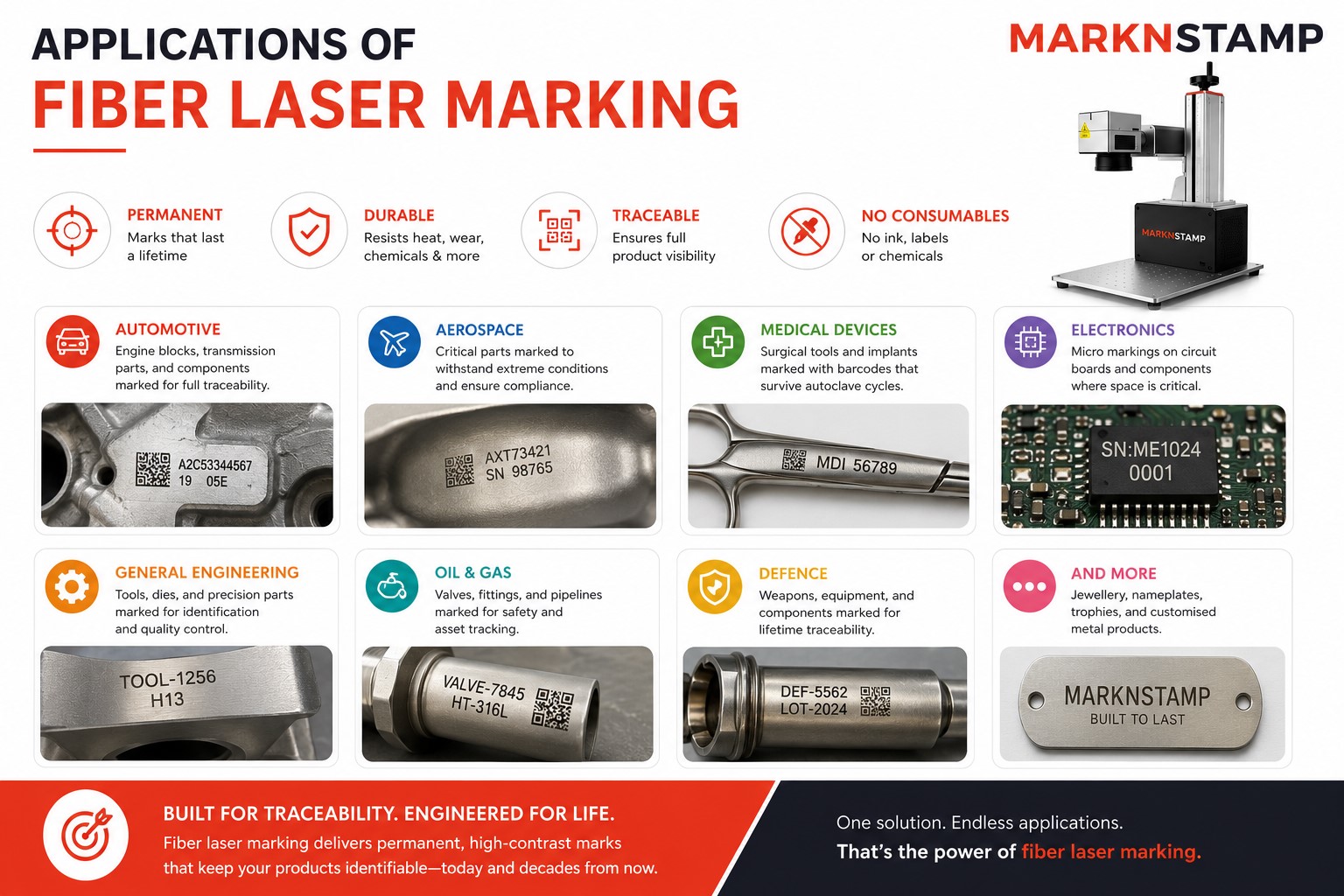
Fiber laser marking is applied across automotive, aerospace, medical devices, electronics, and general engineering, wherever permanent, traceable identification is needed on metal. The mark must survive heat, wear, chemicals, and years of service, which rules out ink and labels.
Real examples make the range clear.
In automotive plants, engine blocks and transmission parts receive laser-marked part numbers that stay legible through oil, heat, and vibration. Medical instrument makers anneal barcodes onto surgical tools that endure repeated autoclave cycles without corroding.
Electronics manufacturers mark micro-serial numbers onto circuit boards where nothing else fits. Aerospace suppliers mark critical components that face extreme temperature swings yet must remain identifiable for decades.
For anyone weighing up an engraving machine for metal, these traceability-driven applications are usually the deciding factor.
How does fiber laser marking compare to a traditional stamper machine?
Fiber laser marking produces permanent, high-detail marks without contact, while a traditional stamper machine physically presses or indents the mark into the surface. Laser suits fine codes and delicate parts, whereas mechanical stamping suits deep, simple marks on tough material.
A mechanical stamper is fast, rugged, and cheap to run for basic identification.
But it has limits. It applies force to the part, which can distort thin components, and it struggles with intricate logos, tiny data-matrix codes, or fine serial text. It also wears down over time and needs replacement dies.
A fibre laser has none of those constraints. It marks the finest detail on the most delicate part without ever touching it. For heavy, low-detail marking a stamper still earns its keep, but for permanent traceability at high resolution, fibre is the modern standard.
Frequently asked questions
What materials can a fiber laser mark? Fibre lasers mark almost all metals, including steel, stainless steel, aluminium, brass, copper, and titanium, plus many hard plastics. They are less suited to organic materials like wood or glass, where CO2 lasers perform better.
Is fiber laser marking permanent? Yes. Fibre laser marking permanently alters the surface through annealing, engraving, or etching, so the mark resists heat, chemicals, and abrasion. It will not fade, smudge, or wear away over the part’s lifetime.
Is fiber laser marking better than CO2 for metal? Yes, for metal, fibre lasers are clearly better. Their 1064 nm wavelength is absorbed strongly by metal surfaces, giving cleaner marks, higher efficiency, and lower maintenance than CO2 lasers, which suit non-metal materials.
How long does a fiber laser source last? A fibre laser source typically lasts around 100,000 hours of operation. Because it is solid-state with no gas or mirrors, it needs very little maintenance, making it reliable for high-volume, continuous production environments.
Does fiber laser marking use consumables? No. Fibre laser marking needs only electricity and the beam itself. There are no inks, gases, acids, labels, or tool bits to replace, which keeps running costs low and eliminates storage and disposal of materials.
Why manufacturers trust Mark N Stamp
Selecting the right fibre laser system depends on your materials, volumes, and marking detail, and this is where Mark N Stamp adds real value.
The team helps manufacturers match the correct marking technology to the job, from fibre laser to dot peen and portable systems, all built for demanding Indian industrial conditions. The focus is on durable, low-maintenance equipment supported by genuine technical guidance rather than a one-size sales pitch.
That practical, industry-first approach is what makes the brand a trusted name for permanent part marking across automotive, engineering, and electronics manufacturing.
Fibre laser marking has earned its place as the standard for permanent metal identification, combining efficiency, precision, and marks that outlast the parts themselves. If you are considering an upgrade or your first system, the smartest step is to speak to specialists who can assess your parts and production needs. Talk to our team today and explore the fibre laser marking machines built to keep your line accurate, compliant, and running.