By Mark N Stamp | 11 min read
Meeting OEM traceability standards means every part carries a permanent, readable mark that links it to its batch, process data and supplier, for as long as the vehicle is on the road. In practice you need a metal marking machine that puts the right content, in the right format, in the right place, at a quality your customer’s scanners can read every time. Dot peen and laser both qualify; the part decides which.
Key insights
- OEM specs are about the data, not the marker: content, format, location and readability come first, the machine follows.
- IATF 16949 makes traceability a system requirement: the mark is only one link in a chain your auditors will check end to end.
- 2D codes are now standard on many parts: a Data Matrix carries far more data than text in the same space.
- Integration is half the job: the marking machine has to take data from your system and confirm back that it marked.
Before you quote
Ask your customer for their part marking specification before you price the job, not after. Most OEMs and Tier 1s have one. It’ll tell you the content, code type, size, location and quality grade they expect, and every one of those affects which machine you need.
If you supply the automotive industry, you already know traceability isn’t optional. When a fault turns up in the field, the OEM wants to know exactly which parts are affected, and they want to know fast.
The scale makes that obvious. NHTSA reported that just over 27.7 million vehicles were recalled in the US in 2024. Every recall starts with the same question: which parts, from which batch, made when, by whom? The tighter your traceability, the smaller your share of that answer.
This guide covers what OEMs typically expect from part marking, where the standards come from, and how to set up marking that passes the audit and the scanner.
What do automotive OEMs expect from part marking?
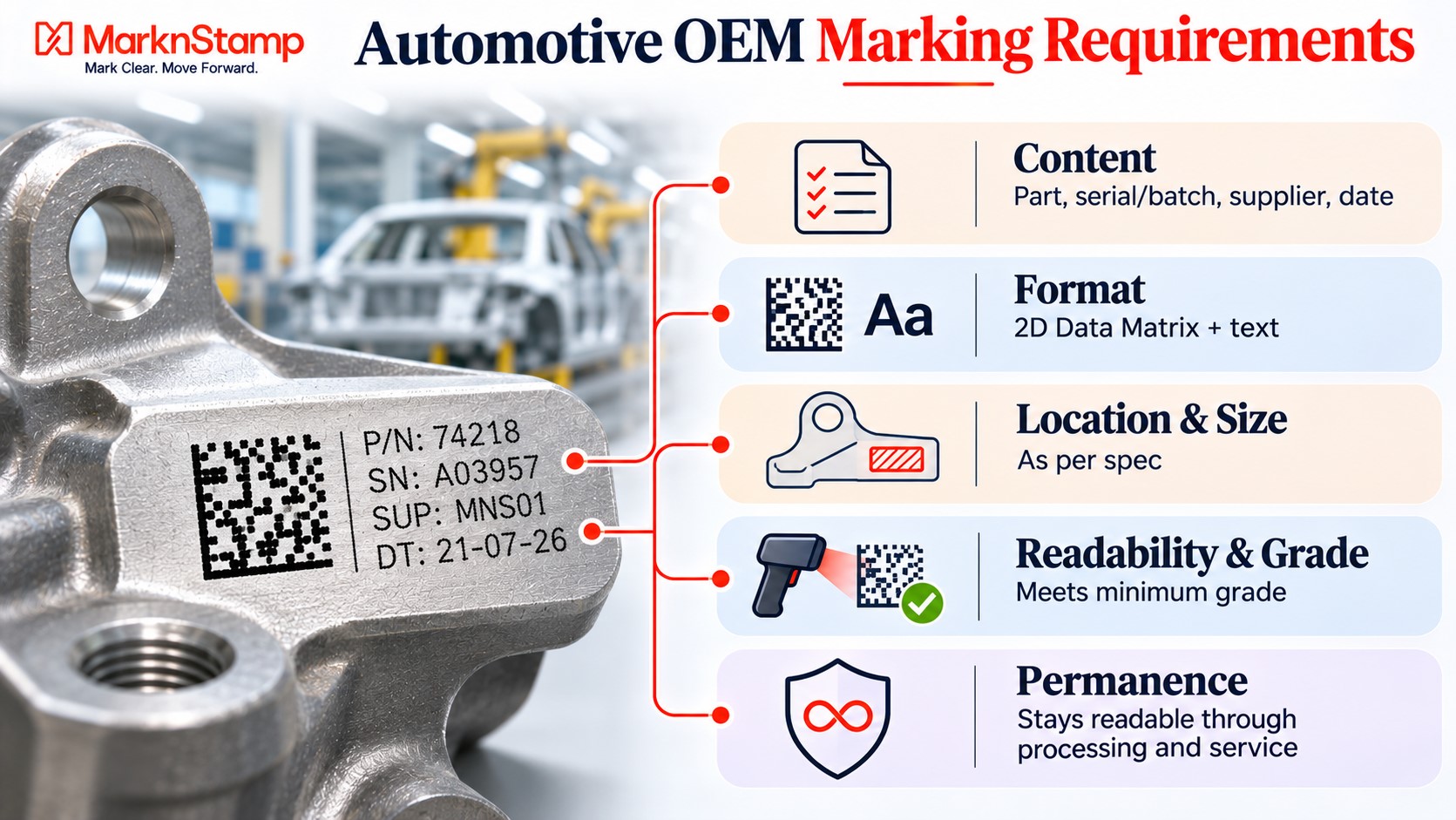
OEMs expect a permanent mark that carries agreed content, in an agreed format and location, readable by machine at every point the part is scanned. The details live in each customer’s own specification, but most cover the same ground.
Content
Usually a part number, a serial or batch number, a supplier code and a date or shift code. Some parts add process data references, such as a heat treatment lot or a test result ID.
Format
Many parts now carry a 2D Data Matrix code alongside human-readable text. The code feeds scanners on assembly lines; the text lets a person check it without one.
Location and size
The spec often fixes where the mark goes and how big it is, so automatic readers on the customer’s line can find it. A perfect mark in the wrong place still fails.
Readability and grade
Many customers set a minimum print-quality grade for 2D codes and expect you to verify it. A code that only scans at the third attempt isn’t good enough.
Permanence
The mark must last the part’s working life, through machining, washing, coating, assembly and years of service.
Where do these standards come from?
Most automotive traceability requirements come from three places: the quality management standard, industry guidelines and each OEM’s own spec.
IATF 16949
IATF 16949 is the automotive quality management standard, and its identification and traceability requirements turn marking into an audited system rather than a shop-floor habit. Adoption is wide: VDA QMC counts 93,713 IATF 16949 certified locations worldwide. If you supply OEMs, you’re almost certainly one of them or supplying one.
AIAG guidelines
In North America and beyond, AIAG guidelines are widely referenced for part identification. Their direct part marking guidance covers marking and reading Data Matrix and QR codes by laser, dot peen and inkjet.
Customer-specific requirements
On top of the general standards, every OEM and Tier 1 adds its own rules. These are the ones auditors check first, so keep the latest version on file for every customer.
| Source | What it governs | What you need to do |
| IATF 16949 | Traceability as part of your quality system | Prove the chain from raw material to dispatched part |
| AIAG guidance | How 2D codes are marked and read | Mark and verify codes to the agreed quality |
| Customer spec | Content, format, size, location, grade | Match it exactly, part by part |
Which marking method suits which automotive part?
Choose by material, part size, what happens to the part after marking, and line speed. Dot peen and laser both meet OEM requirements when they’re matched to the part.
| Part type | Typical method | Why |
| Engine blocks, heads, crankshafts | Dot peen | Deep, permanent marks that survive machining and washing |
| Rough castings and forgings | Pneumatic dot peen | Copes with uneven surfaces and scale |
| Chassis and structural parts | Dot peen | Survives coating, e-coat and harsh service |
| Precision machined parts | Laser | Small, high-grade codes on finished faces |
| Sensors, electronics housings, plastics | Laser (fibre, CO2 or UV) | Non-contact, fine detail, non-metals |
| Nameplates and VIN-style plates | Dot peen with plate clamping | Repeatable position, deep text |
When dot peen is the safer choice
If the part is machined, washed, painted or e-coated after marking, a dot peen indentation is far more likely to stay readable. It’s also more forgiving on rough castings.
When laser is the better choice
If the part leaves your cell as marked and needs a small, high-grade code at line speed, laser usually wins. It’s also the answer for plastics and electronics.
How do you build a marking process that passes audit?
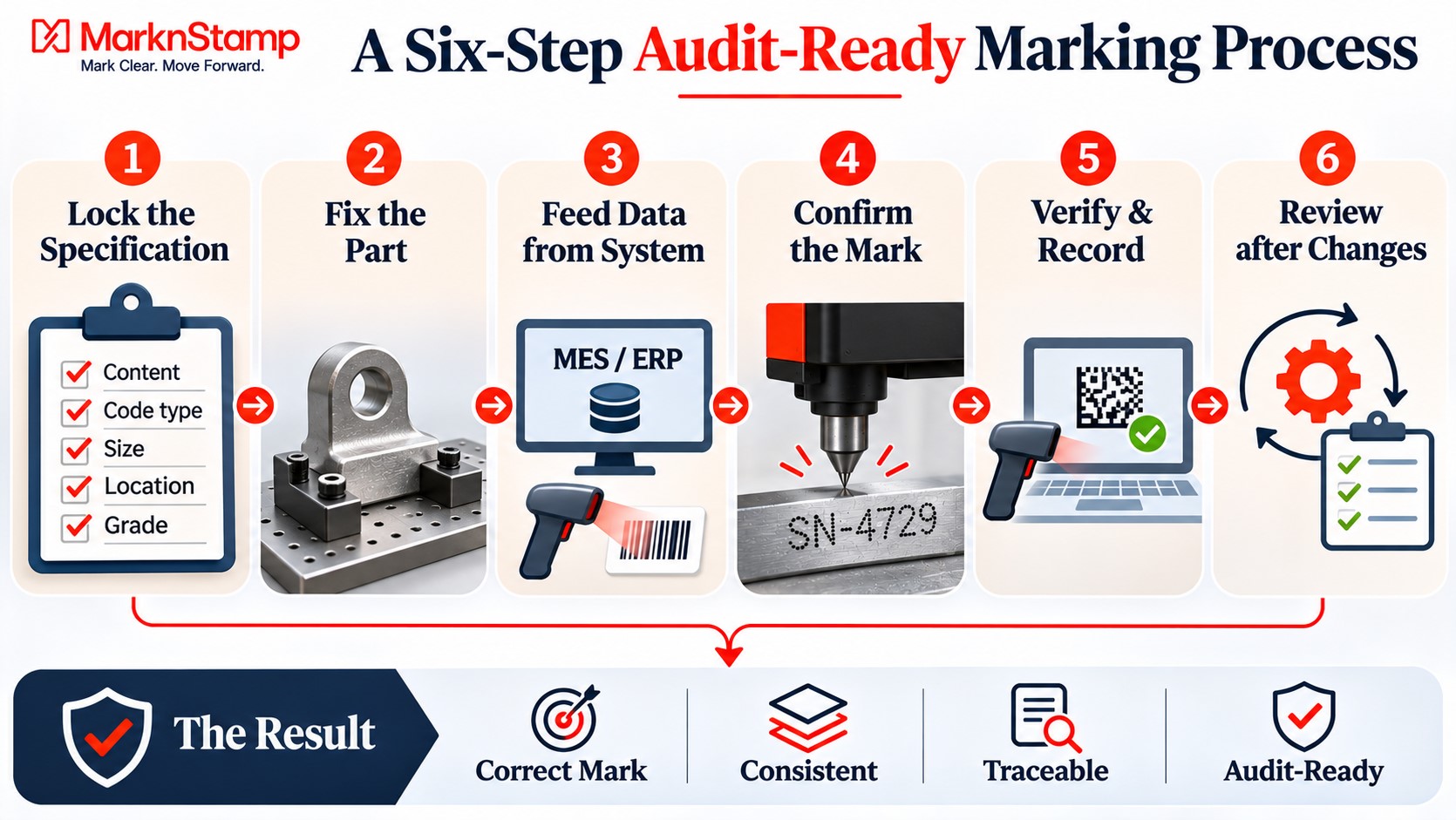
Follow these steps and you’ll have something an auditor can trace from end to end.
1. Lock the specification
Collect each customer’s marking spec and turn it into a one-page sheet per part: content, code type, size, location, grade and permanence. That sheet becomes the reference for programming the machine.
2. Fix the part in the same place every time
Consistent location starts with fixturing. A dedicated fixture or nest means the mark lands in exactly the same position on every part, which automatic readers depend on.
3. Feed data from your system, not the keyboard
Typing serials by hand invites errors. Pull the data from your MES or ERP, or scan it from a barcode, so the machine marks exactly what the system expects.
4. Confirm the mark was made
Use the machine’s outputs to signal end of marking and errors back to your line or PLC. That way a part can’t move on unmarked.
5. Verify and record
Scan every code, or a defined sample, with a verifier or reader. Store the result against the serial so you can prove quality later.
6. Review after every change
New materials, new coatings or a new customer spec all mean a quick revalidation. Keep a record of it for the next audit.
Which machines fit an automotive line?
Pick by the part, then by how the machine connects to your line.
Stand-alone dot peen stations
For parts loaded at a bench, the MNS-PC computer based marking machine marks Data Matrix and QR codes, connects over Ethernet or Wi-Fi, takes five inputs for automatic design selection and gives two outputs for end of marking and errors. That’s the kind of handshake an audited line needs.
Dot peen built into the line
Where parts move automatically, integration heads mount straight onto your machine or conveyor. They come in pneumatic and electric versions, with marking windows from 50 x 30mm to 120 x 100mm and linear guides on both axes for uniform depth.
Laser stations
For finished parts and high-grade codes, an enclosed laser such as the Stallion XL Station offers fibre, CO2 or UV sources, Class 1 safety, a large working area and built-in fume extraction, on wheels so it can move with your cell layout. Our post on laser marking machines for automotive parts covers the laser side in more depth.
If you’re not sure which of these your parts call for, share the spec and a sample. A test mark on the real part, read by the real scanner, settles it quickly.
Why choose Mark N Stamp for automotive traceability?
We design and build dot peen and laser marking systems in India and supply manufacturers in the automotive, aerospace and heavy engineering sectors. Because we make both technologies, we can recommend the method that fits your part rather than the one we happen to sell.
Our team helps with the parts that make or break an audit: fixturing for repeatable location, data links to your systems, and test marks verified on your own parts. And if you want the bigger picture on why serials matter so much, read our piece on why serial numbers are the backbone of modern manufacturing.
Wrapping up
OEM traceability comes down to a simple promise: every part can be identified, quickly and reliably, for its whole life. The right Marking Machine is the one that keeps that promise on your parts, in your process, for your customer’s scanners.
Start with the spec, fix the location, connect the data and verify the result. If you’d like help setting that up, talk to our team and send us a sample to test.
FAQs
What is automotive part traceability?
It’s the ability to identify any part and trace it back to its batch, materials, process data and supplier. A permanent mark, often a Data Matrix code, links the physical part to those records for its whole life.
Does IATF 16949 require part marking?
IATF 16949 requires identification and traceability as part of the quality system. It doesn’t dictate one marking method, but customer-specific requirements usually specify the mark’s content, format and location.
Which metal marking machine is best for automotive parts?
It depends on the part. Dot peen suits engine parts, castings and anything coated after marking. Laser suits finished precision parts, electronics and plastics where small, high-grade codes are needed.
Can a dot peen machine mark Data Matrix codes for OEMs?
Yes. Dot peen machines such as table top and computer based models mark Data Matrix and QR codes. Cells are larger than laser codes, so check the code size fits your customer’s specified location.
How do I stop wrong serial numbers being marked?
Feed serials from your MES, ERP or a barcode scan instead of typing them, and use the machine’s outputs to confirm each mark. Verifying codes after marking catches any remaining errors before parts ship.
Do I need to verify 2D code quality?
Often, yes. Many OEMs set a minimum print-quality grade for 2D codes. Verifying with a code verifier or reader, and recording the result, gives you proof if a customer or auditor asks.