By Mark N Stamp | 9 min read
Automatic nameplate clamping on a dot peen engraving machine beats manual punching on speed, consistency and accuracy. The plate is gripped in the same spot every time, the text comes straight from a file or a barcode, and serial numbers change without anyone picking up a punch. Manual punching still works for a handful of one-off tags, but once you’re making them every day, it costs you in time, rework and wrong numbers.
Key insights
- Manual punching relies on the person: every character is chosen, aligned and struck by hand, so every character is a chance for an error.
- Clamping fixes position: a nameplate clamping device holds each plate in exactly the same place, so text lines up plate after plate.
- Data entry is where the wrong numbers come from: pulling serials from a file or barcode removes most of the typing.
- Pneumatic clamping speeds up batches: load, clamp, mark, release, with no hand-tightening between plates.
Before you go
Pull last month’s rejected or re-made tags out of the scrap bin and sort them by fault: wrong character, crooked line, faint strike, bent plate. The biggest pile tells you exactly which part of the process to fix first.
Almost every manufacturer makes nameplates. Pumps, motors, valves, compressors, pressure vessels and control panels all leave the factory with a metal tag showing the model, serial number, ratings and date.
In many workshops, those tags are still made the old way. Someone sits at a bench with a set of letter punches and a hammer, picks each character, lines it up by eye and strikes it. It works, and it’s cheap to start. But it’s slow, it’s tiring, and it’s surprisingly easy to get wrong.
This guide compares manual punching with a dot peen engraving machine fitted with nameplate clamping, step by step, so you can see where the time and the mistakes actually come from.
How does manual punching compare with clamped dot peen marking?
The difference is who controls each character. With manual punching, a person does. With clamped dot peen, the machine does, from data it’s given.
| Manual punching | Dot peen with nameplate clamping | |
| How text is chosen | Pick each punch by hand | Typed, loaded from a file or scanned |
| Alignment | By eye, character by character | Fixed by the clamp and the program |
| Depth | Varies with each hammer blow | Set by force setting, even across the plate |
| Serial numbers | Changed by hand every plate | Changed automatically |
| Logos and 2D codes | Not practical | Possible on suitable machines |
| Plate distortion | Common on thin plates | Lower, force adjustable |
| Operator fatigue | High over a shift | Low |
| Best for | A few one-off tags | Daily or batch tag production |
Where manual punching still makes sense
If you make a few tags a month, with no codes and no tight layout, a punch set is fine. The investment is tiny, and nobody needs training.
Where it starts to hurt
As soon as you’re making tags every day, with serials that change on every plate, manual punching becomes a bottleneck and a source of rejects.
Where do errors come from in manual tag production?
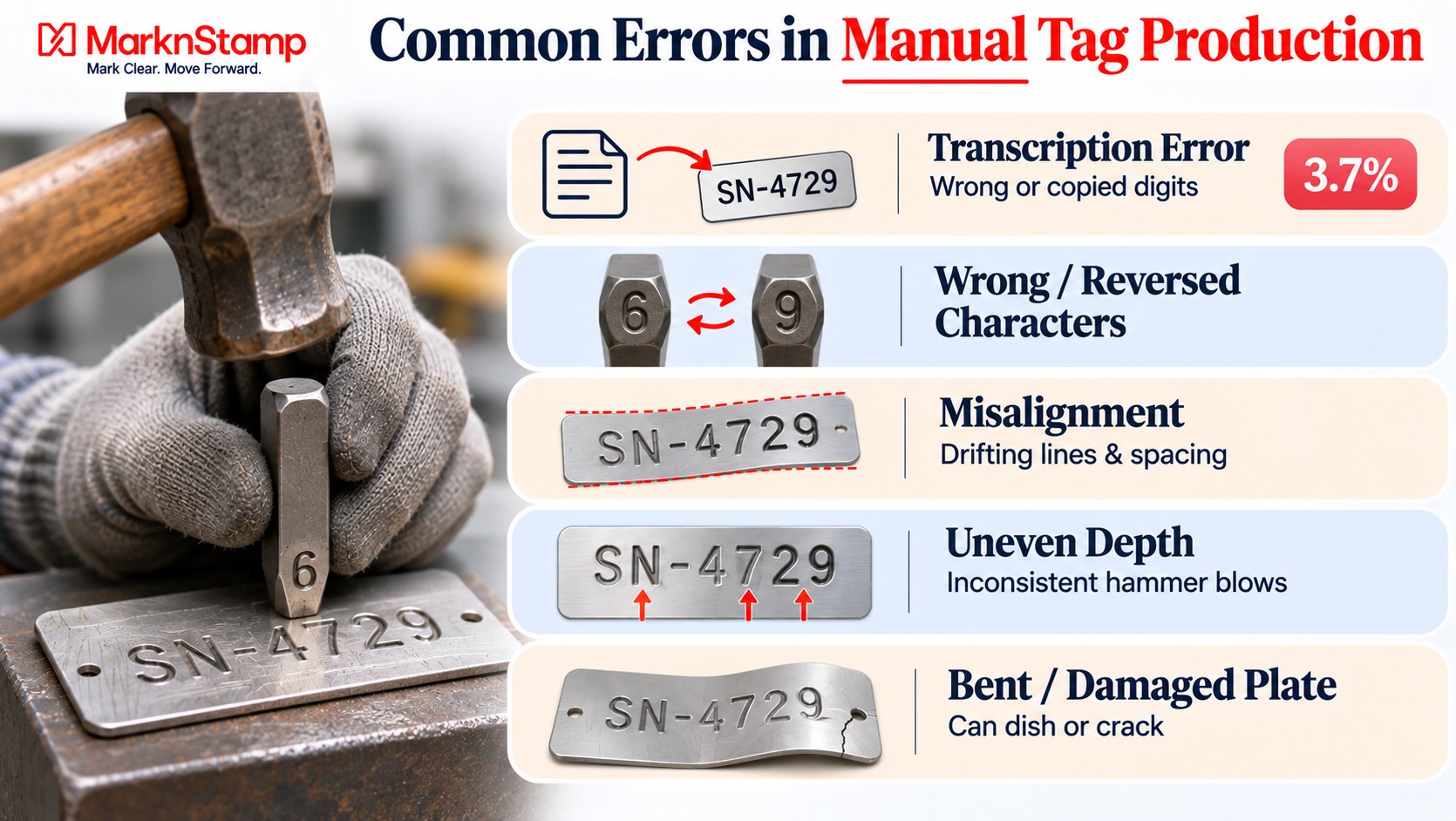
Errors come from people doing repetitive, precise work by hand, and from copying data from one place to another. Both are unavoidable with manual punching.
Transcription errors
The serial number starts in a system or on a job card, and someone copies it onto the plate. Copying data by hand goes wrong more often than people expect. One clinical study found that 3.7% of manually entered results didn’t match the original data. A nameplate isn’t a lab result, but the human habit is the same: transposed digits, a 6 read as an 8, a skipped line.
Wrong or reversed characters
Punches look alike. An upside-down 6 is a 9, an M can go in as a W, and a worn punch can be mistaken for its neighbour.
Misalignment
Each character is placed by eye, so lines drift, spacing changes and text slopes across the plate.
Uneven depth
Every hammer blow is slightly different. Some characters end up deep, others faint, especially late in a long shift.
Bent and damaged plates
Thin aluminium and stainless plates can dish or crack under hard blows, which means re-making the plate.
Why do wrong nameplates cost so much?
A wrong nameplate isn’t just a scrap plate. It can mean a product that doesn’t match its paperwork, a delayed dispatch, a certification query or a field fault that can’t be traced.
The cost of poor quality adds up
Errors that escape the factory are always more expensive than ones caught at the bench. Industrial engineering research has put the cost of poor quality in manufacturing at around 15% of sales on average, spread across scrap, rework, returns and the time spent chasing problems. Tag errors are a small slice of that, but they’re one of the easiest to remove.
Traceability depends on the tag
On many products, the nameplate is the traceability record. If the serial on the plate is wrong, the link between the product and its test, warranty and service history is broken.
How does automatic nameplate clamping work?
A nameplate clamping device grips each plate in a fixed position under the marking head, so every plate is marked in exactly the same place. Paired with a dot peen engraving machine, it turns tag making into load, clamp, mark and release.
Step 1: Load the data
Type the text once as a template, then let the serial number change for each plate. On machines that read barcodes, the operator can scan a job card instead of typing at all.
Step 2: Load the plate
Drop the blank plate into the clamping device. Because the device locates the plate the same way every time, there’s no measuring or lining up.
Step 3: Clamp
On the manual device, the operator tightens the clamp by hand. On the pneumatic device, it clamps at the press of a button, which is quicker and identical every time.
Step 4: Mark
The dot peen head marks the full layout, including text, serial number and, on suitable machines, a logo or 2D code, at an even depth across the plate.
Step 5: Release and repeat
Unclamp, remove the finished tag, load the next blank. The serial moves on by itself.
Manual or pneumatic clamping?
| Manual nameplate clamping | Pneumatic nameplate clamping | |
| How it clamps | Hand adjusters | Compressed air, at a button press |
| Speed between plates | Good | Faster |
| Clamping force | Depends on the operator | The same every time |
| Best for | Mixed plate sizes, moderate volume | Repeated batches of the same plate |
| Needs compressed air | No | Yes |
The manual nameplate clamping device has adjustable clamps, so it handles different plate sizes easily. The pneumatic nameplate clamping device suits plant-floor batches where an operator loads plate after plate. It fits a wide range of our heads with their column frames, so check compatibility with your machine when you order.
Which dot peen engraving machine suits nameplate work?
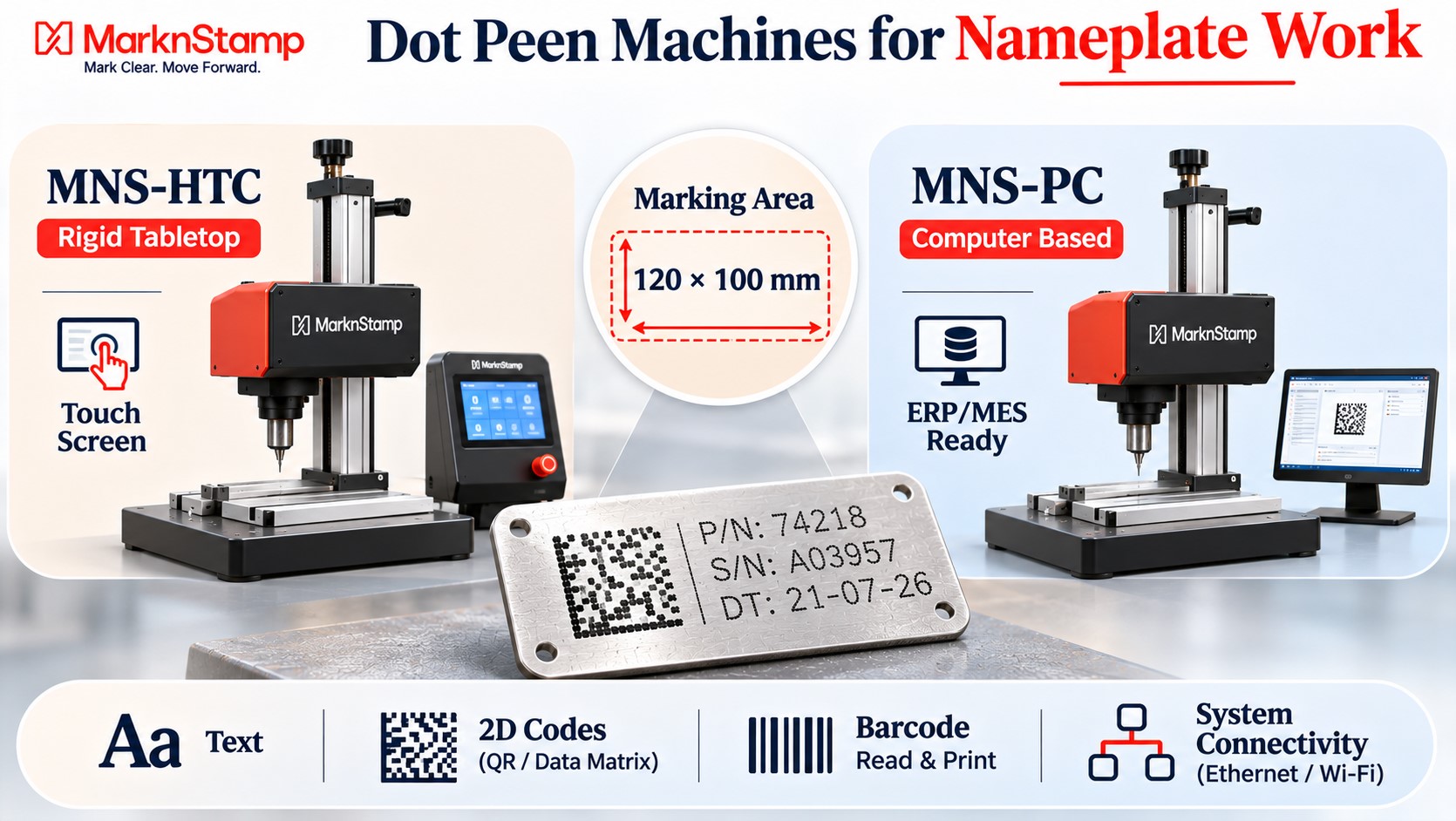
Choose a table top or stand-mounted machine with a marking area big enough for your largest plate, and a controller that handles serials and data import.
For a self-contained tag station
The MNS-HTC rigid tabletop machine has a 120 x 100mm marking area and a touch screen, and it can also connect to a PC over Ethernet. It marks text, logos, and Data Matrix and QR codes, and it can scan barcodes, which makes it a practical all-in-one nameplate station.
For a station linked to your systems
The MNS-PC computer based marking machine also offers a 120 x 100mm area, connects over Ethernet or Wi-Fi, reads and prints barcodes, and has inputs for automatic design selection and outputs to signal end of marking. That suits plants that want tag data to come straight from their ERP.
If you’re new to the technology, our guide to understanding dot peen marking machines explains how the stylus, force and controller work together.
Have a stack of tag drawings? Send us one with your plate size, material and typical batch, and we’ll suggest a machine and clamp combination to test.
Why choose Mark N Stamp for nameplate marking?
We manufacture dot peen marking machines and their work-holding accessories in India, including both manual and pneumatic nameplate clamping devices. Because the machine and the clamp come from the same team, we can match them properly to your plates.
We supply manufacturers of pumps, motors, valves, panels and heavy equipment, and we’re happy to mark sample plates from your own stock before you decide.
Wrapping up
Manual punching is fine for the occasional tag. For daily serial number production, it’s slow, tiring and too easy to get wrong. A dot peen engraving machine with nameplate clamping puts every plate in the same place, takes the text from your data, and marks it evenly every time.
Pull last month’s rejected tags, count the faults, then talk to our team about a nameplate setup that takes those faults off the bench.
FAQs
What is a nameplate clamping device?
It’s a fixture that holds a metal nameplate firmly in a fixed position under a marking head. It stops the plate moving during marking and makes sure every plate is marked in exactly the same place.
Is a dot peen engraving machine better than hand punching for nameplates?
For regular production, yes. It’s faster, marks at an even depth, keeps text aligned and changes serial numbers automatically. Hand punching only makes sense for a few occasional tags.
Can a dot peen machine mark logos and barcodes on nameplates?
Yes, on suitable machines. Table top and computer based models can mark logos and 2D codes such as Data Matrix and QR codes alongside text and serial numbers.
What is the difference between manual and pneumatic nameplate clamping?
Manual clamping uses hand adjusters and suits mixed plate sizes. Pneumatic clamping uses compressed air at a button press, giving faster, identical clamping for repeated batches of the same plate.
Will dot peen marking bend thin nameplates?
Much less than hand punching. Force can be set lower for thin aluminium or stainless plates, and a clamping device supports the plate. Test on your own plate material to confirm the right setting.
How do I avoid wrong serial numbers on tags?
Avoid retyping. Load serials from a file or scan them from a job card barcode, and let the machine change the number for each plate. Check the first plate of every batch before running the rest.